
Physiotherapy for Back Problems: Recovery Guide in Whitby
Imagine stepping out of your car after a long commute through Whitby, only to find your lower back has locked into a rigid, painful protest. For many residents across the Durham Region, this persistent stiffness is more than a daily nuisance; it’s a barrier that keeps you off the local sports field and prevents you from playing with your children. You’ve likely wondered if surgery is your inevitable future or felt confused about whether to seek a chiropractor or specialized physiotherapy for back problems to find lasting relief.
We understand that living with chronic discomfort creates a sense of uncertainty about your physical capabilities. It’s exhausting to manage symptoms rather than addressing why they occur in the first place. This guide will show you how evidence-based, assessment-driven care can identify the mechanical root causes of your pain. We’ll preview the transition from clinical assessment to active recovery, highlighting how an integrated approach featuring manual therapy and functional movement can help you return to the activities you love without the need for invasive interventions.
Key Takeaways
- Learn how to identify the clinical indicators of spinal dysfunction, such as localized stiffness or radiating nerve pain, to move beyond temporary symptom management.
- Understand the mechanical approach of physiotherapy for back problems in resolving complex conditions like lumbar disc herniations and sciatica without invasive interventions.
- Discover why an integrated framework combining manual therapy with progressive therapeutic exercise is essential for achieving long-term spinal stability.
- Gain insight into the comprehensive assessment process that evaluates your movement patterns to create a personalized, results-driven recovery plan in the Durham Region.
- Realize the benefits of one-on-one, evidence-based care in a collaborative environment where multiple disciplines work together to support your journey back to an active lifestyle.
Understanding Back Problems and the Role of Physiotherapy
Physiotherapy for back problems is a sophisticated clinical discipline dedicated to restoring the intricate mechanics of your spine and improving overall mobility. When spinal function is compromised, the impact ripples through your entire life. You may experience localized stiffness that makes morning routines difficult, sharp muscle spasms during simple tasks, or radiating leg pain known as sciatica. These symptoms are your body’s signal that the structural integrity of your musculoskeletal system requires professional attention.
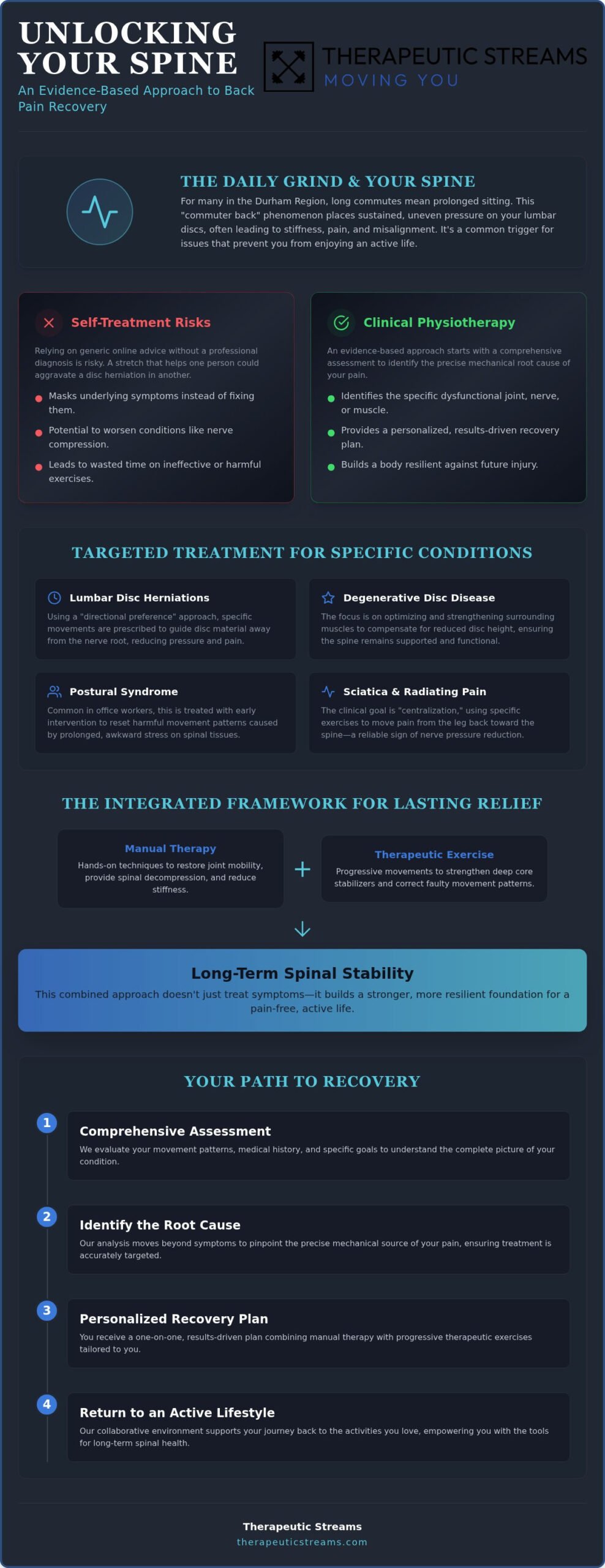
Addressing these issues early is vital to prevent an acute strain from evolving into a debilitating chronic condition. This proactive approach is particularly important for residents in the Durham Region who face the daily commute into Toronto. Whether you’re navigating the 401 or sitting on a GO Train, prolonged sedentary positions place sustained, uneven pressure on your lumbar discs. This “commuter back” phenomenon is a common catalyst for spinal misalignment and persistent discomfort that requires a targeted clinical response.
Why a Clinical Approach Beats Self-Treatment
While it’s tempting to rely on “YouTube stretches” for quick relief, self-treating without a professional diagnosis carries significant risks. A movement that helps one person could potentially aggravate a disc herniation in another. A physiotherapist performs a comprehensive assessment to identify whether the source of your pain is a compressed nerve, a strained muscle, or a dysfunctional joint. By utilizing evidence-based practice, we ensure every part of your recovery plan is grounded in modern research rather than guesswork. This precision allows us to treat the root cause of your discomfort, ensuring you don’t waste time on ineffective or harmful exercises.
The Long-Term Benefits of Spinal Physiotherapy
Spinal physiotherapy for back problems focuses on building a body that’s resilient against future injury. By integrating manual therapy with functional movement, patients often experience several key outcomes:
- Improved Posture: Aligning the spine reduces the mechanical load on your joints during daily activities.
- Core Stability: Strengthening the deep stabilizer muscles protects the spine during lifting or sports.
- Reduced Medication Reliance: Restoring natural movement patterns often decreases the need for long-term pain management drugs.
Spinal decompression achieved through skilled manual therapy serves as a powerful, non-invasive alternative to surgery for many patients. This methodology prioritizes long-term wellness and empowers you to return to an active, pain-free lifestyle in your community.
How Physiotherapy Targets Specific Back Conditions
Effective physiotherapy for back problems isn’t a one-size-fits-all solution. Instead, it’s a precise mechanical intervention tailored to the specific pathology of your spine. Whether you’re dealing with a sudden disc injury or the gradual wear of Degenerative Disc Disease (DDD), the clinical focus remains on restoring structural integrity and unloading sensitive tissues. We don’t just look at where it hurts; we analyze why the tissue is failing under its current load.
For Lumbar Disc Herniations and bulges, we use a mechanical approach to reduce the internal pressure on the spinal nerves. By identifying a patient’s “directional preference,” we can prescribe specific movements that help the disc material move away from the nerve root. In cases of Degenerative Disc Disease, our goal is to optimize the surrounding musculature to compensate for reduced disc height. This ensures your spine remains supported and functional, even as the structural components change over time.
We also frequently treat Postural Syndrome, which is increasingly prevalent among Whitby’s office workers and students. This condition occurs when otherwise healthy spinal tissues are placed under prolonged, awkward stress. It often starts as a dull ache during the workday but can lead to long-term adaptive changes if left unaddressed. Early intervention helps reset these patterns before they become permanent mechanical issues.
Managing Sciatica and Radiating Pain
Pain that travels down the leg into the foot is often more distressing than back pain itself. Our primary clinical objective when treating sciatica is “centralization.” This involves using specific directional exercises to move the pain from the extremity back toward the spine. Centralization is a reliable indicator that the pressure on the nerve root is decreasing. We also incorporate nerve gliding exercises to restore the smooth movement of the sciatic nerve through its surrounding tissues. For active individuals aiming to return to high-intensity training, this specialized care aligns with our approach to sports physiotherapy, which prioritizes both neural mobility and explosive power.
Addressing Mechanical Low Back Pain
Mechanical pain is defined by its relationship to movement; it’s the sharp catch you feel when bending over or the ache that starts after standing for ten minutes. We address this through joint mobilization, where gentle manual pressure helps restore the natural “glide” of the facet joints. This manual relief provides a window of opportunity for muscle re-education. We focus on the multifidus and transverse abdominis, the deep stabilizers that often “switch off” during an episode of pain. If you’re ready to rebuild these foundations, scheduling a professional assessment is the first step toward reclaiming your mobility.
Manual Therapy vs. Therapeutic Exercise: The Integrated Framework
The clinical success of physiotherapy for back problems depends on a carefully sequenced integrated framework. We view manual therapy and therapeutic exercise not as competing options, but as two essential phases of a single recovery pathway. Manual therapy serves as the necessary catalyst; it reduces immediate pain and “opens the window” of movement. Once that window is open, therapeutic exercise acts as the anchor, solidifying those gains by building the long-term strength and resilience needed to prevent recurrence. This dual approach ensures you aren’t just feeling better for a day, but are actually moving better for a lifetime.
In our Whitby clinic, we often enhance this framework by collaborating with other disciplines. Incorporating chiropractors in Whitby into an integrated back care plan allows for a comprehensive focus on both spinal alignment and soft tissue health. For stubborn or complex back issues, we may also utilize adjunct therapies such as neurofunctional acupuncture to modulate pain signals or shockwave therapy to stimulate healing in chronic connective tissue injuries.
Hands-On Manual Therapy Techniques
Manual therapy involves precise, hands-on interventions designed to restore joint and tissue mobility. We utilize soft tissue release to address muscle guarding, a protective mechanism where your body “locks down” muscles around an injury. By relaxing these tissues, we can then perform joint mobilizations. These are gentle, rhythmic movements that improve the glide within the spinal segments. They differ significantly from high-velocity adjustments, focusing instead on gradual range-of-motion improvements. Integrating Registered Massage Therapy into this stage further assists in managing deep muscular tension, creating a more receptive environment for the rehabilitation process.
Progressive Exercise Prescription
Recovery is a transition from pain control to functional loading. Your initial exercises focus on gentle activation of the deep core stabilizers to protect the spine during daily tasks. As your symptoms subside, we progress to “back-safe” movements that challenge your strength without compromising spinal integrity. This is particularly vital for athletes in the Durham Region who need to return to high-demand environments. We prioritize movement patterns that distribute load efficiently across the entire kinetic chain. For a deeper look at protecting your body during activity, our guide on how to prevent sports injuries provides essential strategies for maintaining peak physical performance while staying injury-free.
What to Expect During Your Initial Back Assessment
The initial assessment at Therapeutic Streams is the essential foundation for any successful recovery journey. We don’t just treat the area of pain; we investigate the entire kinetic chain to understand why your spine is under stress. This one-on-one session ensures a thorough investigation into your unique biomechanics, providing the clarity needed to resolve persistent issues. By dedicating this time to a professional evaluation, you ensure that your physiotherapy for back problems is targeted and efficient from day one.
Your history serves as a vital diagnostic tool. We examine how your work environment, sports participation, and previous injuries interact to influence your current physical state. This holistic view allows us to move beyond temporary relief and develop a strategy that addresses the structural and functional drivers of your discomfort. You are an active partner in this process, and your insights into your daily movement patterns are crucial for our clinical investigation.
The Diagnostic Process
A clinical diagnosis requires a methodical three-step approach to ensure no detail is overlooked. This systematic evaluation allows us to differentiate between various spinal conditions with high precision.
- Step 1: Subjective History. We begin by discussing your pain patterns and goals. Understanding whether your pain is worse after a commute or during physical activity helps us narrow down the likely source of the problem.
- Step 2: Physical Examination. Your clinician will test your range of motion, muscle strength, and neurological reflexes. This helps us determine if the issue is primarily joint-based, muscular, or related to nerve root compression.
- Step 3: Functional Testing. We observe how you move during real-world tasks like squatting, reaching, or lifting. This reveals compensatory patterns that may be contributing to your back strain.
Creating Your Personalized Recovery Roadmap
Following the assessment, we translate our findings into a clear, time-bound treatment plan. This roadmap outlines exactly which interventions we’ll use and how we’ll progress your care over the coming weeks. We prioritize setting measurable goals, such as walking 5km pain-free or returning to a full work week without lower back stiffness. A proper assessment ensures you realize faster results by targeting the true driver of your back pain rather than just chasing the symptoms. If you’re ready to gain professional clarity on your spinal health, booking your initial assessment in Whitby is the first step toward a more active, comfortable life.
Why Choose Therapeutic Streams for Back Physiotherapy in Whitby?
Choosing the right clinical partner is the most important decision in your recovery journey. At Therapeutic Streams, we’ve built our practice on a commitment to evidence-based, one-on-one care. Unlike clinics that double-book or rely on passive machines, our approach ensures you have the undivided attention of an expert clinician for the duration of your session. While we operate within a high-performance sports rehab environment, these advanced techniques are equally effective for non-athletes seeking to reclaim their daily mobility. Our Whitby clinic provides a central hub for residents across the Durham Region, offering professional physiotherapy for back problems to those in Oshawa, Ajax, and Bowmanville.
We advocate for your long-term wellness by focusing on autonomy. Our goal isn’t to keep you in the clinic indefinitely; it’s to provide you with the tools and knowledge to manage your spinal health independently. This dedication to patient advocacy means we prioritize results-driven treatments that move you through the phases of healing efficiently. We treat you as a whole person, considering how your lifestyle and goals influence your recovery path.
Integrated Care for Superior Outcomes
Our clinical model thrives on collaboration. We recognize that spinal health often involves complex interactions between joints, nerves, and soft tissues. By housing physiotherapists, chiropractors, and massage therapists under one roof, we provide a more comprehensive solution than single-modality clinics. This multi-disciplinary approach allows us to address your condition from every angle, ensuring no factor is overlooked. If your back issues are accompanied by other mechanical hurdles, such as lower limb dysfunction, our knee pain physiotherapy Whitby resources offer additional insights into how we manage complex, multi-joint recovery plans.
A Patient-Centred Experience
We prioritize your comfort and privacy through the use of dedicated, private treatment rooms. We’ve eliminated double-booking because we believe quality care requires focused time and thorough investigation. Our staff acts as an “Empowering Expert,” taking on an educator role to help you understand the mechanics of your own body. We want you to leave each session with more than just temporary relief; we want you to have the confidence to return to the sports and activities you love. If you’re tired of managing symptoms and are ready to resolve the root cause of your discomfort, we invite you to take the first step toward a pain-free life by joining us for a comprehensive assessment.
Reclaiming Your Physical Autonomy in Whitby
Achieving a pain-free lifestyle requires moving beyond temporary symptom management and embracing a structured, clinical pathway. We’ve explored how a comprehensive assessment serves as the foundation for healing, identifying the mechanical drivers of your discomfort. By integrating manual therapy with progressive loading, you don’t just find relief; you build a body that’s resilient against future injury. This evidence-based framework ensures that every intervention is purposeful and aligned with your personal wellness goals.
Therapeutic Streams has proudly served Whitby and the Durham Region since 2026, providing a sophisticated environment for recovery. Our model prioritizes one-on-one sessions with Registered Physiotherapists who are dedicated to your success. We believe an informed patient is a more successful one, and our integrated care model ensures you receive a holistic solution for your needs. If you’re ready to experience specialized physiotherapy for back problems, the first step is a thorough evaluation of your movement patterns. Book Your Comprehensive Back Assessment in Whitby Today and start your journey toward thriving again. You don’t have to navigate this path alone; we’re here to act as your partner in wellness.
Frequently Asked Questions
Is physiotherapy or chiropractic better for lower back pain?
Both disciplines are highly effective and often yield the best results when used together in an integrated care plan. Physiotherapy focuses on movement mechanics and muscle re-education, while chiropractic care emphasizes spinal alignment and joint function. At our clinic, we use a collaborative model where both professionals work together to address the structural and functional aspects of your recovery.
How many sessions of physiotherapy will I need for my back problem?
The number of sessions depends on your specific diagnosis and how long you’ve been experiencing symptoms. Minor muscle strains might resolve in 4 to 6 sessions, while complex spinal issues like disc herniations often require a longer management plan. Your therapist will provide a clear, time-bound roadmap after your initial assessment to ensure your progress stays on track.
Will I need an X-ray or MRI before starting physiotherapy for my back?
You don’t typically need diagnostic imaging before beginning physiotherapy for back problems. Clinical research indicates that a thorough physical assessment is highly accurate in identifying mechanical spinal issues. If your therapist identifies specific clinical “red flags” during your examination, they will refer you back to your physician to request the necessary X-ray or MRI scans.
Can physiotherapy help with a herniated or slipped disc?
Physiotherapy is a primary, evidence-based treatment for lumbar disc herniations and bulges. We use specific directional exercises to reduce pressure on the affected nerve roots and manual therapy to restore spinal mobility. This mechanical approach helps manage radiating leg pain and promotes the body’s natural healing process, often allowing patients to avoid invasive surgical procedures.
What should I wear to my first back physiotherapy appointment?
Wear comfortable, loose-fitting clothing that allows you to move freely during your assessment. Athletic wear, such as shorts and a t-shirt or tank top, is ideal because it allows your clinician to clearly observe your spinal alignment and hip movement. If you’re arriving directly from work, you’re welcome to bring a change of clothes to use in our private treatment rooms.
Is back physiotherapy covered by my extended health insurance in Ontario?
Most extended health insurance plans in Ontario provide coverage for physiotherapy services. While OHIP coverage is restricted to specific groups like seniors or youth with a medical referral, private insurance typically covers our assessment-driven care. We recommend contacting your insurance provider to confirm your specific policy details, such as annual limits or whether they require a doctor’s referral for reimbursement.
Can I do physiotherapy for my back if I am currently in acute pain?
You can and should begin physiotherapy even if you’re in the acute phase of pain. Early intervention focuses on pain modulation and gentle movement to prevent your muscles from entering a protective “lock down” state. We use soft tissue release and light mobilizations to reduce inflammation, which helps you move through the acute phase and into active recovery much faster.
How soon can I return to sports after starting physiotherapy for a back injury?
Your return to sports depends on the severity of the injury and the physical demands of your specific activity. We follow a progressive loading protocol, ensuring you can handle functional stresses before you return to full competition. Most patients begin sport-specific drills within a few weeks, provided they have met the strength and mobility benchmarks established during their personalized rehabilitation plan.