
PRP vs Hyaluronic acid for Knees
What if the most effective way to avoid knee replacement surgery isn’t found in a single vial, but in how you manage the joint’s environment? You’ve likely spent hours researching how to handle persistent stiffness and the frustration of missing out on your morning run or time in the garden. It’s exhausting to face contradictory medical studies while trying to find a clear path forward for PRP, hyaluronic acid, Knee health, and Knee pain relief. We understand that you want to stay active without the fear of invasive procedures hanging over your head.
This guide clarifies the clinical differences between these two popular injection options so you can determine the most effective strategy for your recovery. While injections can alter the chemical environment of the joint, lasting success depends on how you support that change through professional movement strategies. We’ll explore the latest 2025 meta-analysis data, Canadian cost expectations for treatments like Monovisc or Durolane, and why an assessment-driven rehabilitation plan is the essential partner to any regenerative approach. By the end, you’ll have the evidence-based clarity needed to reclaim your mobility and prioritize your long-term joint health.
Key Takeaways
- Understand the clinical distinction between biological repair signaling with your own growth factors and mechanical lubrication for joint cushioning.
- Discover why 2026 research trends favour PRP for more durable, long-term functional improvements in mild to moderate osteoarthritis cases.
- Learn why the decision between PRP, hyaluronic acid, Knee injections, and chronic Knee pain management should be driven by a personalized musculoskeletal assessment.
- Recognize that any injection requires a foundation of integrated physiotherapy and load management to prevent future joint degradation.
- Gain a clear strategy for navigating your recovery journey in Whitby, ensuring you have the professional support needed to return to sports or gardening.
Understanding Chronic Knee Pain and the Rise of Regenerative Medicine
Chronic knee pain often feels like a losing battle against time. The knee joint is uniquely vulnerable because it bears the brunt of our daily weight while allowing for the complex rotation and flexion required for everything from walking to gardening. Over years of activity, the protective cartilage can degrade, leading to the bone-on-bone friction characteristic of osteoarthritis. Regenerative medicine offers a significant shift in this narrative. Instead of simply managing symptoms, it focuses on using biological substances to support the body’s natural mechanisms for joint health. In 2026, we define regenerative therapy as a biological approach to joint preservation that leverages signaling systems to improve the internal environment of the musculoskeletal system.
The goal is to move beyond the era of “masking” discomfort. For years, the standard protocol for Knee pain involved temporary fixes that ignored the underlying biological decay. Today, the focus has shifted toward healing tissue and preserving function through advanced options like PRP, hyaluronic acid, Knee injections, and integrated rehabilitation. This approach doesn’t just aim for a pain-free day; it aims for a decade of active living.
Why Traditional “Quick Fixes” are Falling Out of Favour
For decades, the standard response to joint inflammation was a corticosteroid injection. While these “quick fixes” offer rapid relief, they primarily work by suppressing the immune response, which can have unintended consequences. Research indicates that repeated use of certain steroids can actually hasten cartilage loss, creating a cycle of dependency that eventually leads toward surgical intervention. Residents in Whitby are increasingly moving away from these temporary solutions. They are looking for sustainable, non-surgical pathways that prioritize biological longevity and joint preservation. By choosing options like Platelet-Rich Plasma (PRP), patients are opting for a strategy that works with their biology rather than against it.
The Biological Goal: Reducing Inflammation and Promoting Repair
A healthy knee relies on synovial fluid to provide lubrication and essential nutrients to the joint surfaces. When chronic inflammation takes hold, this fluid thins and loses its protective properties. This creates what clinicians call a “hostile environment” where the joint actively breaks down its own tissues. Biotherapeutics act as a biological reset button for this environment. The primary goals of these treatments include:
- Dampening the “inflammatory storm” that causes daily stiffness and swelling.
- Restoring the viscosity of the synovial fluid to reduce mechanical friction.
- Signaling the body’s own cells to focus on maintenance and repair rather than degradation.
By resetting the joint environment, we create a vital window of opportunity. This calm state allows for more effective physical therapy, where you can strengthen the muscles around the joint without being sidelined by constant irritation. It’s a proactive way to thrive rather than just survive your recovery journey.
PRP vs. Hyaluronic Acid: How These Injections Compare
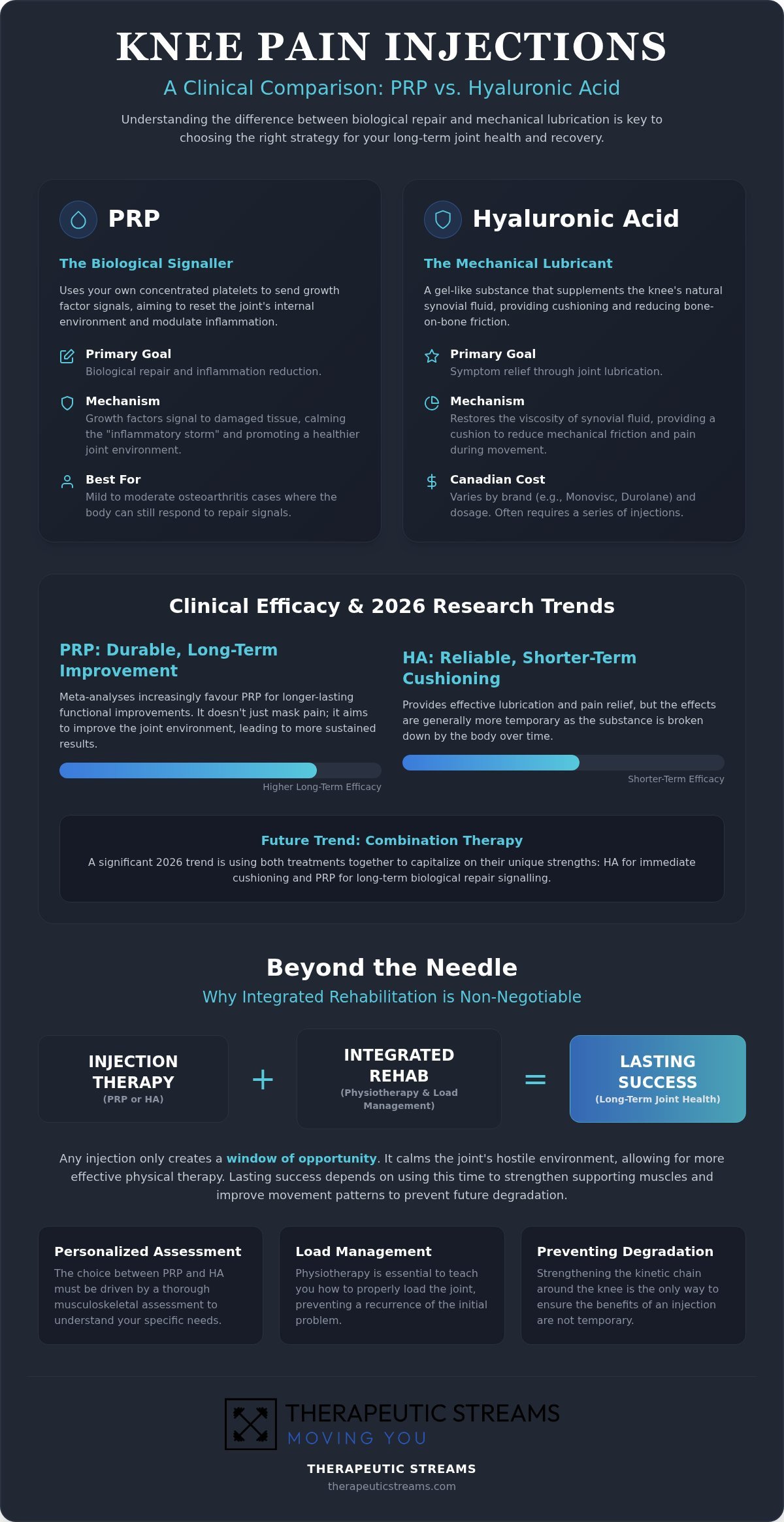
While both injections aim to alleviate Knee pain, they operate through fundamentally different pathways. Choosing between them requires an understanding of whether your joint needs a biological signal for change or a mechanical supplement for lubrication. PRP is a biological intervention that uses your own cellular resources to communicate with damaged tissues. In contrast, hyaluronic acid is a mechanical intervention that provides external cushioning. A significant trend in 2026 is the use of combination therapy, where both substances are administered to capitalize on their unique strengths simultaneously, potentially offering more comprehensive relief than either treatment alone.
Platelet-Rich Plasma (PRP): The Biological Signaller
The process for PRP begins with a standard blood draw from the patient. This sample undergoes centrifugation to concentrate the platelets, creating a potent solution rich in growth factors. These proteins act as biological messengers. When introduced into the Knee, they interact with the synovial lining and damaged tissues to modulate the inflammatory response. This doesn’t just mask discomfort; it aims to reset the joint’s internal chemistry.
Research suggests that a series of PRP injections can be roughly four times more effective for pain relief than a single session. The ideal candidate for this approach typically has mild to moderate osteoarthritis or a specific sports-related injury. Because PRP relies on the body’s own signaling capacity, it’s most effective when there is still viable tissue to respond to these growth factors. It’s a proactive strategy for those looking to improve long-term function rather than just seeking a temporary lull in symptoms.
Hyaluronic Acid (HA): The Mechanical Lubricant
Hyaluronic acid, or viscosupplementation, involves injecting a gel-like substance that mimics the natural synovial fluid found in a healthy joint. As we age or develop osteoarthritis, this fluid thins and loses its protective qualities. HA injections act as a synthetic replacement, providing immediate shock absorption and reducing the physical friction between bone surfaces. This “mechanical” fix is often preferred by patients who experience significant grinding or “bone-on-bone” sensations during daily activities.
The duration of relief from hyaluronic acid typically ranges from 6 to 12 months. While it does not signal biological repair in the same way PRP does, it effectively restores the “glide” to the joint. This window of reduced friction is the perfect time to engage in a structured assessment-driven rehabilitation program. By strengthening the muscles that support the joint while the lubrication is at its peak, you can extend the life of the injection and improve your overall mobility. Both pathways offer a professional alternative to surgical intervention, provided they are supported by the right structural care.
Clinical Efficacy: What the Research Says in 2026
The scientific consensus regarding joint injections has sharpened significantly over the past year. A 2025 meta-analysis of 18 randomized controlled trials, encompassing 1,995 patients, found that PRP was more effective than a placebo for both pain relief and functional improvement. These benefits were clinically meaningful at the three and six-month marks, often lasting up to 12 months when high-platelet formulations were used. This research suggests a clear trend: while hyaluronic acid remains a reliable staple for lubrication, PRP is increasingly favoured for its more durable impact on Knee pain and overall Knee health in mild to moderate osteoarthritis cases.
Success isn’t uniform across all patients. The specific “recipe” of the injection matters. There’s a vital distinction between leukocyte-rich and leukocyte-poor formulations, with high-platelet concentrations showing more significant and durable results. Your “joint age” and the current stage of degradation also dictate the outcome. PRP is generally most effective for those in the earlier stages of wear. It isn’t a universal fix for advanced, bone-on-bone scenarios where the biological environment is too depleted to respond to growth factors. This is why a professional assessment is necessary to determine which path fits your specific pathology.
Pain Relief vs. Functional Improvement
We often see a trade-off between speed and longevity. Hyaluronic acid typically provides faster short-term relief because it acts as an immediate mechanical lubricant. It’s the “quick win” for joint cushioning. PRP requires more patience. Because it relies on signaling a biological shift within the joint environment, there’s a delayed onset of benefits, usually appearing four to six weeks post-injection. However, the functional gains from a series of PRP injections are often more profound. Research indicates a series of injections is roughly four times more effective for pain relief than a single dose. The goal isn’t just to feel less pain while sitting; it’s to regain the ability to climb stairs or return to the golf course without hesitation.
Safety and Side Effects
Safety profiles for both treatments are excellent, though they differ in origin. Since PRP is autologous, meaning it’s derived from your own blood, the risk of an allergic reaction or rejection is virtually non-existent. Hyaluronic acid is also highly safe, though rare allergic reactions can occur depending on the specific formulation. It’s common to experience a temporary “flare” or increased stiffness for 24 to 48 hours after any injection as the joint adjusts to the new fluid volume. Managing these flares involves brief rest followed by guided movement. Neither treatment is a substitute for a comprehensive structural assessment, as the injection manages the environment, but it doesn’t fix the underlying movement patterns that caused the wear in the first place.
Beyond the Needle: Why Integrated Rehab is Essential
An injection into a structurally weak joint is often a temporary patch rather than a permanent solution. When weighing the clinical differences between PRP, hyaluronic acid, Knee injections, and strategies for Knee pain, remember that the needle is only one part of the equation. While these substances can improve the internal chemistry of the joint, they cannot fix a malaligned gait or weak gluteal muscles. Without addressing these mechanical issues, the newly lubricated joint will continue to face the same excessive loads that caused the degradation in the first place. This is why we view injections as a “window of opportunity” rather than a standalone cure.
Our approach at Therapeutic Streams focuses on this critical structural support. By utilizing knee pain physiotherapy Whitby residents can rely on, we target the root cause: load management. We look beyond the knee itself to ensure the hip and ankle are providing the necessary stability. When these adjacent joints function correctly, they absorb the forces of impact, significantly reducing the daily stress placed on your knee cartilage. This integrated model ensures that any biological gains from an injection are protected by a stronger, more resilient body.
Optimizing the Joint Environment with Physiotherapy
Movement is medicine for a recovering joint. Specific, assessment-driven exercises improve the local circulation required for a biological treatment to be truly effective. Manual therapy also plays a vital role by maintaining the joint’s full range of motion, preventing the stiffness that often follows a flare-up. Interestingly, even pelvic floor rehab can influence your recovery; a stable core and pelvis are fundamental to a healthy gait. If your pelvis is tilted or unstable, it changes how your foot hits the ground, which directly impacts how your knee absorbs weight. Patients dealing with both knee dysfunction and core instability may also benefit from exploring pelvic floor physiotherapy, as restoring deep core and pelvic stability is a critical component of healthy lower limb mechanics.
Shockwave Therapy: A Non-Invasive Alternative
Before proceeding to injections, many patients find success with Shockwave Therapy. This needle-free option is particularly effective for tendon-related issues that often mimic or accompany joint pain. It uses acoustic waves to stimulate blood flow and trigger a healing response in the tissue, much like the biological signaling of regenerative injections. It’s a non-invasive first-line therapy that can often delay the need for more intensive interventions. By stimulating repair at the cellular level, shockwave therapy prepares the joint for higher levels of activity without the downtime associated with more invasive procedures.
Whether you are preparing for an injection or recovering from one, our team provides the expert “pre-hab” and post-care needed for long-term success. You don’t have to manage this journey alone. Book your comprehensive assessment at our Whitby clinic today to build a stronger foundation for your joint health.
Navigating Your Knee Recovery Journey in Durham Region
Finding the right path for chronic Knee pain in Durham Region can feel overwhelming, especially when navigating the gap between a family doctor’s visit and a surgical consultation. For residents in Whitby and Oshawa, the journey toward lasting relief follows a logical progression: Assessment, Strategy, and Execution. Before committing to out-of-pocket expenses for PRP, hyaluronic acid, Knee injections, or considering surgical procedures, it’s vital to understand your joint’s structural integrity. A chiropractor in Whitby plays a key role here, assessing your gait and spinal alignment to ensure your knee isn’t compensating for imbalances elsewhere in the body.
When discussing injection options with your specialist, come prepared with questions about formulation and timing. In Ontario, these treatments are not covered by OHIP, and costs can range significantly. PRP sessions in the Toronto and Durham area typically fall between $800 and $1,500 CAD, while hyaluronic acid options like Monovisc or Durolane are often around $700 CAD. Understanding these figures helps you make an informed decision alongside your healthcare team, ensuring the chosen path aligns with your functional goals and recovery timeline.
The Assessment-First Approach
A one-on-one assessment at Therapeutic Streams is designed to be your diagnostic headquarters. We don’t just look at the joint; we look at the person. To get the most out of your first appointment, please bring any recent imaging reports, a summary of your medical history, and a clear list of your activity goals. We take a collaborative approach, often working directly with your family doctor or sports medicine specialist to ensure your rehabilitation plan supports their clinical recommendations. This integrated care model is why our patients feel empowered rather than confused by their treatment options.
Next Steps: Booking Your Consultation
Reclaiming an active lifestyle in Durham is entirely possible. Whether your goal is to return to the walking trails at Heber Down or simply to enjoy a day of gardening without a flare-up, your recovery starts with a professional plan. Pain doesn’t have to be a permanent fixture in your life. By combining the biological potential of modern injections with the structural support of assessment-driven care, you can delay or even avoid more invasive interventions. Take the first step toward wellness today by using our online booking system to schedule your personalized knee assessment at our Whitby clinic.
Your Path to Sustainable Joint Health in Whitby
When evaluating the clinical differences between PRP, hyaluronic acid, Knee health, and chronic Knee pain, the goal is always long-term stability. We’ve explored how PRP leverages your body’s biological signalling for functional gains while hyaluronic acid provides essential mechanical cushioning. However, the most critical takeaway remains: neither vial can replace a foundation of structural strength. Without an assessment-driven movement plan, even the most advanced injections are merely temporary solutions for a complex mechanical problem. You deserve a strategy that addresses both the chemistry of your joint and the way you move.
Our integrated team in Whitby is dedicated to your success. We provide evidence-based, one-on-one care that combines physiotherapy, chiropractic, and massage therapy to support your joint before and after regenerative treatments. By focusing on your specific gait and load management, we ensure your recovery is built on a stable foundation. Book Your Comprehensive Knee Assessment at Therapeutic Streams to build a personalized recovery strategy that lasts. You don’t have to navigate this journey alone; it’s time to move with confidence again.
Frequently Asked Questions
Is PRP or Hyaluronic Acid better for severe knee osteoarthritis?
Hyaluronic acid is typically more effective for severe, advanced osteoarthritis because it provides the mechanical cushioning that a depleted joint lacks. While PRP is a powerful tool for early stages, severe “bone-on-bone” cases often don’t have enough viable tissue to respond to biological signalling. In these instances, viscosupplementation acts as a synthetic buffer to reduce friction during daily movement and can help manage discomfort when surgery isn’t an immediate option.
How long do the effects of a PRP injection usually last in 2026?
The therapeutic effects of a PRP injection generally last between 9 and 12 months for most patients. Recent 2025 meta-analyses indicate that high-platelet formulations can provide clinically meaningful improvements in joint function for up to a full year. The longevity of these results often depends on the patient’s activity levels and their commitment to a structured rehabilitation program to support the joint’s new environment and overall health.
Can I have both PRP and Hyaluronic Acid injections at the same time?
Combination therapy is an emerging standard in 2026 that involves administering both PRP, hyaluronic acid, Knee injections, and Knee pain management strategies during the same treatment window. This approach targets the joint from two angles: the HA provides immediate mechanical lubrication, while the PRP signals biological changes to reduce chronic inflammation. Many clinicians find this dual-action method results in fewer post-injection flares and more durable functional outcomes for the patient.
Will I need physiotherapy after getting a knee injection?
Physiotherapy is considered a requirement rather than an option for ensuring the success of any joint injection. While the injection manages the internal chemistry of the Knee, physiotherapy addresses the mechanical loads and movement patterns that caused the initial wear. Strengthening the surrounding musculature is the only way to protect the joint and extend the lifespan of your clinical results. Integrated care ensures you don’t just feel better, but actually move better.
Are these injections covered by private health insurance in Ontario?
Private health insurance coverage in Ontario is inconsistent for these procedures and requires a review of your specific plan. While the Ontario Health Insurance Plan (OHIP) does not provide funding, some extended health plans offer partial reimbursement for hyaluronic acid products like Cingal or Durolane. PRP is less commonly covered because it’s prepared from your own blood at the point of care, making it a professional service rather than a pharmaceutical product.
How soon can I return to sports after a knee injection?
Most patients can return to light, low-impact activities within two weeks of an injection. Returning to high-impact sports usually requires a six to eight-week window to allow the joint environment to stabilize and the inflammatory response to settle. This timeline is heavily influenced by your progress in a guided exercise program, as premature loading can lead to increased inflammation and a potential setback in your recovery journey.
What is the difference between viscosupplementation and regenerative medicine?
Viscosupplementation is a mechanical process where a gel-like substance is added to the joint to improve lubrication and shock absorption. Regenerative medicine is a broader biological approach that uses cellular components to alter the joint’s chemical environment. While HA acts like “oil for a hinge,” regenerative therapies like PRP act as signalling molecules that encourage the body’s natural maintenance processes. Both aim to delay the need for more invasive surgical procedures.
Is there a difference in recovery time between PRP and HA?
The immediate recovery from the injection site is similar for both, but the onset of relief differs significantly. Hyaluronic acid often provides a “quick win” with reduced stiffness within a few days of the procedure. Conversely, PRP has a slower onset, with patients typically noticing improvements after four to six weeks. This delay occurs because the body needs time to process the growth factors and shift the joint out of a chronic inflammatory state.