Pilates for Back Pain in Whitby: A Clinical Guide to Movement-Based Recovery
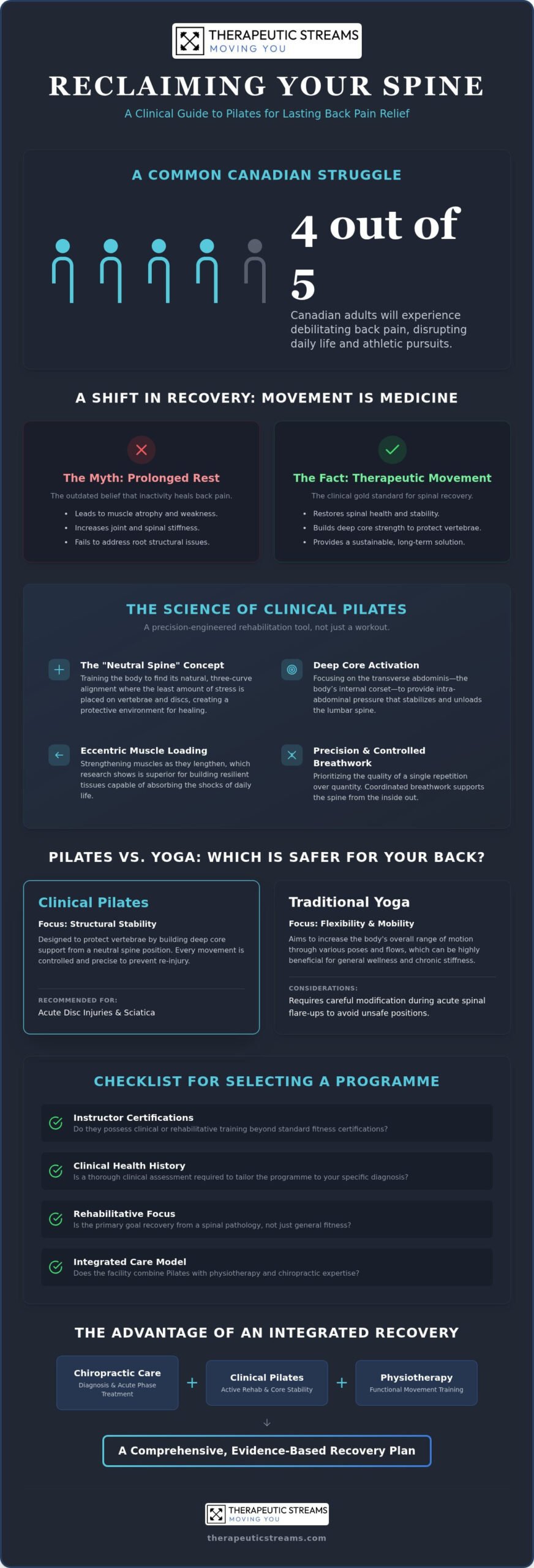
Did you know that four out of five adults in Canada will experience debilitating back pain at some point in their lives? If you are currently struggling, you likely feel the weight of that statistic every time you reach for a bottle of anti-inflammatories or hesitate before picking up your groceries. It’s exhausting to live in a cycle of temporary relief, particularly when you’re searching for pilates for back pain in Whitby but fear that the wrong movement might worsen a disc injury. You aren’t just looking for a workout; you’re looking for a professional pathway to recovery.
We understand that you want more than just a quick fix; you deserve a sustainable solution that addresses the root cause of your discomfort. This guide reveals how clinical Pilates provides a research-driven methodology to restore your spinal health and core stability. You will discover the vital distinctions between general fitness classes and rehabilitative movement, along with a structured plan to help you return to your favourite sports and daily routines with confidence. By prioritizing precise spinal mechanics over simple exertion, we can help you move from a state of chronic pain back to a life of active wellness in the Durham Region.
Key Takeaways
- Understand why movement-based recovery has replaced prolonged rest as the clinical gold standard for managing chronic spinal discomfort.
- Discover how clinical pilates for back pain in Whitby focuses on finding your neutral spine to protect your vertebrae while building core stability.
- Compare the structural focus of Pilates against the flexibility of Yoga to determine which modality is safer for acute disc injuries or sciatica.
- Learn the specific questions to ask when selecting a programme, from instructor certifications to the necessity of a clinical health history.
- Explore the advantages of an integrated care model that combines Pilates with physiotherapy and chiropractic expertise for a comprehensive recovery plan.
Understanding Back Pain: Why Movement is Medicine in Whitby
Lower back pain is a pervasive challenge for residents across the Durham Region. Whether you are an office worker commuting from Whitby to Toronto or an athlete training at local facilities, the physical toll on your spine is significant. For decades, the standard advice for back injuries was “rest and wait.” However, modern clinical research has flipped this narrative. We now recognize that prolonged inactivity can actually lead to muscle atrophy and increased stiffness, making movement the essential medicine for spinal recovery.
Effective recovery requires a shift from general movement to specific, therapeutic exercise. While walking is beneficial, it doesn’t always address the underlying structural issues. This is where pilates for back pain in Whitby becomes a transformative tool. The focus is on the “deep core,” specifically the transverse abdominis. This muscle acts as your body’s internal corset, providing the necessary intra-abdominal pressure to stabilize your vertebrae and reduce the load on your lumbar spine.
Common Causes of Back Pain in Active Adults
The “commuter culture” in Whitby and Oshawa plays a massive role in postural strain. Spending hours in a vehicle or on the GO Train places the spine in a sustained flexed position, which can lead to disc herniations and persistent discomfort. These injuries often require a careful balance of controlled flexion and extension to heal. Muscular imbalances, where certain muscles become overactive while others remain dormant, further complicate the issue. Without intervention, these imbalances create a cycle of pain that affects your ability to perform daily tasks or enjoy your favourite sports.
The Transition from Acute Pain to Active Rehab
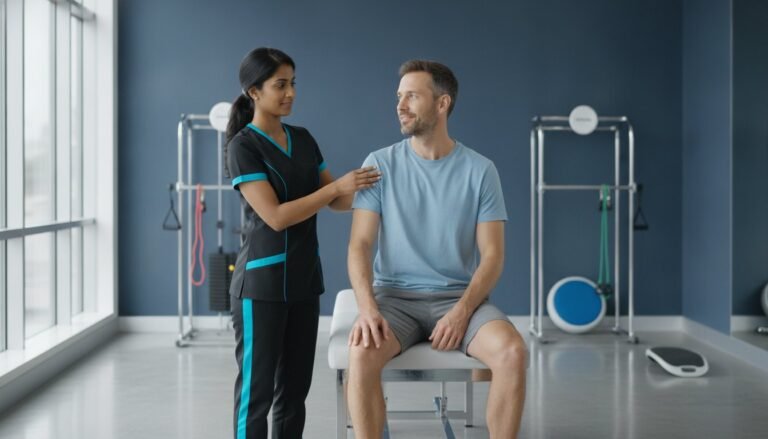
Knowing when to move from the treatment table to the Pilates mat is a clinical decision. In the initial acute phase, passive treatments like manual therapy are often necessary to reduce inflammation. However, long-term success depends on active rehabilitation. At Therapeutic Streams, we believe in an integrated approach. Our team of chiropractors Whitby residents trust works alongside our Pilates instructors to ensure your transition is safe and evidence-based. A professional clinical assessment is the first step, ensuring that your movement plan is tailored to your specific diagnosis rather than a generic fitness template.
The Science of Clinical Pilates for Spinal Stability
Clinical Pilates isn’t just a workout; it’s a precision-engineered rehabilitation tool. While traditional Pilates focuses on general fitness, Clinical Pilates is a modified version of Joseph Pilates’ original method, specifically tailored for injury rehabilitation. When you are searching for pilates for back pain in Whitby, it’s essential to choose a programme that prioritizes spinal pathology over simple exertion. This clinical approach ensures that every movement serves a specific purpose in your recovery journey.
A cornerstone of this methodology is the “Neutral Spine” concept. This refers to the natural, three-curve alignment of your back where the least amount of stress is placed on your vertebrae and discs. By training your body to find and maintain this position during movement, you create a protective environment for healing. This is paired with eccentric muscle loading, where muscles are strengthened as they lengthen. Research suggests this type of loading is superior for long-term back health because it builds resilient tissues capable of absorbing the shocks of daily life.
Effective spinal support also relies on controlled intra-abdominal pressure. Through specific breathwork, we teach you to coordinate your diaphragm and pelvic floor. This creates a stable internal environment that supports the spine from the inside out. This scientific approach makes pilates for back pain in Whitby a superior choice for those recovering from chronic conditions. If you’re ready to move beyond temporary fixes, you can explore our integrated movement programmes to start your recovery.
Core Principles of Rehabilitative Movement
- Centring: Every movement begins with organizing the body from the mid-section outward. This ensures your limbs are moving from a stable, protected base.
- Precision: We prioritize the quality of a single repetition over the quantity. Correct alignment is non-negotiable when dealing with spinal safety.
- Control: You learn to manage movement through the entire range of motion, avoiding jerky or uncoordinated actions that could trigger a pain response.
Reformer vs. Mat Pilates for Back Injuries
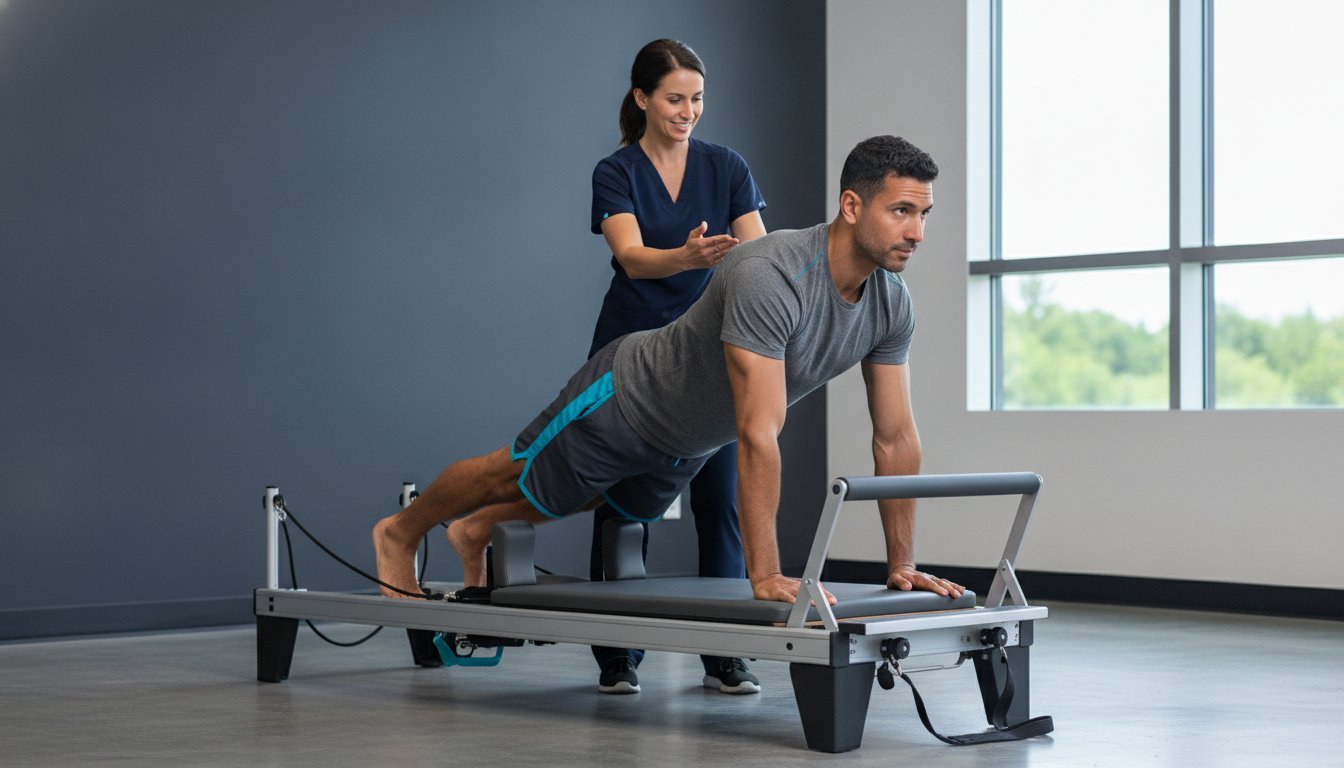
The choice between equipment often depends on your current pain level and mobility. The Pilates Reformer uses a system of springs and pulleys to provide resistance-assisted stretching and strengthening. For many, this is the ideal entry point because the machine can support your body weight or provide gentle traction for the spine. It allows for a greater variety of exercises in a horizontal position, which is often more comfortable for those with acute disc issues.
Mat Pilates, conversely, focuses on building functional, gravity-based stability. It requires more internal control as you don’t have the machine’s assistance to guide your alignment. While both are effective, your instructor will determine which is appropriate based on your clinical assessment. Often, patients begin on the Reformer to build confidence and strength before transitioning to the mat for advanced functional training.
Yoga and Pilates for Rehab: Which is Best for Your Back?
Many patients ask whether they should roll out a mat for Yoga or step onto a Reformer when looking for pilates for back pain in Whitby. While both practices utilize low-impact movement, their clinical applications for spinal health are distinct. Understanding these differences is crucial for avoiding further injury, especially during the vulnerable acute phase of recovery. Grouping them together as “stretching” oversimplifies the specialized mechanics each one offers.
The primary difference lies in the structural focus. Pilates is a system of stability and strengthening designed to support the skeleton. Yoga, conversely, often emphasizes end-range flexibility and mindfulness. For someone dealing with acute disc issues or sciatica, the targeted, controlled movements of Pilates are generally safer. Sciatica often requires nerve gliding and stability rather than the deep, static stretching found in many Yoga poses, which can inadvertently irritate a compressed nerve.
At Therapeutic Streams, we believe the most effective recovery plans are often integrated. Pilates provides the “shield” of stability, while Yoga offers the “fluidity” of movement. By housing these services within a multidisciplinary environment, our instructors can consult directly with clinical staff. This ensures your yoga and pilates for rehab programme is perfectly synchronized with your current stage of healing.
When to Choose Pilates
Pilates is the superior choice for structural rehabilitation. If your clinical assessment reveals spinal instability or a need for post-surgical support, this modality is ideal. The practice focuses on “knitting” the ribs and stabilizing the pelvis, ensuring your lumbar spine remains protected while you build necessary strength. It’s about retraining neuromuscular patterns so your body naturally moves in a way that minimizes spinal load. If you’ve been frustrated by temporary fixes, pilates for back pain in Whitby offers a sustainable way to rebuild your physical foundation from the inside out.
When to Choose Yoga
Yoga is an excellent tool for managing general mobility and muscle tension caused by stress. It focuses on flexibility and the mind-body connection, which can be beneficial once your initial pain has subsided and stability is established. However, back pain sufferers must exercise caution. Certain positions, such as extreme forward folds or deep twists, can aggravate compromised discs. Yoga is best introduced as a secondary phase of wellness or as a tool for muscular relaxation rather than a primary tool for acute injury rehabilitation. Our team helps you determine exactly when your body is ready to safely transition into these more expansive movements.
Selecting a Pilates Programme in Whitby: A Checklist for Sufferers
Choosing a studio in the Durham Region can be overwhelming. Many local facilities promote low-cost introductory offers or a “judgment-free” atmosphere, but for someone with a chronic injury, these factors are secondary to clinical safety. When you seek out pilates for back pain in Whitby, you aren’t just joining a gym; you’re entering a rehabilitation environment. You need to ensure the facility prioritizes form over fitness and safety over sweat. A studio’s commitment to evidence-based practice is what separates a standard workout from a recovery pathway.
Before you sign a contract, use this checklist to evaluate the clinical standard of a programme:
- Instructor Background: Verify if the instructors have specific training in musculoskeletal conditions or clinical rehabilitation rather than just a general fitness certificate.
- Mandatory Assessment: A professional studio should never allow you into a class without a thorough health history review.
- Class Density: Small class sizes are essential. If an instructor is managing twenty people, they cannot possibly correct your pelvic tilt or rib placement with the necessary precision.
- Team Integration: The best results happen when your instructor can speak directly with your physiotherapist or chiropractor to align your treatment goals.
Essential Questions for Your Potential Instructor
Before committing to a programme, interview your instructor to gauge their expertise. Ask: “How do you modify exercises for a L4-L5 disc herniation?” A qualified professional will answer with specific adjustments, such as avoiding deep flexion or utilizing props for support. Ask about their pain protocol: “What is your protocol if I feel sharp pain during a movement?” The answer should always involve stopping and reassessing, never “pushing through.” Finally, check if they offer one-on-one sessions to establish your foundation before you join a group setting. This ensures you have the personal attention required to master the basics safely.
The Importance of Assessment-Driven Care
A “one-size-fits-all” approach is dangerous for back pain sufferers. Your pain might stem from a hypermobile joint, a compressed disc, or a muscular imbalance; each requires a different movement strategy. A clinical assessment identifies the “why” behind your discomfort. This data allows us to build a personalized roadmap for your recovery rather than guessing with generic exercises. If you’re ready to start a plan tailored to your body’s unique needs, you can book your initial clinical assessment today to begin your journey with pilates for back pain in Whitby.
Integrated Recovery at Therapeutic Streams Whitby
Therapeutic Streams operates as a collaborative ecosystem. Unlike a standalone fitness studio, our facility integrates clinical expertise with movement-based rehabilitation. When you choose pilates for back pain in Whitby at our clinic, your instructor isn’t working in isolation. They have direct access to your clinical records and consult with your physiotherapist or chiropractor to ensure every reformer setting and mat exercise aligns with your specific recovery goals. This team approach eliminates the guesswork and creates a seamless transition from acute care to functional strength.
Our integrated model is particularly beneficial because spinal issues rarely exist in a vacuum. Often, lower back discomfort is linked to biomechanical issues in the lower limbs. By housing knee pain physiotherapy in Whitby alongside our spinal care and Pilates studio, we address the entire kinetic chain. This holistic perspective ensures that as we stabilize your core, we also correct the gait or joint issues that may have contributed to your back pain in the first place.
From Treatment Table to Movement Studio
The path to recovery often begins with passive care to manage inflammation and muscle guarding. We frequently utilize Registered Massage Therapy (RMT) to release hypertonic muscles before a client steps into the Pilates studio. Similarly, chiropractic adjustments can improve joint mobility, making it easier for you to achieve the “Neutral Spine” alignment discussed earlier. Consider the case of a typical patient: they may start with chiropractic care to restore joint function, use massage to reduce tension, and then utilize pilates for back pain in Whitby to “lock in” those gains through active stabilization. This progression moves you from a state of protecting an injury to one of high-performance movement. For active individuals and competitive athletes in the Durham Region, our chiropractic care for athletes in Whitby provides the precision biomechanical tuning needed to optimize your kinetic chain alongside your Pilates rehabilitation. Back pain that originates from a motor vehicle collision often requires a specialized recovery pathway; our dedicated MVA rehabilitation Whitby programme integrates seamlessly with Pilates to address the complex musculoskeletal disruptions caused by accident-related whiplash and spinal trauma.
Join the Therapeutic Streams Community
We offer various pathways to suit your comfort level and clinical needs. Our small group classes are limited in size to ensure every participant receives the corrective cues necessary for safety and results. For those with complex injuries or those who prefer personalized instruction, one-on-one sessions provide the highest level of specialized attention. We prioritize accessibility for our Durham Region residents through an intuitive online booking system and flexible scheduling. Whether you are a competitive athlete or someone simply looking to pick up your grandchildren without pain, our community is dedicated to your long-term success.
Restore Your Spinal Health and Reclaim Your Active Lifestyle
Living with chronic back pain doesn’t have to be your permanent reality. By moving away from temporary fixes and embracing a research-driven, movement-based approach, you can rebuild the core stability necessary for a pain-free life. We have explored how clinical precision, the concept of the neutral spine, and the transition from acute care to active rehabilitation form the foundation of a successful recovery. It’s about working with your body’s mechanics rather than against them to achieve lasting results.
At Therapeutic Streams, our integrated team of physiotherapists, chiropractors, and massage therapists collaborates directly with our movement instructors to ensure your safety and progress. Our evidence-based approach to pilates for back pain in Whitby is designed to meet you exactly where you are in your healing journey. With our convenient location and flexible online booking, starting your recovery is straightforward and professional. You don’t have to navigate this path alone; we are here as your dedicated partners in wellness. Book your clinical movement assessment at Therapeutic Streams in Whitby today and take the first step toward moving with confidence once again.
Frequently Asked Questions
Is Pilates better than physiotherapy for back pain?
Physiotherapy and Pilates serve different but complementary roles in your recovery journey. Physiotherapy often focuses on the initial diagnosis and manual therapy to reduce acute symptoms. Pilates then acts as the active phase of rehabilitation, building the strength and stability needed to prevent the pain from returning. At our clinic, we integrate these modalities so your movement programme directly supports your clinical treatment goals.
Can I do Pilates if my back is currently in an acute flare-up?
You should wait until the most intense phase of an acute flare-up has subsided before starting active movement. During the initial 48 to 72 hours, your body needs to manage inflammation. Once you can move with less guarding, a clinical assessment will determine which gentle, supportive exercises are safe. We prioritize finding a “pain-free window” to ensure movement promotes healing rather than further irritation.
How often should I do Pilates to see results for my back pain?
Consistency is vital for retraining the neuromuscular system and seeing lasting results. Most patients benefit from two to three sessions per week to build significant core strength and postural awareness. When utilizing pilates for back pain in Whitby, this frequency allows your body to adapt to the new movement patterns while ensuring you have enough recovery time between sessions to avoid overexertion.
Do I need a referral from a doctor to start Pilates at Therapeutic Streams?
You don’t need a formal doctor’s referral to begin Pilates or any of our clinical services. However, we always recommend checking with your extended health insurance provider, as some plans may require a note to reimburse you for physiotherapy-led sessions. Our team is happy to provide the necessary documentation to help you navigate your coverage and ensure your recovery plan remains accessible.
Will I need to buy special equipment for a Pilates rehab programme?
No personal equipment is required to begin your programme at our studio. We provide all the specialized tools, including Reformers, towers, and various props like foam rollers or small balls to assist your movement. You only need to wear comfortable, athletic clothing that allows you to move freely. We focus on making the clinical environment as supportive and stress-free as possible for your recovery.
Is Reformer Pilates safer than Mat Pilates for a bad back?
Reformer Pilates is often safer during the early stages of back rehab because the machine provides significant support. The springs can act as assistance, helping you move through a range of motion without the full load of gravity. This allows for precise control and decompression of the spine. Mat Pilates requires more internal stability, which is typically introduced once your foundation of strength has been established.
How does Clinical Pilates differ from what I see on social media?
Clinical Pilates prioritizes your specific pathology and spinal safety over aesthetics or athletic “tricks.” While social media often highlights extreme flexibility or high-intensity sequences, our pilates for back pain in Whitby focuses on micro-adjustments and deep core activation. Every repetition is monitored by a professional who understands your injury history, ensuring that the exercises manage your pain rather than simply providing a generic workout.
Can Pilates help with sciatica or shooting leg pain?
Pilates can be highly effective for managing sciatica by addressing the underlying cause, such as a disc bulge or muscular impingement. We utilize specific movements to decompress the lower spine and improve the mobility of the sciatic nerve without overstretching it. By stabilizing the pelvis and lumbar region, we reduce the mechanical stress on the nerve, which often leads to a significant reduction in shooting leg pain.