Professional Bike Fitting in Whitby: Clinical Precision for Every Cyclist
What if the persistent ache in your lower back or the numbness in your hands isn’t a sign that you’re pushing too hard, but a signal that your machine is working against your anatomy? Many cyclists in Whitby accept discomfort as an inevitable part of the sport, even as cycling participation in Durham Region has seen growth of 8.8% in recent years. You shouldn’t have to choose between the ride you love and a pain-free body. Professional bike fitting is often viewed as a luxury for elite racers, but it’s actually a clinical necessity for anyone looking to protect their musculoskeletal health and improve efficiency on the road or trail.
At Therapeutic Streams, we believe that your bicycle should be an extension of your body, not a source of physical stress. You’ll discover how a clinical BikeFIT assessment can help you eliminate persistent knee pain, resolve numbness, and finally feel as fast as your training suggests you should be. We’ll preview the science behind our assessment-driven approach and show you how synchronizing your unique biomechanics with your equipment leads to lasting comfort and optimized power output.
Key Takeaways
- Understand the distinction between retail sizing and clinical bike fitting, which uses biomechanical analysis to align your machine with your unique anatomy.
- Learn how a pre-fit interview and physical assessment of your flexibility and strength imbalances can prevent long-term musculoskeletal injury.
- Realize that professional fitting is not just for elite racers but is a critical tool for casual commuters to eliminate numbness and persistent pain.
- Discover how your preferred Durham Region terrain, whether the technical climbs of Durham Forest or the flats of the Waterfront Trail, influences your optimal setup.
- Gain confidence in your preparation by knowing exactly what to bring to your collaborative session with a registered clinician at Therapeutic Streams.
Beyond the Saddle: Why Clinical Bike Fitting Matters
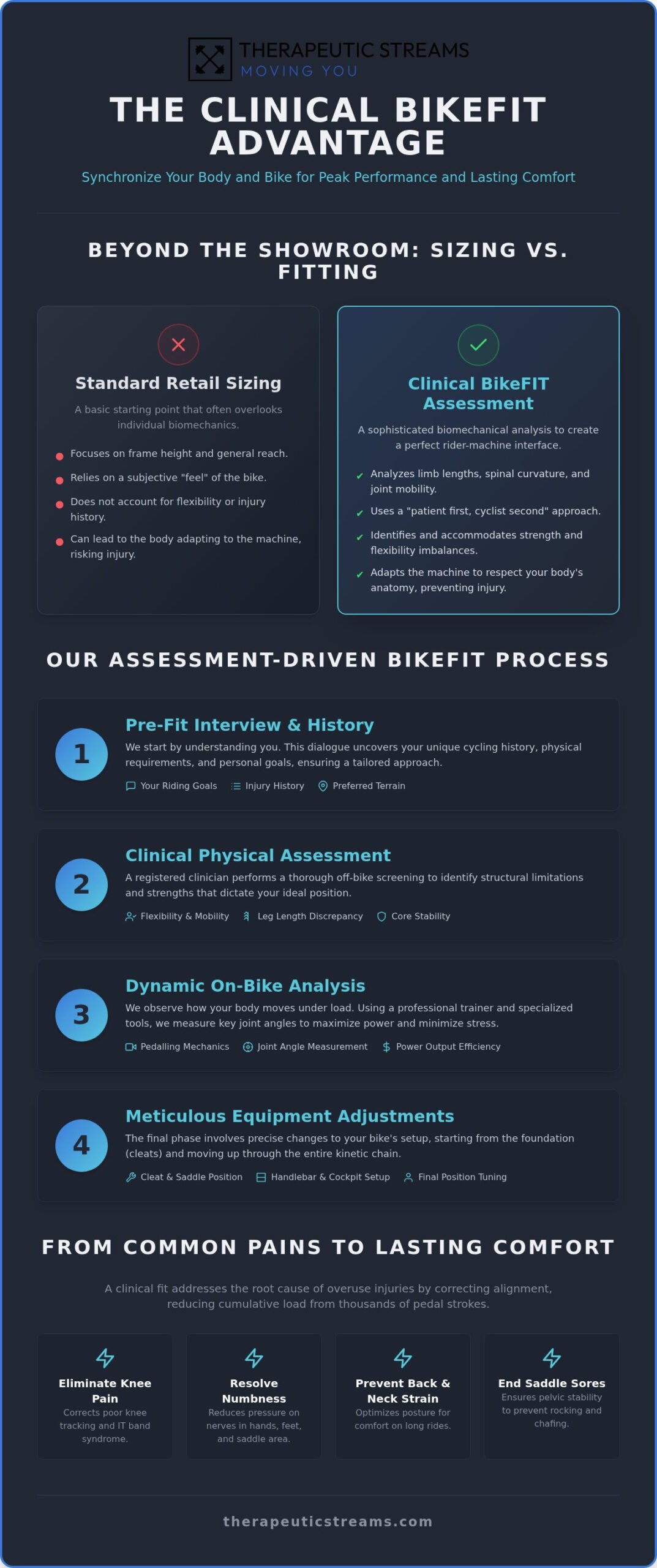
Clinical bike fitting goes far beyond the basic sizing you might receive at a local bike shop. While retail sizing typically focuses on frame height and a general feel of the reach, a clinical assessment is a sophisticated biomechanical analysis of the rider-machine interface. We look at you as a patient first and a cyclist second. This means evaluating how your specific limb lengths, spinal curvature, and joint mobility dictate your ideal position on the bike.
Without this level of precision, you risk forcing your body to adapt to a rigid, unyielding machine. This forced adaptation often results in long-term damage to joints and soft tissues. Over the course of a two-hour ride, you might complete over 10,000 pedal revolutions. If your alignment is off by even a few millimetres, that repetition creates a cumulative load that your body simply wasn’t designed to handle. A clinical fit ensures that your equipment respects your anatomy, preventing the slow degradation of cartilage and connective tissue that often leads to chronic discomfort.
The Kinetic Chain of Cycling
Cycling is a closed-loop activity where your feet are fixed to the pedals. This means any misalignment at the foot or ankle travels up the kinetic chain, affecting the knee, hip, and eventually the lower back. If your cleat position is off, your knee might track poorly, leading to “power leakage” where energy is wasted through lateral movement instead of being driven into the drivetrain. Stable core engagement is also vital; without it, you can’t maintain an efficient position without straining your neck or shoulders. We focus on creating a stable platform through the core, which allows you to maintain an aerodynamic profile without placing excessive demand on your secondary stabilizer muscles.
Preventing Overuse Injuries
Many riders suffer through common cycling pain points like Iliotibial (IT) band syndrome or patellar tendonitis, assuming it’s just part of the sport. These are often avoidable overuse injuries caused by repetitive motions in a suboptimal position. A clinical bike fitting focuses on pelvic stability to prevent the rocking motion that causes saddle sores and nerve numbness. By professionally adjusting saddle fore-aft position and handlebar drop, we can significantly reduce the micro-trauma occurring in your tendons and ligaments. Our goal is to move you from a state of “coping” with your bike to a state of thriving on it.
The Therapeutic Streams BikeFIT Process
Our BikeFIT process begins long before you clip into your pedals. We start with a comprehensive pre-fit interview designed to uncover your unique cycling history and physical requirements. We discuss your typical mileage, the specific terrain you frequent in Durham Region, and any previous injuries that might influence your comfort on the bike. This initial dialogue ensures that our approach is tailored to your goals, whether you’re training for a century ride or simply want to enjoy the Waterfront Trail without knee pain. By understanding your history, we can prioritize the adjustments that will have the most significant impact on your musculoskeletal health.
Clinical Assessment of the Rider
Unlike a retail environment, our process includes a thorough physical screening off the bike. We evaluate your hamstring flexibility and spinal mobility, as these factors directly dictate how aggressively you can comfortably position your cockpit. We also screen for leg length discrepancies and foot structure issues that often go unnoticed in a standard sizing session. A registered clinician possesses the diagnostic expertise to distinguish between a simple lack of flexibility and a structural musculoskeletal limitation that requires a specific equipment accommodation. This assessment-driven foundation ensures that the bike is adapted to your body, rather than forcing your body to adapt to the bike.
Dynamic On-Bike Analysis
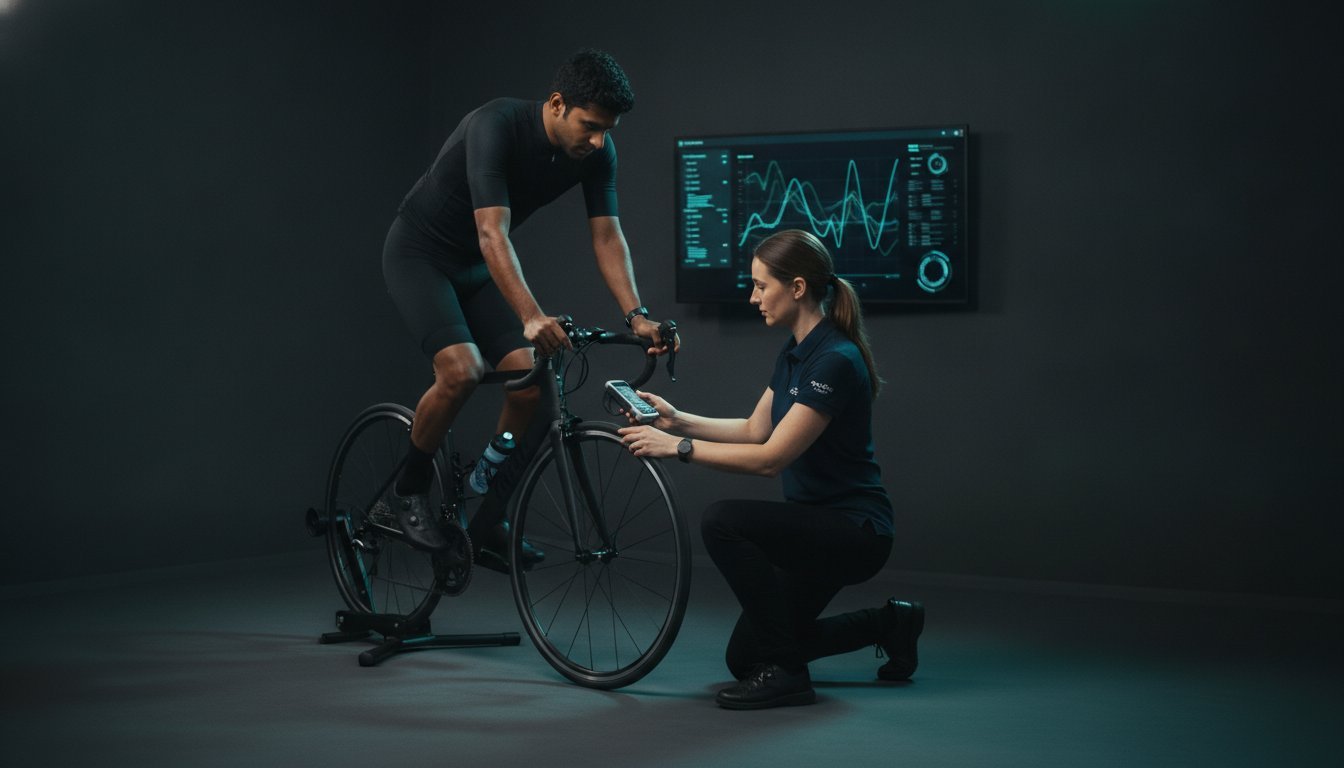
Once we establish your baseline physical profile, we move to the dynamic analysis. Static measurements can only tell part of the story; we need to observe how your body moves under load. Using a professional trainer, we watch your pedalling mechanics from multiple angles to identify subtle compensations or instabilities. Research into clinical bike fitting emphasizes the importance of moving from static to dynamic methods to truly capture a rider’s biomechanical needs. We use specialized tools to measure joint angles at various points in the pedal stroke, allowing us to realize the precise range where power output is maximized and joint stress is minimized.
The final phase involves meticulous adjustments to your equipment. We start at the foundation by aligning your cleats to support your natural foot and ankle mechanics. From there, we fine-tune saddle height and fore/aft position before addressing the cockpit reach and drop. These changes are often incremental but yield profound results in terms of efficiency. Because your body needs time to adapt to these new geometries, we include a follow-up component to monitor your progress. If you are ready to experience a more synchronized ride, you can explore our integrated approach to sports performance and injury prevention. This collaborative journey ensures your equipment is perfectly configured for your unique anatomy.
Solving Common Cycling Pain Points
Many cyclists believe that professional bike fitting is reserved for the elite peloton, yet this assumption often leads to avoidable suffering. If you’re a casual commuter or weekend enthusiast, your body may not have the same resilience or core conditioning as a professional athlete. This makes you more susceptible to chronic issues from a poor fit, not less. Even a short 20-minute commute, when repeated daily with suboptimal alignment, can lead to persistent musculoskeletal strain that eventually requires clinical intervention. Cyclists throughout the region can benefit from a professional BikeFIT in Whitby that bridges the gap between clinical expertise and athletic performance, ensuring every watt of energy translates directly to forward motion.
When chronic inflammation has already set in, adjusting the bike is only half the battle. We often integrate shockwave therapy to treat existing soft tissue injuries like Achilles tendonitis or plantar fasciitis caused by poor pedalling mechanics. This treatment helps restart the body’s natural healing process while the new bike geometry ensures the injury does not return. By combining clinical treatment with mechanical adjustment, we provide a comprehensive pathway to pain-free riding.
Lower Back and Neck Discomfort
Lower back pain is frequently tied to an overly aggressive stack height. If your handlebars are too low for your current spinal mobility, your lumbar spine must compensate by over-rounding or over-extending. This creates significant tension in the cervical spine as you crane your neck to see the road ahead. To check if your reach is too long, observe your elbows while riding; if they are constantly locked straight to reach the controls, your cockpit likely needs shortening. Raising the handlebar height even by 10 millimetres can dramatically redistribute pressure away from your vertebrae. For cyclists who have experienced a collision on local roads, the whiplash and soft tissue injuries sustained may also contribute to neck and back discomfort on the bike, making a structured motor vehicle accident rehabilitation program an important complement to any bike fitting adjustment.
Numbness and Nerve Compression
Nerve compression is another frequent complaint that we address through precise hardware changes. Hot spots or burning sensations in the feet often stem from improper pressure distribution, which we can resolve through cleat shimming or specialized arch support. Hand numbness, specifically in the pinky and ring fingers, is usually a result of ulnar nerve compression. This often happens when a downward-tilted saddle forces too much body weight onto the handlebars. Our approach to bike fitting ensures that every touchpoint is optimized for your comfort. For riders who find that long sessions on the bike leave them feeling dizzy or off-balance, we may even suggest vestibular therapy to ensure their sensory systems are functioning correctly in a high-speed environment.
Optimizing for Durham Region Trails and Roads
Durham Region offers some of the most varied cycling in Ontario. Whether you’re navigating the technical singletrack of Durham Forest or logging long miles on the Waterfront Trail, your bike fitting needs to reflect the environment where you spend the most time. A setup that feels comfortable for a flat 10-kilometre commute might become a liability during a steep climb or a high-speed descent on local rural roads. Terrain dictates your biomechanical needs, and we ensure your equipment is adjusted to meet those specific demands.
Road and Triathlon Performance
For those frequenting the long, exposed stretches of the Waterfront Trail, aerodynamics and sustained power output are the primary objectives. Maintaining a low profile against the wind is only beneficial if your body can support that position for hours. If your spinal alignment is compromised, you’ll experience fatigue long before your legs give out. Integrating chiropractic care can significantly enhance your fit by ensuring your joints and vertebrae are moving optimally, allowing you to hold an efficient position with less effort. This collaborative approach allows you to realize better results without the risk of repetitive strain.
Mountain Bike Specific Considerations
Conversely, mountain bikers in Durham Forest require a fit that prioritizes manoeuvrability and a mobile centre of gravity. Technical trails demand that you move around the saddle, meaning your seat height must accommodate both efficient climbing and aggressive descending. In areas like Oshawa where the terrain can transition quickly from punchy climbs to technical features, a “static” road-style fit will feel restrictive and unsafe. We adjust your cockpit to ensure you have maximum leverage over the bars, which is critical for safe handling on unpredictable surfaces. A more upright, mobile position allows your larger muscle groups to absorb impacts, protecting your smaller stabilizer muscles from premature exhaustion.
Local Whitby and Oshawa roads present their own challenges, from traffic navigation to varying pavement quality. A professional fit ensures you can reach your brakes and shifters instinctively, which is a vital safety consideration when riding in traffic. As you prepare for the upcoming season, realizing your full potential starts with a machine that is perfectly tuned to your physical capabilities. Ensuring your equipment is properly configured gives you the confidence to tackle any local route with precision.
If you’re ready to optimize your performance for the unique challenges of our local trails and roads, book your clinical bike fitting assessment today to secure your spot for the spring.
Booking Your BikeFIT at Therapeutic Streams
Booking your BikeFIT assessment at Therapeutic Streams is an investment in your long-term athletic longevity. Unlike a retail transaction, this is a clinical partnership between you and your practitioner. To ensure the highest level of accuracy during your session, you’ll need to bring your bicycle, your cycling shoes, and your standard cycling kit. Wearing your jersey and padded shorts is essential; it allows us to observe your biomechanics and joint angles without the obstruction of loose clothing. This transparency is vital for identifying the subtle pelvic tilts or knee deviations that contribute to your discomfort. Learn more about what distinguishes an evidence-based BikeFIT Whitby cyclists rely on from a standard retail sizing experience.
Our Whitby clinic operates on an integrated care model, meaning your bike fitting doesn’t exist in a vacuum. If our assessment reveals significant muscle tightness or joint restrictions that a mechanical adjustment alone cannot fix, we can seamlessly coordinate with our on-site teams for Physiotherapy or Registered Massage Therapy. This holistic approach ensures that we aren’t just adjusting the machine; we’re also optimizing the engine. By addressing both the equipment and your physical readiness, we create a sustainable pathway for you to thrive on the road or trail.
Insurance and Coverage
Clinical bike fitting is often eligible for coverage under extended health benefits when it’s performed as part of a chiropractic or physiotherapy treatment plan. Because our sessions are led by registered clinicians, the documentation we provide reflects a medical necessity for injury prevention or rehabilitation. This professional standing offers a distinct advantage over retail shops, as it prioritizes your musculoskeletal health within a regulated healthcare framework. You can request a detailed receipt following your session to facilitate your insurance claim. We recommend checking with your specific provider to confirm the details of your coverage for assessment-based care.
What to Expect During Your Session
You should set aside approximately 60 to 90 minutes for your initial appointment. This time allows for a thorough intake, the physical screening, and the dynamic analysis required to reach a precise fit. Once the adjustments are made, your body will require a “break-in” period. It’s normal to feel a slight difference in your muscle engagement during the first few rides as your nervous system adapts to the new geometry. We typically suggest a follow-up if you experience a major change in your physical condition, such as a new injury, or if you introduce new equipment like a different saddle or pedal system. If you’re ready to secure your spot for a clinical assessment in Whitby, contact our team today to begin your transition from discomfort to peak performance.
Elevate Your Cycling Potential in Durham Region
Professional bike fitting is more than a series of mechanical adjustments; it’s a clinical intervention that respects your unique anatomy and long-term musculoskeletal health. By choosing an evidence-based biomechanical approach, you ensure that every pedal stroke contributes to your performance rather than your discomfort. Our assessments are performed by Registered Physiotherapists and Chiropractors who understand the complexities of injury rehabilitation and sports performance. This clinical expertise allows us to identify and resolve the root causes of pain that standard retail sizing simply cannot address.
Whether you’re preparing for the technical climbs of Durham Forest or the scenic stretches of the Waterfront Trail, our integrated clinic is conveniently located to serve cyclists in Whitby, Oshawa, and Ajax. We’re dedicated to acting as your partner in wellness, helping you move from a state of frustration to one of peak efficiency and confidence. Don’t let avoidable aches or numbness dictate your time in the saddle this season. You deserve to ride with the assurance that your equipment is working with you, not against you.
Book Your Clinical BikeFIT Assessment in Whitby Today and experience the profound difference of a machine perfectly synchronized with your body. We look forward to helping you ride stronger and thrive on every journey.
Frequently Asked Questions
Will my insurance cover the cost of a bike fitting?
Most extended health benefit plans cover the cost of the assessment when it’s integrated into a physiotherapy or chiropractic treatment plan. Since our BikeFIT service is performed by registered clinicians, we provide the medical documentation necessary for your insurance claim. You should contact your provider to confirm your specific coverage details for clinical assessments.
Do I need to be a competitive cyclist to benefit from a BikeFIT?
No, you don’t need to be a racer to experience the benefits of a professional fit. Casual commuters and weekend enthusiasts often have more to gain because their bodies may not be as conditioned to the repetitive stresses of cycling. A proper setup prevents the chronic issues that often discourage newer riders from staying active in the sport.
What should I bring to my bike fitting appointment in Whitby?
You must bring your bicycle, cycling shoes, and your standard riding kit, including your jersey and padded shorts. Wearing your cycling clothes allows us to see your actual joint movement and muscle engagement without the interference of baggy street clothes. If you use specific accessories like custom orthotics or a preferred saddle, please bring those as well.
How often should I get my bike fitting checked?
We recommend an annual checkup or a new assessment whenever you experience a significant physical change. This includes recovering from an injury, a major change in weight, or a shift in your flexibility levels. You should also book a session if you purchase new shoes, pedals, or a different style of saddle to ensure your alignment remains optimal.
Can a professional bike fit help with chronic knee pain?
Yes, professional bike fitting is one of the most effective ways to resolve chronic knee discomfort. We analyze your cleat alignment and saddle height to ensure your knee tracks in a neutral plane throughout the pedal stroke. This reduces the lateral shear forces that typically lead to issues like patellar tendonitis and ligament strain.
What is the difference between a bike sizing and a professional bike fit?
Bike sizing is a retail process used to select the correct frame size based on your height and inseam. A professional bike fit is a clinical assessment of your biomechanics while the bike is in motion. We adjust the touchpoints of the bike to match your unique flexibility, strength, and injury history rather than just checking your stand-over height.
Can I have multiple bikes fitted in one session?
Each bike requires a dedicated session to ensure the highest level of clinical precision. Different bikes, such as a road bike and a mountain bike, have distinct geometries and intended uses that require separate biomechanical analyses. We focus on one machine at a time to guarantee that every adjustment is thoroughly tested under load.
What happens if I buy a new bike after my fitting?
We can often use the data from your previous session to help set up your new machine. However, because frame geometries vary between manufacturers, we recommend a brief follow-up to realize the most accurate position. This ensures your new equipment respects the anatomical foundations established during your initial assessment and prevents new pain points from developing.