Sports Injury Clinic in Durham Region: Find a Care Path That Fits
For athletes and active people in Whitby, Oshawa, Bowmanville, and Ajax, pain or restricted movement can make training and everyday tasks harder. At Therapeutic Streams Sport Rehab, a sports injury clinic Durham Region residents can reach from its Whitby location, care starts with a personalized clinical assessment. The goal is to understand what is affecting your movement before discussing a suitable next step.
If you’re unsure whether physiotherapy, chiropractic care, or massage therapy is the right place to start, you don’t need to choose a treatment before the problem has been assessed. Your clinician can discuss your symptoms and goals, consider how you move, and help shape a care plan around your needs and sport.
This article explains what to expect at an initial assessment, how different services may fit into rehabilitation, what two published research studies say about exercise-based care, and what to consider when choosing a clinic. You’ll also find practical ways to prepare for sports injury care at Therapeutic Streams Sport Rehab in Whitby.
Key Takeaways
- Persistent pain, swelling, weakness, or restricted movement can be a reason to seek a clinical assessment, particularly when symptoms affect training or everyday tasks.
- An assessment at a sports injury clinic in Durham Region can help clarify how your injury, health history, and goals inform possible next steps.
- Physiotherapy, chiropractic care, and registered massage therapy have different areas of focus. Recommendations should reflect your assessment and circumstances.
- Two published Cochrane reviews look at exercise-based rehabilitation for patellofemoral knee pain and ankle sprains.
- Before your appointment at Therapeutic Streams in Whitby, make a note of your symptoms, relevant injury history, and the activities you hope to return to.
Sports injuries in Durham Region: when it is time to seek clinical support
An injury can disrupt more than your training schedule. A sore knee may make stairs at work uncomfortable, while a shoulder problem can affect carrying groceries or reaching overhead. If you run on local trails, play on a community team, or train at the gym, pain that changes how you move can gradually alter your routine. You may start holding back, worry about aggravating the area, or lose confidence in a movement that once felt natural.
Not every ache signals a serious injury. Temporary discomfort can follow unfamiliar activity or a demanding session. But persistent pain, swelling, weakness, or limited movement can be a reason to seek a clinical assessment, particularly if the problem affects daily tasks or isn’t settling as expected. General information about sports injuries can explain common causes and types, but it can’t identify what is behind your symptoms.
A sports injury clinic assesses how an injury affects your movement and helps shape a rehabilitation plan around your needs, activity, and goals. When choosing a sports injury clinic in Durham Region, look for care that starts by understanding your situation rather than expecting you to diagnose yourself.
How an injury can affect more than training
Musculoskeletal stress can change how you move beyond the activity that first brought on discomfort. A runner might shorten a route or avoid hills. A player might modify practice drills and then notice the same movement is difficult when lifting or climbing stairs. These changes can affect confidence and everyday routines, even when symptoms seem manageable.
Notice what has changed, not only where it hurts. Make a note of which movements bring on discomfort, whether it eases with rest, and how it affects work, recreation, or sleep. That context helps your clinician understand your concerns without treating every post-exercise ache as an injury.
When to seek timely medical attention
Consider professional assessment when symptoms persist, recur, worsen, or limit your usual movement. Seek prompt medical attention for severe, sudden, or rapidly worsening symptoms, or if you’re concerned about your immediate health. A rehabilitation appointment is not a substitute for urgent medical care. In an emergency, contact local emergency services or go to an emergency department.
You don’t need to arrive with a diagnosis. Describe what happened, when symptoms began, and what you can no longer do comfortably. An assessment can help clarify appropriate next steps and whether rehabilitation is a suitable part of your care. If the problem is affecting training or daily life, getting an assessment can give you a clearer starting point.
What happens during a sports injury clinical assessment?
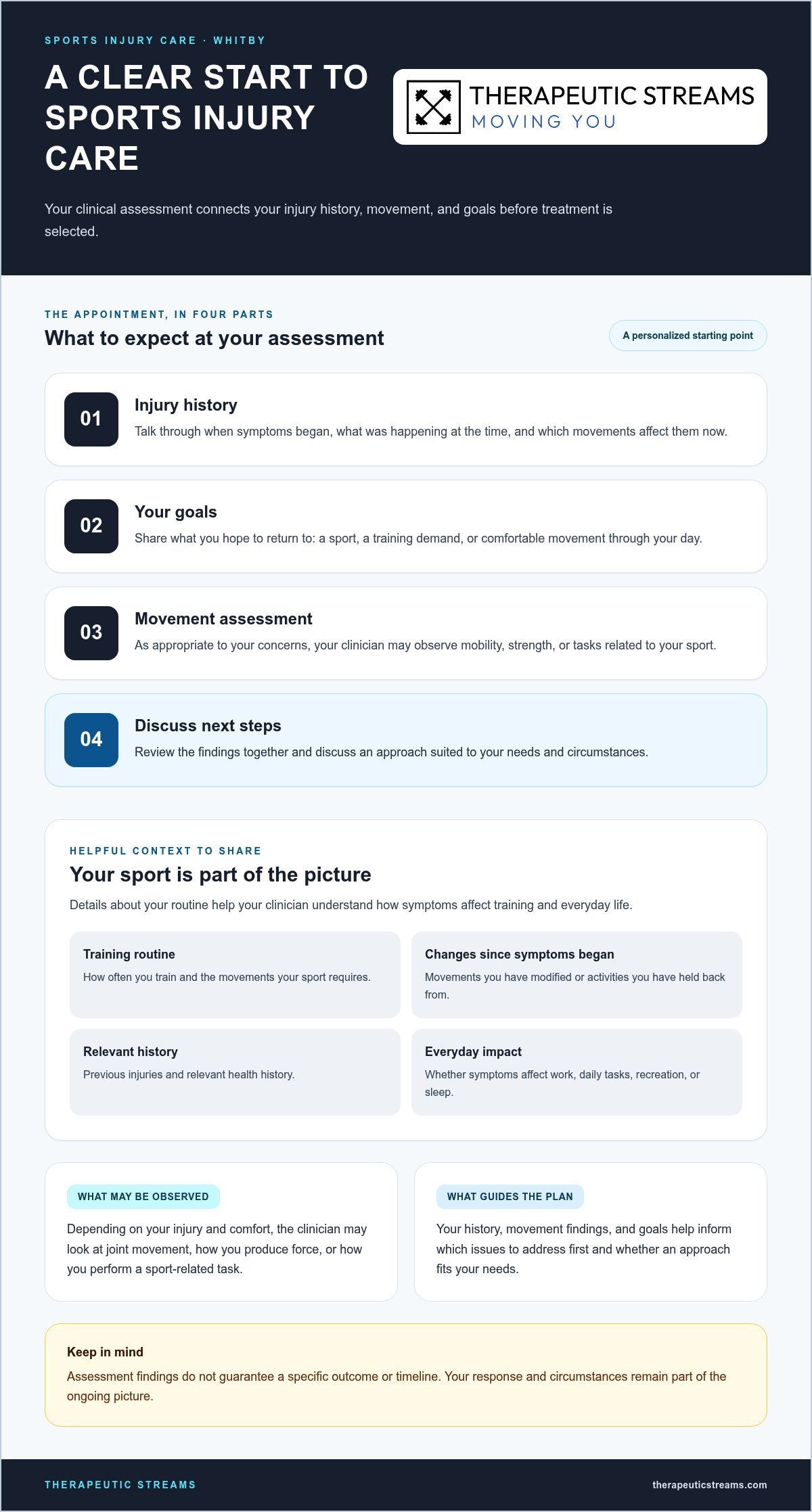
A clinical assessment gives your care a thoughtful starting point. Your clinician gathers relevant details, considers how your body moves, and discusses next steps with you before treatment is selected. The process is collaborative: your experience matters, and you can ask questions or share concerns as they arise. Treatment should follow assessment because the right next step depends on what your history, movement, and goals reveal.
Your appointment will generally move through a clear sequence:
- Discuss the injury history. Explain when the symptoms began, what was happening at the time, and which movements affect them now.
- Describe your goals. Share what you want to return to, whether that’s a sport, a particular training demand, or comfortable movement through your day.
- Assess movement. As appropriate to your concerns, the clinician may observe mobility, strength, or tasks related to your sport.
- Agree on next steps. Review the findings together and discuss an approach suited to your needs.
What to share about your injury and sport
Useful details include how often you train, the movements your sport requires, and any changes you’ve made since symptoms began. Mention previous injuries, relevant health history, and whether work or daily tasks are affected. Before the appointment, jot down your main questions and goals. These notes can help you explain what matters most, even if it’s difficult to recall every detail in the moment.
Context helps the clinician interpret what they find. Symptoms that appear during repeated overhead movements, for example, offer different information from discomfort that occurs at rest. Your training load and recovery habits can also help frame the discussion. For general information on sports injury treatment, MedlinePlus outlines common approaches. Your clinician will consider your circumstances rather than apply a generic formula.
How movement findings shape next steps
Depending on your injury and comfort, the clinician may look at how far a joint moves, how you produce force, or how you perform a task related to your sport. These observations help connect your symptoms with everyday function. They can also provide a practical reference point for reviewing your movement as care progresses, alongside how the area feels at rest.
Findings can guide which issues to address first and whether a particular approach fits your goals. They don’t guarantee a specific outcome or timeline; your response and circumstances remain part of the ongoing picture. At Therapeutic Streams, care begins by understanding your needs before treatment is selected. The clinician’s findings help inform whether chiropractic care is appropriate as part of your plan.
If you’re looking for sports injury care in Durham Region, your assessment should leave you with a clearer understanding of what the clinician observed and what comes next. You don’t need to arrive with a diagnosis. Bring your questions, describe what you’d like to do more comfortably, and take part in shaping a plan that fits your life and activity.
Physiotherapy, chiropractic care, and massage therapy: how roles differ
These services can support different parts of a sports injury plan, but their roles aren’t rigid boxes. Your clinician may recommend one service or coordinate relevant options when they suit your needs. A multidisciplinary approach doesn’t mean using every treatment available. Recommendations should reflect your assessment, goals, preferences, and circumstances. No single modality is right for every athlete or guarantees a faster recovery.
| Service | General focus | How it may relate to sport |
|---|---|---|
| Physiotherapy | Movement, strength, and physical function | May help build capacity for sport-specific activities |
| Chiropractic care | Joint movement and related concerns | May address mobility or discomfort affecting activity |
| Registered massage therapy | Soft tissues, including muscles and related tension | May support comfort when muscle tightness affects movement |
This comparison is general guidance, not a fixed treatment formula. A clinician considers your injury, activity demands, preferences, and everyday responsibilities before discussing suitable options. If you’re considering a sports injury clinic in Durham Region, ask why a service is recommended and how it relates to a specific goal.
How physiotherapy may contribute to sports rehabilitation
Physiotherapy often addresses movement and physical function through activity tailored to your needs. Depending on your assessment, the focus may include building towards a sport-related task, such as running, changing direction, or reaching overhead. Your plan can reflect your circumstances rather than follow a standard exercise routine.
Two published reviews show how research informs this kind of care:
- A 2015 Cochrane review by van der Heijden and colleagues examined exercise therapy for patellofemoral pain. It found that exercise therapy may reduce pain and improve function for people with this common knee problem, though the evidence was limited in quality.
- A 2011 Cochrane review by van der Wees and colleagues, along with related ankle sprain research, has examined exercise and supervised rehabilitation after ankle sprains, a frequent sports injury.
Your assessment determines how this research applies to you. For a related knee concern, our guide to physiotherapy for knee pain in Whitby offers more detail.
Where chiropractic care and registered massage therapy may fit
Chiropractic care may be considered when joint movement or related discomfort is part of your concerns. A registered massage therapist focuses on soft tissues and may be relevant when muscle tension affects comfort or movement. Whether either service suits your plan depends on your clinical assessment and preferences. Your clinician should explain the purpose of the approach being considered.
Comfort matters, too. Side-lying positioning is an option we can discuss when it suits your needs and the care being provided. At Therapeutic Streams, you can talk through which services fit your circumstances and goals.
Choosing a sports injury clinic in Durham Region: practical questions
Choosing a clinic involves more than finding a convenient location. You need care that starts by understanding your injury, explains recommendations clearly, and takes your sport and daily life into account. Consider whether the clinic’s approach helps you feel informed and involved, rather than rushed into a treatment choice.
- Does care begin with an assessment? Your symptoms, movement, health history, and goals should inform the recommendations.
- Are the next steps explained clearly? You should understand the purpose of suggested care and feel comfortable raising questions.
- Can the plan reflect your needs? Training demands, work, daily activities, and personal comfort all matter.
- Are relevant services available in a coordinated setting? Physiotherapy, chiropractic care, and registered massage therapy have different roles, and not everyone needs each service.
These questions can help you evaluate a sports injury clinic Durham Region athletes can access. A thoughtful plan isn’t a promise of a particular result. It’s an individualized guide that can be reviewed as your symptoms, function, or goals change.
What a clear and personalized care plan should explain
Your plan should connect its recommendations to what matters to you, whether that’s returning to a sport, managing work comfortably, or moving through daily activities with less difficulty. Ask how you’ll discuss progress and what changes in symptoms should prompt a review. Clear communication gives you an active role and helps keep care responsive to your needs.
Comfort belongs in that conversation. If a position or movement feels difficult, tell your clinician so you can discuss suitable options. For some people, side-lying positioning may offer a more comfortable way to receive certain care, depending on the treatment and individual circumstances.
If your injury is work-related, WSIB may be relevant, and it is a strength of our clinic. Eligibility and coverage depend on the circumstances of your claim, so raise your questions at your appointment. Extended health insurance also varies by plan, so review your own policy for its terms and any requirements that apply to the services you’re considering.
Local access for athletes across Durham Region
Therapeutic Streams has one clinic in Whitby and serves people from nearby Oshawa, Bowmanville, and Ajax. When planning care, consider how an appointment in Whitby fits alongside work, training, or family routines. Thinking through your schedule can make it easier to plan visits if they form part of your care.
If you’re ready to explore care shaped around your needs, explore sports injury care at Therapeutic Streams.
Start your sports injury care journey at Therapeutic Streams in Whitby
Taking a first step can feel easier when you know what to bring and what you hope to get from care. Before booking, think about the movement or activity you’d like to return to, whether that’s running, team practice, cycling, or comfortable everyday movement. You don’t need to choose a treatment in advance. Therapeutic Streams starts by learning about your needs, then uses that information to guide a personalized care plan.
What to prepare before your first appointment
A little preparation can help you share the details that matter. Make a short note of when your symptoms began, what affects them, any relevant injury or health history, and how your training or daily activities have changed. Include the sport movements you want to resume or modify. Bring your questions, too, including what the assessment involves and how care options are considered. If WSIB relates to your situation, you can raise questions about it during your visit.
- The activities you hope to return to, or adapt for now
- Relevant injury and health history
- Changes to training, work, or daily movement
- Questions about assessment and possible care approaches
A personalized next step, guided by your goals
Your first appointment is a chance to discuss what matters to you and how your movement needs shape the next step. Therapeutic Streams offers physiotherapy, chiropractic care, and registered massage therapy. These are options, not a set package. The clinician considers your circumstances and assessment findings when discussing which service or combination may be appropriate. Share your preferences and ask why a service is recommended so your care feels understandable and collaborative.
Therapeutic Streams is a sports injury clinic Durham Region residents can reach from Whitby, Oshawa, Bowmanville, and Ajax, with care provided at its Whitby clinic. Whether discomfort affects sport, work, or the rhythm of everyday life, you can start with a conversation about your goals and concerns. Book online to take a practical next step towards a plan shaped around you.
Book your sports injury appointment in Whitby.
Take your next step towards confident movement
Returning to the activities you value doesn’t require a perfect plan from the outset. Start with a clear conversation about what’s limiting you, what you hope to do, and what support may suit your circumstances. A sports injury clinic Durham Region athletes can turn to should help you feel heard and involved as you consider your next step.
Give yourself permission to begin where you are. You might want to rebuild confidence in a movement, adjust how you train, or make everyday activity more comfortable. Your goals can guide the discussion while your clinician helps you consider a practical path forward, without promising a particular timeline or result.
If you’re ready to take that first step, book an appointment with Therapeutic Streams. Bring your questions and the activities you want to work towards, then discuss a care plan shaped around your needs.
Frequently Asked Questions
Where can I find a sports injury clinic in Durham Region?
Therapeutic Streams is located in Whitby and serves people from nearby communities, including Oshawa, Bowmanville, and Ajax. You can book an appointment online and attend the Whitby clinic for sports injury care. If you’re travelling from another Durham Region community, consider how the location fits with your work, training, or other commitments as you arrange your visit.
Does Therapeutic Streams treat sports injuries in Oshawa, Ajax, or Bowmanville?
Yes. Therapeutic Streams serves people from Oshawa, Ajax, and Bowmanville at its clinic in Whitby. Your appointment takes place at the Whitby location, so plan to travel there. If you play for a local team or train near home, describe the activities involved and how symptoms affect them. That context helps connect your concerns with your sporting demands.
Can I use WSIB for sports injury treatment at a clinic in Durham Region?
WSIB may be relevant if your injury is connected to work, and it is a strength of our clinic. Eligibility and coverage depend on the circumstances of your claim. If WSIB applies to your situation, bring any relevant claim information or paperwork you have and ask how it relates to your care during your appointment planning.
What should I bring to my first sports injury appointment in Whitby?
Bring any relevant health information you’d like your clinician to consider, such as a current medication list or reports from earlier care, if available. You don’t need to organize a complete medical file or know the name of your injury. A brief note about your main concern and questions can help you make the most of the conversation. Wear clothing that lets you move comfortably if movement is part of the assessment.
Can a sports injury assessment accommodate side-lying positioning?
Yes. Side-lying positioning is one of our clinic’s strengths, and we can discuss it as a comfort option when it suits your needs and the care being considered. Let your clinician know if lying on your back, sitting, or moving into a certain position feels uncomfortable. Discussing comfort openly helps your clinician find a suitable way to proceed.
Do I need to know which treatment I need before booking a sports injury clinic?
No. You can book without choosing between physiotherapy, chiropractic care, or registered massage therapy first. The clinician will consider your concerns and circumstances before discussing suitable options. Start by explaining what you want help with, such as discomfort during training or difficulty with a sport-specific movement. This gives the conversation a useful starting point without requiring you to diagnose the problem yourself.