Vestibular Rehabilitation: What to Expect and How It Can Help
Keywords: proprioception, inner ear, semicircular canals, otoliths, vision, balance, dizziness, vestibular rehabilitation
Could carefully guided movement help you feel steadier, even when movement currently brings on dizziness? If spinning sensations, nausea, or unsteadiness are affecting your daily routines, it’s understandable to feel cautious about exercise. Vestibular rehabilitation uses selected activities to address balance and dizziness concerns, with your plan guided by your symptoms and clinical assessment.
At Therapeutic Streams Sport Rehab in Whitby, care starts with learning what you’re experiencing and how it affects everyday activities. Some exercises can bring on mild, brief dizziness, but your therapist can adjust the pace and monitor your response. The aim isn’t to push through discomfort without guidance. It’s to find an appropriate starting point for you.
This article explains how vestibular rehabilitation works, what an assessment and treatment session may involve, and what the therapy can and can’t address. You’ll also learn how personalised care can support a considered next step if you live in Whitby, Oshawa, Bowmanville, or Ajax. With clear information and skilled guidance, you can approach care with greater confidence and a steadier path forward.
Key Takeaways
- Learn how vestibular rehabilitation can address dizziness, balance, gaze, and movement difficulties through individually selected exercises.
- Understand how a personalized clinical assessment helps shape exercises around your symptoms, goals, and tolerance.
- See how repeated, appropriately paced movement practice may help your nervous system adapt.
- Prepare for an appointment by noting your symptoms, daily challenges, goals, and questions.
- Explore how Therapeutic Streams’ Vestibular Rehab service in Whitby can guide a plan informed by your assessment and needs.
1. Proprioception and its role in balance and dizziness
Dizziness or unsteadiness can make ordinary moments feel uncertain. Turning to speak to someone, walking through a busy shop, or looking up at a shelf may suddenly take more concentration. These experiences are real, but they don’t point to one cause on their own. A clinical assessment can help clarify what may be contributing and whether vestibular care suits your needs.
Vestibular rehabilitation is an individualized programme of exercises and strategies for difficulties with balance, steady vision, and movement. Unlike a general fitness routine, it responds to your symptoms, assessment findings, and everyday goals. The Vestibular rehabilitation overview also describes this focus on symptoms and tailored exercises, rather than exercise for fitness alone.
Proprioception is the sense of where your body is and how it is moving. Signals from muscles, joints, and other body tissues help your brain understand your position, posture, and movement. Your brain combines this information with input from the inner ear and eyes to help you stay balanced. When these signals do not work together smoothly, you may feel less steady, disoriented, or dizzy, particularly when walking, turning, or standing on an uneven surface.
2. The inner ear, including the canals and otoliths
The inner ear contains the semicircular canals and otolith organs, which provide important information about head movement and position. The semicircular canals detect rotational movements, such as turning or nodding your head. The otoliths detect linear movement and changes in head position in relation to gravity, such as moving forward, stopping, or tilting.
Your brain combines information from the canals and otoliths with proprioceptive and visual signals to guide balance and movement. If the information from these systems does not match, you may experience dizziness, unsteadiness, or difficulty orienting yourself. A dim room, uneven ground, or crowded aisle can make balance more demanding because the information available to your brain changes.
Symptoms that may prompt a vestibular assessment
People seek assessment for different experiences, including a spinning sensation, a sense of floating, unsteadiness while standing or walking, or discomfort when turning the head. Some notice motion sensitivity as a passenger in a car, while others find scrolling screens, patterned floors, or busy shops overwhelming. You may also feel that your vision is less steady when you move.
Similar symptoms can have different causes, and one person’s pattern may not match another’s. A clinician can ask when symptoms began, what brings them on, and how they affect daily activities. They may then assess relevant movement, gaze, and balance responses. This information helps guide an appropriate plan instead of assuming every dizziness or balance concern calls for the same exercises.
3. The vision component
Vision helps your brain understand where you are in relation to your surroundings and supports steady movement. The vestibulo-ocular reflex, or VOR, helps your eyes stay focused on a target as your head moves. Vestibular rehabilitation may include activities that practise visual stability during head movement, balance tasks that change the visual information available to you, or strategies for managing visually busy environments.
With repeated, appropriately selected practice, the nervous system can adapt to movement and use sensory information more effectively. This isn’t about forcing your body to “get used to” any activity. It depends on choosing the right type and level of challenge for your needs.
Gaze-stability and balance exercises in plain language
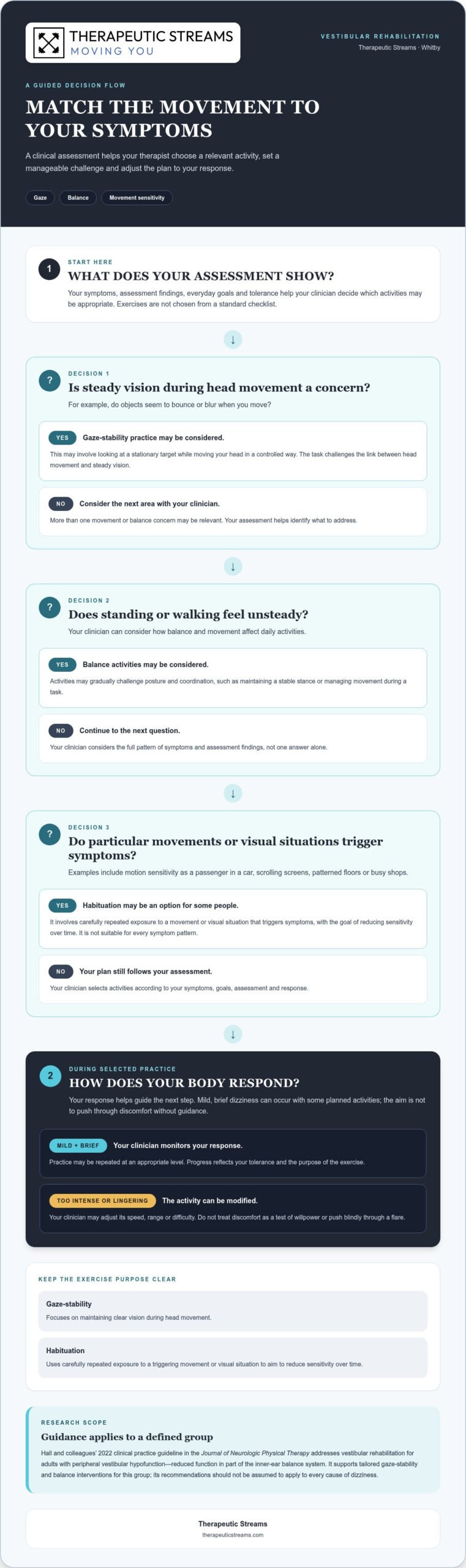
Gaze-stability practice may involve looking at a stationary target while moving your head in a controlled way. The task challenges the connection between head movement and steady vision. Balance activities may gradually challenge posture and coordination, such as maintaining a stable stance or managing movement during a task. Your clinician selects and progresses activities according to your assessment and response, rather than expecting everyone to follow the same routine.
Why progression and symptom response matter
Some planned activities may briefly bring on familiar symptoms, such as mild dizziness. Your response helps guide the next step. If an activity feels too intense or symptoms linger, your clinician can modify its speed, range, or difficulty. Don’t treat discomfort as a test of willpower or push blindly through a flare. Progress should reflect your tolerance and the purpose of the exercise.
Habituation exercises are another option for some people. They involve carefully repeated exposure to a movement or visual situation that triggers symptoms, with the goal of reducing sensitivity over time. They aren’t suitable for every symptom pattern. They also differ from gaze-stability exercises, which focus on maintaining clear vision during head movement. Your clinician can explain why an activity fits your plan and what response to watch for.
Research recommendations also have a defined scope. Hall and colleagues’ 2022 clinical practice guideline, published in the Journal of Neurologic Physical Therapy, addresses vestibular rehabilitation for adults with peripheral vestibular hypofunction, meaning reduced function in part of the inner-ear balance system. It supports tailored gaze-stability and balance interventions for this group. Its recommendations shouldn’t be assumed to apply to every cause of dizziness, which is another reason assessment matters.
At Therapeutic Streams in Whitby, vestibular rehabilitation care starts with an assessment to guide a personalized plan. Understanding what each exercise is meant to address can help you take part with greater confidence and share how your symptoms respond.
What to expect from vestibular rehabilitation: assessment, options, and limits
Your first appointment is a chance to describe what you’re experiencing and understand how care may proceed. The clinician will ask when symptoms began, what tends to bring them on, how they affect daily activities, and about relevant health history. Practical details, such as difficulty walking in a grocery aisle or turning your head while moving, help connect assessment findings with goals that matter to you.
What a clinical assessment may explore
Depending on your symptoms, the clinician may observe your balance, walking, eye movements, visual stability, and response to selected head or body movements. Share any concerns as you go, including if a movement feels uncomfortable or you need a pause. No single test necessarily explains every symptom. The clinician considers findings alongside your history, then discusses what they may mean and which next steps are appropriate.
You and your clinician can agree on practical goals, such as managing a particular movement more comfortably or feeling steadier during a daily task. A tailored plan may include different approaches and can change as your needs and responses become clearer. This assessment-first approach helps avoid treating every type of dizziness as if it had the same cause.
Different symptoms can call for different care
Vestibular rehabilitation isn’t interchangeable with care for every cause of dizziness. For example, benign paroxysmal positional vertigo (BPPV) can cause brief spinning sensations with particular changes in head position. Assessment for suspected BPPV may involve specific positioning checks. If the findings fit, a clinician may consider a repositioning manoeuvre. That differs from general gaze or balance training, and neither approach is automatically right for everyone.
Rehabilitation also doesn’t replace urgent medical evaluation. Sudden dizziness accompanied by facial drooping, weakness or numbness, trouble speaking, chest pain, fainting, or a severe new headache may signal an emergency. Call 911 or seek emergency care rather than waiting for a rehabilitation appointment.
The table below outlines common exercise categories and their purposes. It’s a guide to options a clinician may discuss, not a home programme or a prescription for your symptoms.
| Exercise category | General purpose | How selection may vary |
|---|---|---|
| Gaze-stability | Practise keeping vision clear during head movement. | Chosen according to visual symptoms and movement tolerance. |
| Balance and walking | Address steadiness, posture, or coordination during functional movement. | Adjusted to your balance findings and everyday goals. |
| Positional treatment | Address specific position-triggered symptoms when assessment findings support it. | Depends on the suspected cause and clinician’s examination. |
Your questions are part of the process. Ask what an activity is intended to address, what response to expect, and how to let your clinician know if it feels too demanding. Understanding the plan helps keep it relevant to you.
Preparing for vestibular rehabilitation in Whitby and nearby communities
A little preparation can help you make the most of your first appointment. You don’t need to identify the cause of your symptoms or know clinical terms. Everyday descriptions, such as “I feel unsteady when I turn” or “busy shops make me feel off balance,” give your clinician a useful starting point.
Getting ready for your first appointment
Before your visit, take a few minutes to note what you’ve noticed. A short record can help you recall details, especially if symptoms vary from day to day.
- Note the pattern. Record when symptoms began, how often they occur, how long they last, and what seems to bring them on or ease them.
- Connect symptoms to daily life. Think about activities that feel harder, such as walking outdoors, working at a screen, or moving through a busy setting.
- Gather relevant information. Bring health records or details about recent medical care that may help explain your health history, along with a list of current concerns.
- Prepare your questions. You might ask what the assessment involves, how a suggested activity relates to your concerns, and how to share if it feels too challenging.
There’s no need to rehearse a perfect explanation. Your clinician can ask follow-up questions and help organize the details. If you’re worried that movement may bring on symptoms, say so. Sharing that concern helps your clinician understand your comfort level and discuss appropriate next steps with you.
Questions about insurance and WSIB
Coverage varies by insurer and individual plan. Before your appointment, review your benefits documents for details such as eligible physiotherapy services, any referral requirements, and how claims are submitted. If anything is unclear, your insurer can explain how your specific plan applies. Don’t assume that a service is covered simply because another plan includes it.
WSIB may be relevant when dizziness or balance concerns follow a workplace injury. Eligibility and treatment coverage depend on the circumstances of the claim and applicable WSIB requirements. Coverage or approval isn’t automatic. Review your claim documents and current WSIB information to understand any steps that apply to your situation.
Therapeutic Streams is located in Whitby, serving people from Whitby and nearby communities, including Oshawa, Bowmanville, and Ajax. If you’re ready to discuss your concerns and prepare for an individualized assessment, connect with Therapeutic Streams about vestibular care.
Personalized vestibular rehabilitation at Therapeutic Streams in Whitby
Dizziness and balance concerns can affect people differently, so care should start with your experience rather than a preset routine. At Therapeutic Streams, an assessment-first approach helps connect your symptoms and clinical findings with goals that matter in your day-to-day life. You can describe what feels difficult, ask questions, and take part in decisions about your care.
A care plan shaped around your symptoms and goals
A clinical assessment gives your clinician a clearer picture of how movement, balance, and visual stability relate to your concerns. It can help shape practical goals, such as feeling more confident during a particular daily activity or managing a movement that currently feels challenging. Your plan is personalized to the findings and your tolerance, rather than based on a generic exercise routine.
Communication remains part of care as it progresses. Tell your clinician what feels manageable, what brings on symptoms, and whether an activity affects you differently than expected. You can also ask why an exercise or strategy is being considered and how it relates to your goals. That conversation helps your clinician make informed adjustments when appropriate and keeps the plan connected to your needs.
There’s no need to arrive with a diagnosis or a perfect explanation. Your observations are useful, even if symptoms are hard to describe or vary from one day to another. The plan can respond to information gathered during assessment and to what you share as care continues. This supports thoughtful decisions without promising a fixed timeline or a particular result.
Taking the next step at the Whitby clinic
Therapeutic Streams provides Vestibular Rehab at its clinic in Whitby, Ontario, serving people from Whitby and nearby communities, including Oshawa, Bowmanville, and Ajax. Care focuses on understanding your concerns, using assessment findings to guide a personalized plan, and keeping you informed about the choices being made.
If you’re considering vestibular rehabilitation, a supported next step can begin with a conversation about what you’ve noticed and what you’d like to work towards. You don’t have to figure it all out on your own. Explore vestibular rehabilitation at Therapeutic Streams and learn about care at the Whitby clinic.
Choose a next step that feels manageable
You don’t need to have every answer before moving forward. A useful next step can be deciding which part of daily life you’d most like to approach with greater confidence. Perhaps it’s tending your garden, walking along a familiar path, or enjoying a conversation without worrying about how movement might feel. Your priorities can help shape a care conversation around what matters to you.
As you consider vestibular rehabilitation, give yourself permission to ask questions and share what you hope to work towards. The right starting point respects your experience and leaves room for your needs to change. Small, thoughtful steps can help replace uncertainty with a clearer sense of direction.
Explore care at Therapeutic Streams and consider how a personalized assessment can help you plan a next step. Explore vestibular rehabilitation at Therapeutic Streams.
Frequently Asked Questions
Can vestibular rehabilitation help with dizziness and balance problems?
It may help when your symptoms relate to a vestibular condition that responds to rehabilitation. A clinician first considers what could be causing your dizziness or unsteadiness, since similar symptoms can have different origins and may call for different care. For example, difficulty staying steady while walking and brief spinning brought on by a change in head position aren’t necessarily addressed in the same way. Assessment helps determine whether this approach may suit you.
Is it normal to feel dizzy during vestibular rehabilitation exercises?
Mild, brief dizziness can occur during some prescribed exercises, but you shouldn’t feel pressured to push through strong or lingering symptoms. Tell your clinician how you feel during and after an activity, including whether symptoms settle or interfere with the rest of your day. The exercise or its difficulty may need adjustment. New or severe symptoms deserve prompt medical attention rather than being assumed to be a routine exercise response.
How long does vestibular rehabilitation take?
There’s no single timeline that applies to everyone. The length of care can depend on what’s contributing to your symptoms, your assessment findings, your goals, and how you respond to the plan. Your clinician can review your progress with you and discuss whether the approach needs to change. Rather than relying on a promised number of visits, focus on whether care is addressing the activities you’ve identified as important.
What happens during a vestibular rehabilitation assessment?
You’ll discuss your symptoms, health history, and the activities you find difficult. The clinician may assess balance, walking, eye movements, visual steadiness, or responses to selected head and body movements, as appropriate. For instance, they may ask how a movement feels before and after observing it. Findings are considered together, not treated as proof from one test alone, and help guide a plan suited to your needs.
Can I access vestibular rehabilitation in Whitby if I live in Oshawa, Bowmanville, or Ajax?
Yes. Therapeutic Streams provides Vestibular Rehab at its clinic in Whitby for people from nearby Oshawa, Bowmanville, and Ajax. Before your visit, consider noting your main concerns and questions so you can use appointment time to discuss what matters most. The clinic’s Whitby location is where you can access this service.
Does WSIB cover vestibular rehabilitation in Ontario?
WSIB may cover vestibular rehabilitation when it’s clinically required under its Mild Traumatic Brain Injury Program of Care for a worker with an allowed WSIB claim and an mTBI diagnosis. Coverage isn’t automatic for every workplace injury or dizziness concern. Review your claim documents and current WSIB information to understand which requirements apply to your circumstances and whether vestibular care is part of your approved treatment.
Should I see a doctor before starting vestibular rehabilitation?
You can generally book directly with a physiotherapist in Ontario without a doctor’s referral. However, your insurer may require a referral for reimbursement, so review your plan documents if you intend to submit a claim. If dizziness comes with sudden weakness, trouble speaking, fainting, chest pain, or a severe new headache, seek emergency medical care instead of waiting for a rehabilitation appointment.
Ready to take a supported next step? Explore vestibular rehabilitation at Therapeutic Streams in Whitby.