How Do I Know If a Chiropractor Is Good or Not?
Choosing a chiropractor can feel overwhelming, especially when you’re in pain and looking for a solution you can trust. You’ve likely heard conflicting stories—some people swear by their chiropractor, while others are skeptical about the entire practice. The core question you’re asking is a valid and important one: How can you tell if a chiropractor is a legitimate healthcare professional focused on your recovery, or someone more interested in selling a long-term, high-volume package?
The difference between excellent and subpar chiropractic care isn’t about the “crack” or the adjustment itself. It’s about the clinical process that precedes and follows it. A good chiropractor functions as a clinical partner, prioritizing a thorough assessment, evidence-based treatments, and an integrated rehabilitation plan. They aim to empower you, not create a dependency on their services.
This guide will provide you with the clinical markers, red flags, and professional standards you need to confidently evaluate a chiropractor. We’ll break down what to look for in your first appointment, how to spot outdated or unethical business practices, and how to verify that your practitioner meets the high standards required in Ontario. By the end, you’ll have a clear framework for finding a practitioner who will be a true partner in your journey back to pain-free movement.
The First Impression: Why a Thorough Assessment is Non-Negotiable
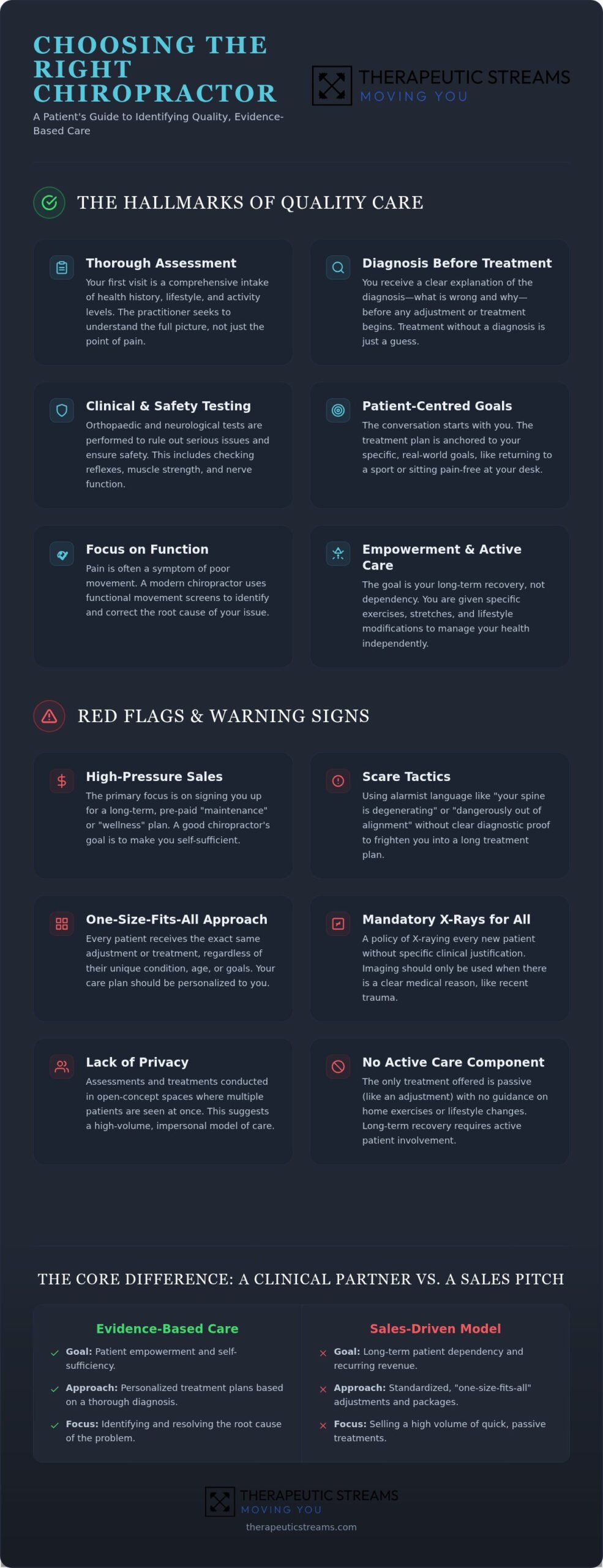
Your first visit to a chiropractic clinic should feel like a comprehensive medical consultation, not a quick stop for a spinal adjustment. A quality chiropractor understands that effective treatment is impossible without an accurate diagnosis. This begins with a detailed assessment that looks at the complete picture of your health, not just the single point of pain.
- A quality chiropractor begins with a comprehensive intake of your health history, lifestyle, work demands, and activity levels.
- The physical exam should go beyond the area of pain to look at your overall movement patterns, posture, and biomechanics.
- You should always receive a clear explanation of the diagnosis—what the practitioner thinks is wrong and why—before any treatment or “adjustment” occurs.
- One-on-one time is a major indicator of quality. Avoid clinics that feel like a “revolving door” where practitioners spend only a few minutes with each patient.
The Anatomy of a Professional Initial Assessment
A professional, evidence-based initial assessment is systematic and patient-focused. It’s a data-gathering process designed to understand your unique condition and create a targeted treatment plan. Here’s what it should include:
- Discussing Your Goals: The conversation should start with you. What do you want to achieve? Are you trying to return to a sport, lift your child without pain, or simply sit comfortably at your desk? A good clinician anchors their treatment plan to your specific, real-world goals.
- Orthopaedic and Neurological Testing: This is a critical step to ensure your safety and rule out more serious underlying issues. Your chiropractor should perform a series of tests to check your reflexes, muscle strength, nerve function, and joint range of motion. This clinical diligence is a hallmark of a true healthcare professional.
- Functional Movement Screens: Pain is often a symptom of a dysfunctional movement pattern elsewhere in the body. A modern chiropractor will watch you move. They might ask you to squat, bend, or perform other basic movements to see how your body’s kinetic chains are functioning. This helps identify the root cause of the issue, not just the symptom.
Red Flags During Your First Consultation
Just as there are clear signs of quality, there are also immediate red flags that should make you cautious. Your health is too important to entrust to a practitioner who cuts corners. Be wary of:
- Treatment Before Diagnosis: If a practitioner suggests an adjustment or any other treatment before taking a detailed history and performing a physical exam, this is a major red flag. Treatment without a diagnosis is guessing, not healthcare.
- Mandatory X-rays for All Patients: While X-rays are a valuable diagnostic tool, they are not necessary for every patient. Clinical guidelines recommend imaging only when there’s a specific reason, such as recent trauma, suspected pathology, or a failure to respond to initial care. A policy of X-raying every new patient without clinical justification can be a sign of a sales-driven, rather than a patient-driven, practice.
- A Lack of Privacy: Your health history and physical assessment are confidential. Assessments and treatments should be conducted in a private room. Open-concept treatment areas where multiple patients are adjusted in the same space compromise privacy and suggest a high-volume, impersonal model of care.
Spotting the Red Flags: When to Walk Away from a Clinic
Beyond the first impression, certain business practices and communication styles can reveal a clinic’s philosophy. A good chiropractor’s goal is to help you get better and become self-sufficient. A poor one may focus on creating a long-term dependency. Knowing the difference is key to protecting your health and your wallet.
- Scare Tactics: Beware of practitioners who use alarmist language. Claims that your spine is “dangerously” out of alignment, “degenerating rapidly,” or that you have the “spine of a 70-year-old” without clear, evidence-based diagnostic findings are often used to frighten you into a long-term treatment plan.
- The “Lifetime” Sales Pitch: The objective of modern rehabilitation is to resolve your issue and give you the tools to prevent it from recurring. If the primary focus is on signing you up for a year or more of “maintenance” or “wellness” adjustments, you should be skeptical. A good chiropractor aims to get you better so you don’t need them.
- Lack of Variety in Treatment: If you notice that every patient in the clinic receives the exact same adjustment, regardless of their age, condition, or goals, it’s a sign of a one-size-fits-all approach. Your treatment plan should be as unique as you are.
- No Home Care or Empowerment: Passive care (like an adjustment) can provide relief, but long-term recovery comes from active care. A quality practitioner will empower you with specific exercises, stretches, and lifestyle modifications to do between sessions. If they don’t, they are not building your capacity for independent health.
The Problem with Long-Term Pre-Paid Contracts
One of the most significant red flags in the chiropractic world is the high-pressure sales pitch for a large, pre-paid treatment package. While some clinics offer small bundles for convenience, be extremely wary of any practice that asks for thousands of dollars upfront for a year-long plan.
- Ethical clinics bill per session or in small, manageable blocks. They do not require a massive financial commitment before a therapeutic relationship has even been established.
- Your care plan should be dynamic. A professional will re-evaluate your progress every few weeks and adjust the plan accordingly. Locking you into a rigid, 12-month contract removes this essential flexibility.
- “Unlimited” adjustment packages often sound like a good deal, but they can subtly discourage the most important part of recovery: active rehabilitation. The focus should be on getting better, not on getting as many adjustments as possible.
Communication Failures to Watch For
How a chiropractor communicates with you is just as important as the treatment they provide. As an “Empowering Expert,” their role is to educate and collaborate with you.
- Dismissing Your Questions: A good clinician welcomes questions and takes the time to answer them thoroughly. If you feel rushed, or if your concerns are dismissed, it’s a sign they don’t view you as a partner in your own care.
- Failing to Explain Risks and Benefits: Every treatment, including a spinal adjustment, has potential risks and benefits. Your chiropractor has an ethical and legal obligation to obtain your informed consent, which means you must understand the proposed treatment, its alternatives, and any associated risks.
- Not Coordinating with Other Providers: Modern healthcare is collaborative. Your chiropractor should be willing to communicate with your family doctor, physiotherapist, or massage therapist to ensure your care is aligned. A practitioner who works in a silo may not be practicing with your best interests in mind.
Trust Your Gut: The Importance of a Second Opinion
Ultimately, you are the primary stakeholder in your health. If something about a clinic or a practitioner feels off, you have every right to pause and seek another perspective. It is perfectly acceptable—and often very wise—to “shop around.”
Getting a second opinion from another chiropractor is not a sign of distrust; it is a sign of an engaged and responsible patient. A confident, professional clinician will support your decision to do so. They will be secure in their assessment and treatment plan, and they will understand that your comfort and confidence are paramount. If a practitioner becomes defensive or tries to pressure you against seeking another opinion, consider that a definitive red flag. Your relationship with any healthcare provider should be built on a foundation of trust and mutual respect.
Evidence-Based vs. Traditional Care: Understanding Modern Chiropractic
The field of chiropractic has evolved significantly over the decades. While some practitioners still adhere to older, more traditional philosophies, the modern, evidence-based chiropractor operates as a primary care provider for musculoskeletal issues. Understanding this distinction is crucial for finding effective care.
- Modern chiropractic care is rooted in current musculoskeletal research and clinical best practices, similar to physiotherapy or sports medicine.
- It focuses on a balance of “active” care (exercise, education, movement rehabilitation) and “passive” care (adjustments, soft tissue therapy).
- A good practitioner realizes that a chiropractic adjustment is just one tool in a much larger rehabilitation toolbox, and it isn’t always the most important one.
- Integrated clinics, where chiropractors work alongside physiotherapists and massage therapists, often provide a more comprehensive and effective path to recovery. For many patients, understanding the difference between these disciplines is a key first step. You can learn more about how to choose the right path to recovery in our detailed guide.
The Role of Soft Tissue Therapy and Exercise
Pain and dysfunction are rarely limited to the joints. Muscles, ligaments, tendons, and fascia all play a critical role. A modern chiropractor spends a significant amount of time addressing these soft tissues.
- Why Muscles Matter: Your chiropractor should be using their hands to do more than just adjust. Techniques like Active Release Technique (ART®), Graston Technique®, or general myofascial release are essential for addressing muscle tightness, scar tissue, and adhesions that restrict movement and cause pain.
- Rehab and Stabilization: An adjustment can improve joint mobility, but if the surrounding muscles are weak or uncoordinated, the problem will likely return. A good chiropractor provides “rehab” exercises designed to strengthen and stabilize the affected area, making the benefits of the treatment last.
- Complementary Modalities: Many evidence-based chiropractors are also trained in other techniques that support their primary work. Neurofunctional acupuncture, for example, can be a powerful tool for modulating pain and improving muscle activation, complementing a standard adjustment perfectly.
Collaborative Care Models
A sign of a truly high-quality clinician is their recognition of their own limits and their willingness to collaborate. No single profession has all the answers for every condition.
- The Power of Referrals: If your chiropractor regularly refers patients to a Registered Massage Therapist (RMT) for soft tissue work or a Physiotherapist for complex rehabilitation, it’s a sign of a secure, patient-first mentality. They are putting your outcome ahead of their ego.
- The Integrated Advantage: The benefit of a clinic where multiple experts consult on your case cannot be overstated. At an integrated recovery centre, your chiropractor, physiotherapist, and RMT can communicate directly about your progress, ensuring everyone is working toward the same goal.
- Knowing When to Triage: A crucial skill for any primary contact practitioner is knowing when a condition is outside their scope of practice. A good chiropractor will not hesitate to refer you to your family doctor or a medical specialist if they suspect an underlying pathology that requires a different type of care.
Verifying Professionalism: Credentials and Standards in Ontario
In Canada, chiropractic is a regulated health profession with high standards for education, ethics, and practice. Ensuring your chosen practitioner meets these standards is a simple but vital step in your selection process.
- All chiropractors in Ontario must be registered with the College of Chiropractors of Ontario (CCO). This is not optional; it is the law.
- You can and should verify their standing by using the “Find a Chiropractor” public register tool on the CCO website.
- Look for the “Doctor of Chiropractic” (DC) credential, which signifies they have graduated from an accredited institution after a rigorous, multi-year program.
- Professional chiropractors are committed to lifelong learning. They regularly engage in continuing education to stay updated on the latest research and rehabilitation techniques.
What Does “In Good Standing” Actually Mean?
When you look up a practitioner on the CCO register and see they are “in good standing,” it provides several layers of assurance. It means:
- The practitioner has no active disciplinary actions or restrictions on their practice.
- They are required to adhere to the strict ethical and clinical standards of practice set by the CCO and provincial law.
- They carry appropriate professional liability (malpractice) insurance to protect their patients.
The Value of Specialized Post-Graduate Training
While all licensed chiropractors meet a high baseline of competency, many pursue advanced certifications in specific areas of interest. This post-graduate training indicates a deeper level of expertise and a passion for a particular field.
- Specialized Certifications: Look for certifications in areas relevant to your needs, such as sports sciences (FRCCSS(C)), rehabilitation, pediatrics, or vestibular rehabilitation for dizziness and vertigo.
- Advanced Clinical Skills: For example, a chiropractor who has invested in advanced training in a technical skill like BikeFIT for cyclists demonstrates a commitment to a high level of clinical precision for a specific patient population. This is a strong indicator of a dedicated and skilled practitioner.
- Generalist vs. Specialist: While a generalist can treat a wide variety of conditions, a chiropractor with a specialized focus on sports performance, for instance, may be better equipped to handle the unique demands of an athlete’s body. Consider your own needs and look for a practitioner whose expertise aligns with them.
The Therapeutic Streams Standard: Integrated, Assessment-Driven Care
Navigating the world of chiropractic care can be complex, but at Therapeutic Streams, we believe the choice should be simple. We have built our practice on the very principles of quality, transparency, and evidence-based care that this guide outlines.
- At Therapeutic Streams, we prioritize evidence-based, assessment-driven treatments for every patient. Your care starts with a comprehensive diagnosis, not a predetermined treatment plan.
- Our one-on-one sessions ensure you are never just a number in a crowded waiting room. You get the dedicated time and attention needed for a thorough, effective treatment.
- We believe in truly integrated care. Our chiropractors work hand-in-hand with our registered massage therapists, physiotherapists, and yoga instructors to build a holistic and robust recovery plan.
- Our goal is your long-term wellness and independence in Whitby, not a never-ending treatment cycle. We aim to get you better and give you the tools to stay that way.
Personalized Treatment Plans for Whitby Residents
We understand that residents of Whitby, Oshawa, and Ajax lead active lives and expect a high standard of healthcare. Our model is designed to meet and exceed those expectations.
- We tailor our approach to your specific musculoskeletal condition, whether it’s chronic back pain, a sports injury, or a repetitive strain from work.
- The benefit of having chiropractors and physiotherapists collaborating under one roof means you get the best of both worlds—expert manual therapy combined with advanced rehabilitative exercise.
- We focus heavily on education. We want you to understand your condition and feel empowered to manage your own health between visits, reducing your reliance on passive care.
How to Book Your Professional Assessment
Taking the first step toward recovery should be easy and stress-free. We offer a straightforward booking process and ensure you know exactly what to expect.
- We offer convenient online booking options for busy residents in Oshawa, Whitby, and Ajax.
- For your first appointment, please wear comfortable clothing that allows for easy movement. Bring any relevant medical information, such as imaging reports or notes from other healthcare providers.
- Ready to experience the difference that professional, patient-centred care can make? Experience the Therapeutic Streams difference—book your assessment today.
Frequently Asked Questions (FAQs)
- How many sessions should it take to see results from a good chiropractor?
For most acute conditions, you should notice some measurable improvement (e.g., reduced pain, increased range of motion) within 4-6 visits. A good chiropractor will set clear expectations and re-evaluate your progress regularly. If you are not responding to care as expected, they should be willing to change the treatment plan or refer you for a different opinion.
- Is it a bad sign if my chiropractor does not take X-rays?
No, quite the opposite. It’s often a sign of a good, evidence-based practitioner. Clinical guidelines recommend against routine X-rays for non-traumatic back pain. A responsible chiropractor will only order imaging when there is a specific clinical reason, such as a history of trauma, suspicion of disease, or if your condition isn’t improving with conservative care.
- Can a chiropractor help with things other than back pain, like sciatica or headaches?
Absolutely. A modern chiropractor is a musculoskeletal expert who can diagnose and treat a wide range of conditions affecting nerves, muscles, and joints. This includes issues like sciatica treatment, tension headaches, neck pain, carpal tunnel syndrome, plantar fasciitis, and various sports injuries.
- What is the difference between a chiropractor and a physiotherapist?
While there is significant overlap, chiropractors often have a stronger focus on manual therapy, particularly joint manipulation (“adjustments”), and diagnosis. Physiotherapists traditionally place a greater emphasis on exercise-based rehabilitation and modalities. In a modern, integrated clinic, the lines are often blurred as both professions borrow techniques from one another to achieve the best patient outcomes.
- Should a chiropractic adjustment hurt if the practitioner is good?
A properly performed chiropractic adjustment should not be painful. You might feel a sensation of pressure followed by relief. Some patients may experience mild, temporary soreness afterward, similar to the feeling after a workout, but sharp or lasting pain is not a normal or acceptable outcome.
- Why do some chiropractors want me to come back three times a week?
In the initial, acute phase of an injury, more frequent visits (2-3 times per week) for a short period may be clinically justified to manage pain and inflammation. However, this frequency should decrease quickly as you move into the rehabilitation phase. A treatment plan that requires high-frequency visits for many months without a clear plan to transition to active, independent care is a red flag.
- How do I know if the “cracking” sound is actually doing anything?
The audible “pop” or “crack,” known as a cavitation, is simply the release of gas from the joint fluid. While it can be satisfying, it is not the primary indicator of a successful adjustment. The therapeutic benefit comes from the rapid stretch of the joint capsule and surrounding tissues, which stimulates nerve receptors that can reduce pain and relax muscles. A good chiropractor focuses on the functional improvement, not the sound.
- Is it okay to ask my chiropractor about their specific treatment techniques?
Yes, it is more than okay—it’s essential. A professional chiropractor will be happy to explain their treatment philosophy and the specific techniques they use (e.g., Diversified, ART®, Graston). They should be able to tell you why they are choosing a particular technique for your specific condition. This transparency is a key part of informed consent and a strong therapeutic partnership.