Physiotherapy for Knee Pain in Whitby: A Recovery Guide
What if the clicking in your joint or that sharp ache after a walk along the Whitby Waterfront Trail wasn’t just an inevitable sign of wear and tear? It’s common to feel frustrated when temporary fixes fail or to fear that your mobility is permanently degrading. Many of our neighbours feel stuck choosing between different specialists while searching for effective physiotherapy for knee pain whitby to finally realize lasting results. We believe that true recovery requires moving beyond masking symptoms to identifying the mechanical failures in your lower limb chain.
This guide explores how an integrated, assessment-driven approach to physiotherapy for knee pain whitby can resolve the root cause of your discomfort and return you to an active lifestyle. We will preview the Joint-by-Joint theory, the benefits of one-on-one clinical advocacy, and why choosing professional physiotherapy for knee pain whitby is the first step toward a clear, long-term health plan. By the end of this guide, you’ll have the confidence to move from a state of protection to peak performance with a team that is deeply invested in your success.
Key Takeaways
- Realize that persistent knee pain is often a mechanical signal of dysfunction rather than an inevitable consequence of aging or wear and tear.
- Understand the “Joint-by-Joint” theory and how issues in your hips or ankles can create secondary strain on your knee joints.
- Learn why an integrated approach to physiotherapy for knee pain in Whitby produces superior results by combining the expertise of physiotherapists, chiropractors, and massage therapists.
- Discover the professional roadmap that transitions your care from initial protection to peak performance based on functional milestones.
- Identify the essential qualities of a local clinic, including a focus on one-on-one sessions and assessment-driven treatment plans.
Understanding Knee Pain in Whitby: Moving Beyond Wear and Tear
Many Whitby residents believe that an aching knee is simply a tax paid for getting older. It’s time to reframe that perspective. Pain isn’t an inevitable part of aging; it’s a mechanical signal from your body that something in the system is out of alignment. Whether you’re feeling a sharp twinge during a tennis match at Iroquois Park or a dull ache after a walk through the Heber Down Conservation Area, your knee is communicating a need for intervention. Seeking professional physiotherapy for knee pain whitby allows you to listen to those signals before they turn into permanent joint degradation.
Being sidelined doesn’t just hurt physically. It affects your mental well-being when you can’t join the morning walking group or keep up with your active family. This frustration often leads people to rush back into activity too soon, which only restarts the cycle of injury. Realizing that your pain has a specific, treatable cause is the first step toward reclaiming your independence. Our goal is to move you from frustration to a state of confident, pain-free movement.
Common Knee Conditions We Treat in Durham Region
Our clinical team frequently sees patients struggling with Patellofemoral Pain Syndrome (Runner’s Knee), which often presents as discomfort behind or around the kneecap. While it’s common among local runners, it also affects those whose daily routines involve repetitive bending or stairs. We also manage osteoarthritis, where we focus on how strategic movement preserves joint health and reduces inflammation. For those facing ligamentous injuries like ACL or MCL tears, our goal is to restore stability through a structured, assessment-driven program. Each of these conditions requires a unique roadmap rather than a generic exercise sheet.
The Problem with “Masking” the Pain
It’s tempting to reach for ice packs and anti-inflammatories the moment discomfort flares up. While these tools manage symptoms, they don’t address why the joint is under stress. Relying on temporary measures often leads to compensation patterns. You might start limping or shifting your weight, which eventually causes hip or lower back issues. When you choose our approach to physiotherapy for knee pain whitby, we look beyond the surface. We identify the true source of your discomfort, whether it’s a lack of hip mobility or poor foot mechanics, to ensure your recovery is both thorough and lasting. This assessment-driven care is the only way to realize long-term relief and prevent a “bad knee” from becoming a permanent limitation.
The Biomechanical Chain: Why Your Knee Pain Starts Elsewhere
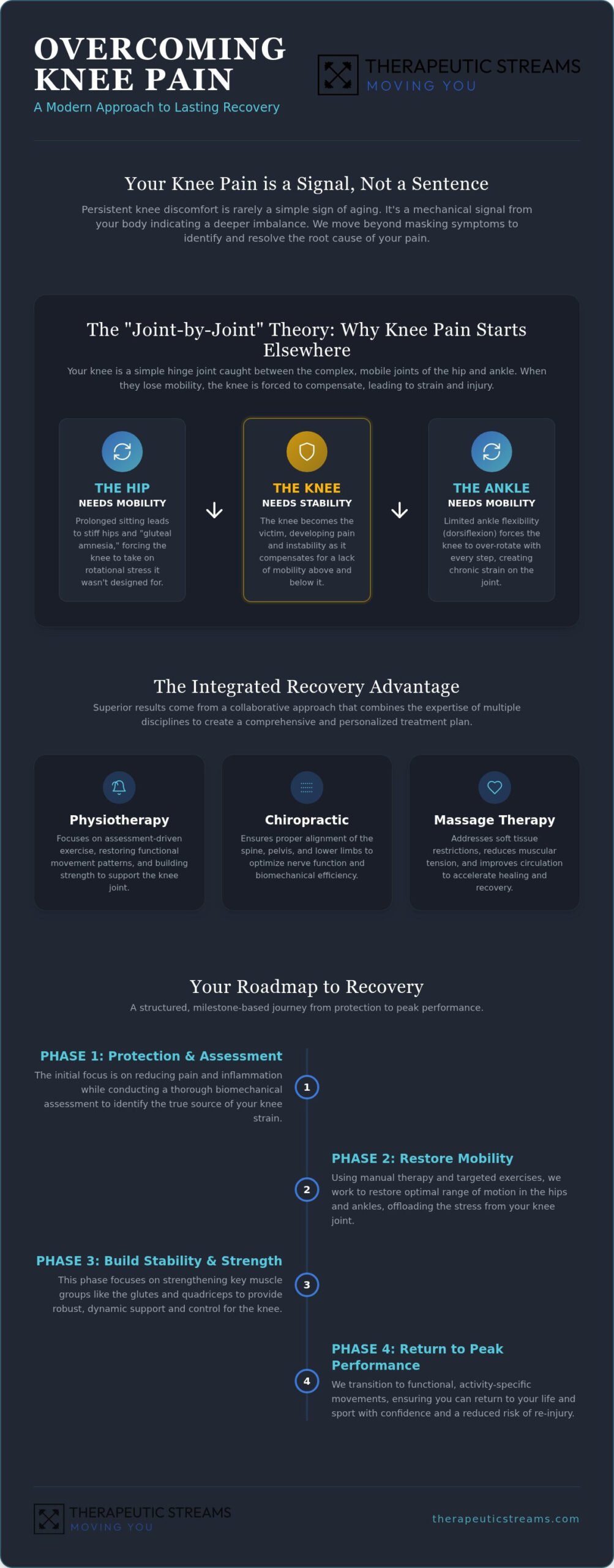
Your knee is often the “middle child” of the lower body. It is a relatively simple hinge joint caught between two highly mobile and complex structures: the hip and the ankle. According to the “Joint-by-Joint” theory, the knee requires stability, while the joints above and below it require mobility to function correctly. When your hip or ankle becomes stiff or dysfunctional, the knee is forced to compensate by moving in ways it wasn’t designed to handle. This holistic perspective is what distinguishes high-quality physiotherapy for knee pain whitby from generic treatments that only focus on the site of the ache.
Sedentary work habits contribute significantly to local health trends in Durham Region. Many professionals in Whitby spend hours at desks, which often leads to “gluteal amnesia.” This condition occurs when the gluteal muscles essentially “forget” how to fire correctly after prolonged sitting. Without the glutes to provide pelvic stability, the knee loses its primary protector, leading to poor tracking and increased joint stress during even simple activities like walking or climbing stairs. This lack of central control is a primary driver of chronic discomfort.
The Ankle-Knee Connection
Limited ankle mobility is a frequent culprit behind chronic knee strain. If your ankle cannot flex properly as you move, your body will seek that missing range of motion by over-rotating the knee joint. This is especially noticeable when walking the Whitby Waterfront Trail or navigating uneven terrain. Addressing these restrictions is a core component of effective physiotherapy for knee pain whitby. To resolve this, a comprehensive recovery plan may include:
- Detailed gait analysis to identify subtle movement dysfunctions in the foot and ankle.
- Manual therapy to restore restricted ankle joint play and improve dorsiflexion.
- An evaluation of your footwear to ensure proper arch support and shock absorption.
- Assessment for custom orthotics if structural foot issues are causing secondary knee stress.
Hip Strength and Knee Stability
The hip serves as the primary controller of the leg’s alignment. Specifically, the gluteus medius muscle prevents the knee from caving inward, a movement known as valgus, which puts immense pressure on the ACL and medial meniscus. An integrated approach that includes chiropractic care can help optimize pelvic alignment, ensuring these muscles have a stable base to work from. Recovery often begins with a well-structured conditioning program that focuses on activating these “protectors” of the knee joint. Identifying these subtle movement dysfunctions through a professional gait analysis is often the turning point in a patient’s journey. By addressing these upstream and downstream factors, we ensure that your physiotherapy for knee pain whitby provides a permanent solution rather than a temporary fix.
Integrated Recovery: The Therapeutic Streams Advantage
The “factory-style” model of rehabilitation often leaves patients feeling like a number on a clipboard. In these environments, one therapist might juggle three or four people at once, leading to generic exercise sheets and minimal hands-on time. We prioritize a different standard of care. By offering dedicated one-on-one sessions, we ensure your physiotherapy for knee pain in Whitby is focused entirely on your specific biomechanical needs. This intensive focus allows us to adjust treatments in real time, helping you realize progress faster than with a rigid, pre-set protocol.
True recovery rarely happens in isolation. Our clinical philosophy centres on a collaborative team approach where your physiotherapist works alongside chiropractors and massage therapists. For instance, Registered Massage Therapy plays a critical role in addressing the soft tissue tension that often accompanies Common causes of knee pain. By releasing tight quadriceps or restricted IT bands, we create a window of opportunity for your physiotherapy exercises to be more effective. This team-based goal setting ensures every clinician is moving you toward the same functional outcome.
Neurofunctional Acupuncture for Knee Pain
When a joint is injured, the nervous system often “shuts down” the surrounding muscles as a protective measure. This is frequently seen in the quadriceps after a knee injury, where the muscle appears to have lost its strength despite no actual tear. Neurofunctional acupuncture is a modern, evidence-based technique designed to “reboot” these neural pathways. Unlike traditional Chinese medicine that focuses on energy meridians, this approach targets specific peripheral nerves. By applying a gentle electrical stimulus to the needles, we can encourage the nervous system to restore proper muscle firing patterns, which is essential for joint stability.
Shockwave Therapy: A Game Changer for Tendinitis
For chronic conditions like patellar tendinitis or “Jumper’s Knee,” traditional stretching and strengthening might not be enough to break through stagnant healing. Shockwave therapy uses high-energy acoustic waves to create micro-trauma in the damaged tendon tissue. This process stimulates a fresh inflammatory response and triggers the body’s natural repair mechanisms. It’s a non-invasive alternative for Whitby residents who haven’t found relief through conventional methods. Most patients describe the sensation as a deep, pulsing pressure, and a typical session lasts only five to ten minutes. It is an ideal modality for those looking to accelerate tissue repair without the need for surgical procedures.
Your Roadmap to Recovery: Phases of Professional Physiotherapy
Recovery is rarely a linear path. It is a structured journey that transitions you from a state of protection to one of high-level performance. We don’t measure your progress solely by a reduction in pain; instead, we prioritize functional milestones that reflect your ability to navigate real-world challenges. Whether you’re aiming to walk through your Whitby neighbourhood without a limp or return to competitive sport, our roadmap ensures every step is purposeful. This phased approach to physiotherapy for knee pain in Whitby allows us to build a resilient foundation before we challenge the joint with higher loads.
A surprising but vital component of this journey often involves looking at the core. Stability in the lower limbs is frequently dictated by the strength and coordination of the pelvis. In some cases, Pelvic Floor Physiotherapy is a necessary part of the recovery plan to ensure the knee isn’t compensating for a lack of central stability. By educating you on these connections, we empower you to take an active role in your long-term health.
Phase 1: Pain Modulation and Assessment
Your journey begins with a comprehensive 60-minute assessment. This is a deep dive into your clinical history, movement patterns, and lifestyle requirements. During this phase, we use gentle manual therapy and evidence-based modalities to reduce acute inflammation and quiet an overactive nervous system. We focus on setting realistic, Whitby-lifestyle-specific goals, such as walking to the grocery store or managing stairs at home without significant discomfort. It’s about establishing a baseline of comfort so that active rehabilitation can begin.
Phase 2: Restoring Movement and Strength
Once the acute pain has subsided, we move from passive care to active rehabilitation. This phase is characterized by introducing load-bearing exercises that challenge the knee joint in a safe, controlled manner. We also prioritize proprioception, or balance training, which is essential for joint protection. By teaching your body to react to small shifts in terrain, we prepare you for the unpredictable surfaces of local trails or the sudden movements required in daily life.
Phase 3: Functional Integration and Prevention
The final phase focuses on returning you to the activities you love, whether that involves cycling, soccer, or hiking. Functional integration is the process of returning a patient to their highest level of activity without compensatory pain. We create a long-term maintenance plan that addresses your specific weak points to ensure the injury doesn’t recur. You’ve worked hard to reclaim your mobility; our goal is to help you keep it. If you’re ready to start your journey toward lasting relief, schedule your comprehensive knee assessment with our expert team today.
Choosing the Right Whitby Clinic for Your Knee Health
Finding a provider for physiotherapy for knee pain in Whitby requires looking beyond simple proximity. You need a clinical partner who prioritizes one-on-one time and an integrated team approach. A clinic that understands the local terrain can better tailor your rehab to your actual lifestyle. For instance, a therapist who knows the specific challenges of the hills in North Whitby or the impact of concrete paths along the waterfront provides more relevant guidance. Look for clinical advocacy, where your therapist acts as a passionate advocate for your long-term wellness rather than a technician providing a temporary “rub” or “crack” of the joint.
Preparing for your initial assessment ensures you maximize your time with the clinician. Wear comfortable clothing like shorts to allow for a thorough physical examination of the knee, hip, and ankle. Bring the footwear you use most often, whether they are running shoes for local trails or your daily work shoes. Having a clear timeline of your symptoms and any previous treatments helps your physiotherapist piece together the biomechanical chain discussed in previous sections. This preparation allows us to move quickly from diagnosis to a structured recovery plan.
Questions to Ask Your Potential Physiotherapist
When searching for physiotherapy for knee pain in Whitby, your priority should be the quality of the therapist-patient relationship. Use these questions during your first call or visit to gauge the clinic’s standards:
- “Do you provide one-on-one care, or will I be with an assistant?” Professional care should be delivered directly by the registered therapist to ensure clinical precision.
- “How do you coordinate with other specialists like chiropractors or RMTs?” Integrated care produces better results for complex joint issues by addressing both alignment and soft tissue tension.
- “What is your specific experience with my type of knee injury?” Specialization in sports rehab or chronic pain management ensures your plan is based on the latest evidence-based practices.
Start Your Recovery at Therapeutic Streams
Located in the heart of Whitby, our clinic is a dedicated pillar of the Durham community. We recognize that every patient is unique, which is why we reject generic exercise sheets in favour of personalized, assessment-driven care. Our integrated team is ready to help you transition from pain to performance by identifying the root cause of your discomfort. With our streamlined online booking system, scheduling your initial 60-minute assessment is simple and efficient. We don’t just treat symptoms; we restore lives by returning you to the active lifestyle you deserve.
Reclaim Your Active Whitby Lifestyle
Persistent knee pain doesn’t have to be your permanent reality. By shifting the focus from masking symptoms to resolving the mechanical failures within your biomechanical chain, you can return to the activities that define your life in Durham Region. Whether your journey requires restoring hip stability or addressing restricted ankle mobility, a structured, assessment-driven plan is the most reliable way to realize lasting results. Prioritizing professional physiotherapy for knee pain whitby allows you to transition from a state of protection to one of high-level performance.
Our clinic provides the clinical advocacy you need through one-on-one integrated care. By combining the expertise of our physiotherapists with Registered Massage Therapy support and evidence-based modalities like Shockwave Therapy and Neurofunctional Acupuncture, we ensure every aspect of your recovery is addressed. You deserve a clear, professional roadmap that prioritizes your unique functional goals. We are ready to act as your collaborative partner in health, ensuring you have the joint stability and confidence to thrive on local trails and in your daily neighbourhood routines.
Book Your Comprehensive Knee Assessment in Whitby Today
You have the power to change your physical trajectory. We look forward to helping you move with confidence once again.
Frequently Asked Questions
Do I need a doctor’s referral for knee physiotherapy in Whitby?
You don’t need a doctor’s referral to access private physiotherapy for knee pain in Whitby. In Ontario, physiotherapists are primary healthcare providers, meaning you can book an assessment directly. However, it’s important to check with your extended health insurance provider, as some plans still require a physician’s note for reimbursement. If you are seeking OHIP-funded care due to age or recent hospitalization, a medical referral remains a mandatory requirement under provincial regulations.
How many sessions will it take before my knee pain starts to improve?
Most patients begin to realize significant functional progress within six to twelve physiotherapy visits. While initial pain modulation often occurs in the first few sessions, lasting mechanical changes take longer to solidify. Chronic conditions or complex post-surgical recoveries, such as an ACL reconstruction, typically require a more extended commitment of nine to twelve months for a full return to sport. We focus on measurable milestones to ensure your recovery stays on a predictable professional track.
Is physiotherapy for knee pain covered by my workplace benefits?
Yes, the vast majority of extended workplace health benefit plans in Ontario include coverage for registered physiotherapy services. Because our team consists of licensed professionals, your sessions are typically eligible for reimbursement. We recommend reviewing your specific policy to understand your annual coverage limits or any requirements for a medical referral. Our administrative team can provide the necessary documentation to ensure your claims process is seamless and transparent during your recovery journey.
Can physiotherapy help me avoid knee replacement surgery?
Physiotherapy is often a highly effective strategy for delaying or entirely avoiding knee replacement surgery. By optimizing the biomechanical chain and strengthening the “protectors” of the joint, we can reduce the load on damaged cartilage. Research indicates that targeted exercise and manual therapy can manage osteoarthritis symptoms effectively, even as national knee replacement rates increase. Our goal is to preserve your natural joint function through evidence-based interventions and personalized movement strategies.
What should I wear to my first knee assessment appointment?
You should wear comfortable, loose-fitting clothing that allows for easy movement and clear access to your knee joint. We specifically recommend bringing a pair of shorts, as a thorough assessment requires our clinicians to observe the joint’s alignment and skin health. It is also helpful to bring the footwear you use most frequently, whether they are running shoes for the waterfront trail or your daily work shoes, to assist with our gait analysis.
Is it okay to exercise while I am undergoing physiotherapy for knee pain?
Exercise is not only okay but is usually a critical component of your recovery plan. However, the type and intensity of activity must be carefully managed to avoid aggravating the joint. During your sessions of physiotherapy for knee pain in Whitby, we will provide specific modifications for your existing routine. This ensures you stay active while prioritizing the healing of your tissues and avoiding compensatory patterns that could lead to secondary injuries elsewhere.
What is the difference between a physiotherapist and a chiropractor for knee issues?
While both professionals treat musculoskeletal issues, their primary focus often differs. Physiotherapists typically emphasize functional movement, exercise rehabilitation, and soft tissue health to restore mobility. Chiropractors often focus on joint mobilization and nervous system regulation through spinal or peripheral adjustments. At our clinic, we utilize an integrated team approach where these disciplines work together. This collaborative model ensures that your pelvic alignment and muscle firing patterns are both optimized for the best possible outcome.
Can you treat knee pain that has been present for several years?
Yes, chronic knee pain that has persisted for years is a common concern we address through assessment-driven care. Long-term discomfort often involves complex compensation patterns and nervous system sensitization that require a sophisticated clinical approach. By using advanced modalities like shockwave therapy or neurofunctional acupuncture, we can stimulate healing in stagnant tissues and “reboot” muscle firing. It’s never too late to realize better mobility and a reduction in the daily ache of a long-standing injury.