Diastasis Recti Repair Exercises in Oshawa: Safe Core Moves
More abdominal effort isn’t always the best first step after pregnancy. For diastasis recti repair exercises in Oshawa, begin by learning to engage your core with coordinated breathing, then progress to more challenging movements as your recovery and symptoms allow. The right starting point depends on your needs, not a one-size-fits-all routine.
If you’ve noticed abdominal doming or a sense of weakness, it’s understandable to wonder which movements may help and which could aggravate symptoms. Exercise can support recovery, but technique, pressure control, and gradual progression matter more than pushing through harder repetitions.
This article explains abdominal separation, when to begin gentle core work, and how movements such as pelvic tilts, bridges, and everyday tasks may fit into recovery. You’ll also learn which signs call for a pause and what to consider when choosing pelvic floor physiotherapy in Oshawa, Whitby, Bowmanville, or Ajax.
Key Takeaways
- Abdominal separation is common during pregnancy, and a midline bulge or feeling of trunk weakness may be worth discussing with a pelvic health physiotherapist.
- Build core control with breathing and coordinated movement before progressing to more challenging exercises.
- Pelvic tilts and bridges may support pelvic floor and core work when they suit your recovery and symptoms.
- Pause any exercise that causes or increases pain, and seek guidance to adapt your movement plan.
- Your postpartum starting point depends on your birth and healing; an individualized assessment can help guide the next steps.
Choosing a pelvic health physiotherapist in Oshawa
Look for a pelvic floor physiotherapist who assesses abdominal separation alongside pelvic floor function. Diastasis recti varies, and the same exercise may not suit every stage of recovery. Start by discussing your symptoms, birth history, daily activities, and goals. For example, explain whether your abdomen domes when lifting your baby or getting out of bed. These details help shape a program around the movements you need to manage.
A clinical assessment can examine how your abdominal wall and pelvic floor work together. The physiotherapist may assess the separation and observe how your trunk responds during movement. They can also ask about symptoms such as leakage, pelvic pressure, discomfort, or difficulty coordinating muscle activity. This gives context beyond the appearance of your abdomen. It can also help distinguish a movement-control concern from a need to adjust exercise difficulty.
Pelvic floor muscle function may be assessed externally or through an internal examination. An internal examination can help identify weakness, increased muscle tension, or other dysfunction. Findings can guide the choice of targeted strengthening, relaxation strategies, manual techniques, or a combination. Discuss the purpose and process beforehand, share your comfort level, and ask how the findings will shape your home exercise plan.
Ask how exercises will be adapted to your symptoms and progress. If a movement causes pain or increases abdominal doming, the plan may need a different position or less effort. Kegels involve contracting and relaxing the pelvic floor, but they aren’t automatically right for everyone. Guidance can help determine whether your pelvic floor needs strengthening, relaxation, or improved coordination.
After therapy, maintenance can connect pelvic health with everyday habits. Continue the exercises recommended for your needs, practise comfortable posture during feeding or desk work, and follow a balanced diet. If constipation leads you to strain, consider how bowel habits affect pressure through your abdomen and pelvic floor. A physiotherapist can help you apply suitable strategies to tasks such as lifting laundry or carrying a child.
For extended health benefits, review your plan’s physiotherapy coverage before booking. Policies can differ in eligible services, annual limits, practitioner requirements, and claim procedures. Confirm whether pelvic floor physiotherapy falls under your plan’s physiotherapy benefit and what documentation it requires. Keep appointment receipts and claim details together. Tracking claims can help you plan follow-up visits while keeping treatment needs separate from reimbursement rules.
Pelvic tilts and bridge poses
There isn’t one exercise everyone with diastasis recti must avoid. Sit-ups aren’t automatically unsuitable; whether they’re appropriate depends on your recovery stage and separation. Stop any movement that causes or increases pain.
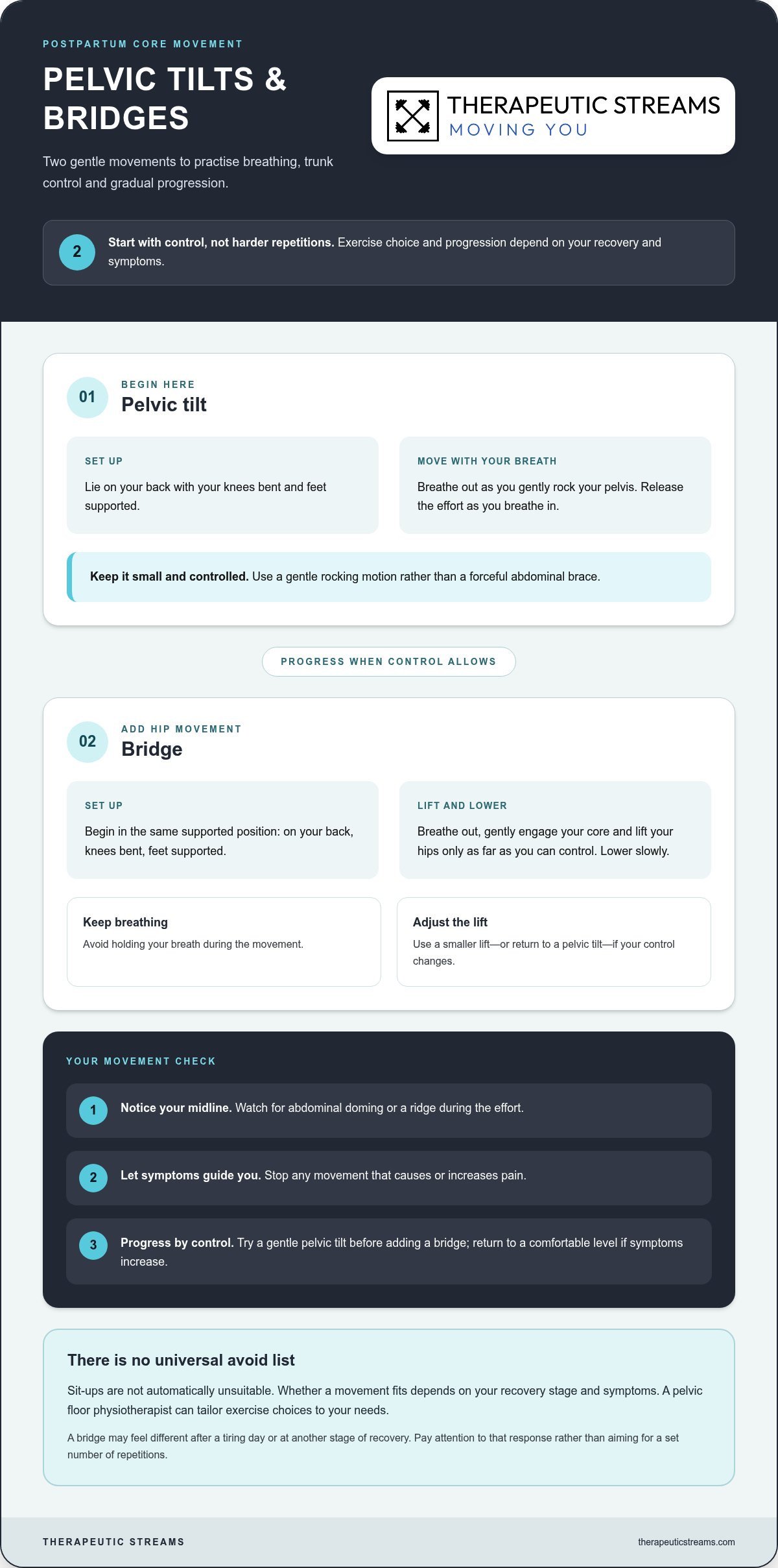
Pelvic tilts and bridge poses can be included in at-home programs to reinforce pelvic floor muscles. They also let you practise coordinating your trunk, pelvis, and breathing before adding more demanding movement. A pelvic tilt uses a small, controlled rocking motion rather than a forceful abdominal brace. A bridge adds hip movement, so notice whether you can maintain control as your pelvis lifts and lowers.
Use movement quality, not a target number of repetitions, to judge whether an exercise suits you. For a pelvic tilt, lie on your back with knees bent and feet supported. Breathe out as you gently rock your pelvis, then release the effort as you breathe in. Keep the movement small. If your abdomen forms a ridge or you feel pain, reduce the effort or pause.
For a bridge, begin in the same supported position. Breathe out, gently engage your core, and lift your hips only as far as you can control. Lower slowly without holding your breath. A bridge may feel manageable while lying down but harder after a tiring day or at a different recovery stage. Notice that response when deciding how to progress.
- Keep breathing: Let your breath flow during each pelvic tilt or bridge.
- Watch your midline: Notice whether your abdomen domes during the effort.
- Adjust the movement: Use a smaller lift or return to a pelvic tilt if control changes.
- Stop for pain: Don’t continue an exercise that causes or increases discomfort.
Pelvic organ prolapse also matters when choosing pelvic floor exercises. If you have a prolapse diagnosis or symptoms that concern you, don’t assume pelvic tilts or bridges are a complete treatment plan. A pelvic floor physiotherapist can assess function and tailor exercises to whether your muscles need strengthening, relaxation, or better coordination. This connects each movement to your assessment rather than a generic routine.
Progression should follow control. For example, practise a gentle pelvic tilt before adding a bridge, then observe how the movement feels during ordinary tasks such as standing from a chair. If symptoms increase, return to a comfortable level and seek individualized guidance. Pelvic floor physiotherapy support can help you adapt exercises to your recovery and pelvic health needs.
An initial pelvic floor physiotherapy assessment may evaluate muscle function using external and internal methods. A pelvic floor physiotherapist may use an internal examination to assess weakness, increased tension, or other dysfunction. Findings can help guide manual techniques for muscle tension or exercises for weak muscles.
Biofeedback and electrical stimulation may be used in pelvic floor physiotherapy as part of a treatment plan. Maintaining pelvic health after therapy may involve continuing pelvic floor exercises, maintaining comfortable posture, and following a balanced diet.
Breathwork and functional movement
Breathing gives your core a starting point before you add movement. Begin with a comfortable inhale, then breathe out as you gently engage your abdominal muscles. Aim for coordinated effort, not a hard brace or holding your breath through every task. Practise lying down or sitting, then notice whether you can keep breathing easily as you stand.
Progress gradually from controlled breathing to familiar activities. For example, breathe out as you rise from a chair, lift a light laundry basket, or climb stairs. These tasks involve your trunk as part of a whole-body movement. Keep your movement smooth and notice whether your abdomen pushes forward or forms a ridge. That response can guide adjustments to your effort or range of motion.
Core control also matters during activities that increase abdominal pressure. Try to avoid straining during bowel movements, and address constipation as part of managing pressure. During a strenuous task, such as lifting a full basket, breathe steadily rather than bearing down. Small changes in how you breathe and move can help you manage everyday demands as you rebuild coordination.
- Standing from a chair: Breathe out as you rise, keeping your movement controlled.
- Lifting laundry: Keep the basket close and breathe through the effort.
- Climbing stairs: Use a natural breath instead of bracing or holding it.
- Bowel movements: Avoid straining, which can increase pressure through your abdomen.
Progress according to your control, symptoms, and recovery stage. A movement that feels manageable while lying down may feel different when you stand or carry something. If your abdomen domes, reduce the task’s demand or return to a simpler movement. Sit-ups aren’t automatically unsuitable for everyone with diastasis recti; their suitability depends on recovery stage and the separation. Choose control over a fixed exercise label.
Breathwork can help you coordinate your pelvic floor with your abdominal wall. Don’t treat every core exercise as a pelvic floor squeeze. Some people need to strengthen these muscles, while others need to release excess tension or improve timing. A physiotherapist can observe how your breathing and trunk respond during movement, then adapt the task to your needs.
Use daily activities as practice, not as a strength test. For instance, break a heavy load into smaller carries, exhale during effort, and pause if you lose control. As coordination improves, a physiotherapist may progress the movement or add challenge. This gradual approach builds from breathing to functional tasks, with each step guided by your body’s response.
Diastasis recti and abdominal muscle separation
Diastasis recti involves widening between the left and right abdominal muscles. The gap alone doesn’t describe how your trunk functions during everyday movement.
Understanding abdominal muscle separation
During pregnancy, the abdominal muscles can separate along the midline as the abdomen expands. You may notice a ridge or bulge when straining or contracting your abdominal muscles. Low back pain, incontinence, or a feeling of trunk weakness can also occur with diastasis recti. Consider how these signs affect daily activities, such as carrying groceries or changing positions, rather than judging recovery by appearance alone.
Checking for separation at home
To check at home, observe your abdomen during a gentle contraction while lying comfortably, such as during a small head lift. Look for a ridge along the midline, and stop if the movement causes pain. This can help you describe what you notice, but it can’t establish the full extent of the separation. Note when the bulge appears, such as during coughing or getting out of bed, and share those examples during an assessment.
Physiotherapy can address abdominal separation with a plan tailored to your assessment. Treatment may include targeted exercises, manual therapy, and lifestyle advice. The physiotherapist can relate your concerns to daily activities and adapt the plan as your movement changes. Explain, for example, whether lifting a child feels different from carrying a light bag. Specific examples help connect treatment goals with your routine.
Pelvic floor function can also be considered alongside abdominal movement. A physiotherapist may assess pelvic floor muscles externally or, with your consent, through an internal examination. Findings can guide whether your plan focuses on strengthening, relaxing, or coordination. This matters because an exercise that suits one person may not address another person’s muscle function or symptoms.
An at-home check or exercise assessment can’t determine whether surgery is recommended or identify procedure-specific risks. A surgical consultation is the appropriate setting to discuss your symptoms, goals, possible procedures, risks, and recovery considerations. Bring notes about activities that feel difficult and questions about how each option relates to your priorities.
Use your observations as information, not a verdict. If an activity brings on a bulge, discomfort, or a change in control, note what you were doing and how your body responded. That detail can make a clinical assessment more useful and clarify which movements need attention. Don’t treat the size of a visible gap as the only measure of progress; consider how comfortably you manage the activities that matter to you.
Postpartum recovery start times
Postnatal rehabilitation timing depends partly on birth and recovery. For an uncomplicated vaginal birth, the recommended starting point is 2 to 3 weeks postpartum. After a second-degree tear or more, the suggested timeframe is 4 to 6 weeks postpartum. After a C-section, the recommendation is 6 weeks.
These timelines describe when to consider postnatal rehabilitation, not automatic clearance for strenuous exercise. Start by noticing how basic activities feel, such as walking, getting out of bed, or caring for your baby. Early recovery work can focus on comfortable breathing and gentle movement instead of demanding abdominal exercises. Pain, increased bleeding, or difficulty with daily movement should guide your activity choices.
After an uncomplicated vaginal birth, the 2 to 3 weeks postpartum timeframe offers a reference point for beginning rehabilitation. That doesn’t mean jumping into sit-ups or strenuous workouts. Rehabilitation may begin with learning to coordinate breathing and gentle core engagement, then observing your response. A short walk across the room or a controlled position change can offer useful feedback before adding effort.
After a second-degree tear or more, the suggested timeframe is 4 to 6 weeks postpartum. Following a C-section, the recommendation is 6 weeks. These timelines reflect different recovery circumstances, so don’t use one birth experience as a guide for another. As you return to activity, consider the movement’s demands, your comfort, and whether symptoms change during or afterwards.
How long diastasis recti exercise treatment takes depends on your symptoms, abdominal control, pelvic floor function, and how your plan progresses. Treatment may change as you build coordination and return to tasks such as lifting or carrying. Progress is measured by function and symptom response, not a fixed date or the appearance of the abdominal gap alone.
A practical way to approach recovery is to progress by task:
- Begin gently: Use comfortable breathing and movements that don’t increase symptoms.
- Observe your response: Notice how walking, standing, and caring for your baby feel during and afterwards.
- Build gradually: Add more demanding activity as control and comfort allow.
- Adjust when needed: Stop a movement that causes or increases pain, and revisit its demands.
For example, if standing from a chair feels controlled but lifting a car seat causes discomfort, keep practising the easier task while adapting the lift. A pelvic health physiotherapist can assess your recovery and tailor exercise progression to your birth history, symptoms, and daily goals. Explore postpartum rehabilitation support to take a guided next step.
Diastasis recti is common during pregnancy, and the gap closes on its own in many postpartum women. Natural closure is one possible part of postpartum recovery, not a promise that every gap will close without support or on the same schedule.
Therapeutic Streams Sport Rehab: Chiropractic Care
Therapeutic Streams Sport Rehab can help you connect postpartum movement concerns with appropriate care. If back discomfort or movement limits accompany abdominal separation, Chiropractic Care may address related musculoskeletal concerns, while Physiotherapy and Pelvic Floor Physiotherapy can support movement assessment and exercise planning. The focus is your symptoms, function, and recovery goals, not simply the appearance of your abdomen.
Consider an assessment if daily tasks remain difficult, symptoms affect your activity, or you need help progressing core exercises. A personalized plan can help you understand which movements suit your needs and how to adapt them as recovery changes.
Contact Therapeutic Streams Sport Rehab to discuss your next step.
Take your next recovery step
Your next step can be a conversation about the movements and activities you want to return to. If you’re considering diastasis recti repair exercises in Oshawa, bring your questions and describe how recovery affects your day. Your goals can help guide a plan that fits your life, whether you’re lifting your child, returning to work, or rebuilding confidence in exercise.
Therapeutic Streams offers Chiropractic Care, Physiotherapy, and Pelvic Floor Physiotherapy in Whitby, serving people in Oshawa, Bowmanville, and Ajax. These services are options to discuss when abdominal separation concerns overlap with movement or pelvic health needs. Care is shaped around your concerns and practical goals.
Choose a next step that feels manageable. Contact Therapeutic Streams Sport Rehab to start a conversation about your recovery. You can move forward with care, clarity, and a plan that supports your return to everyday activity.
Frequently Asked Questions
What exercises are safe and effective for diastasis recti repair?
There’s no single exercise sequence that suits every recovery. Exercise selection can account for range, speed, and load, along with the activity you’re preparing for. Reaching overhead without a load differs from reaching while holding a child. A useful program considers those changing demands, so practice prepares you for real activities rather than focusing only on repetitions.
When should you start diastasis recti exercises after pregnancy or surgery?
Separate the decision to begin gentle rehabilitation from the decision to resume strenuous training. These are different steps, and the next one depends on your recovery and the activity you hope to return to. After surgery, follow the progression specific to that procedure rather than assuming postpartum exercise timing applies. In either case, plan a gradual return that matches your current activity demands.
Are there pelvic floor physiotherapists in Oshawa who treat diastasis recti?
Yes, pelvic floor physiotherapy in Oshawa can assess abdominal separation and help tailor an exercise program. Treatment may include targeted exercises, manual therapy, lifestyle advice, biofeedback, or electrical stimulation, depending on the treatment plan. Biofeedback can help you observe muscle activity during practice. These options can support a plan addressing pelvic floor and abdominal concerns together.
What are the costs of diastasis recti physiotherapy in Oshawa?
This FAQ addresses treatment choices, not billing details. To clarify the clinical focus of an appointment, consider whether you want abdominal separation assessed, pelvic floor function reviewed, or both. Note the daily movements you hope to manage more comfortably. This information helps frame a useful discussion about your care needs without assuming every appointment follows the same format.