Shockwave Therapy Whitby: Your 2026 Guide to Treatment Options
Most chronic tendon issues require only three to five localized sessions of shockwave therapy whitby to achieve significant pain reduction and restored mobility. Shockwave therapy delivers high-energy acoustic waves directly to injured soft tissue to accelerate cellular repair and break down recalcitrant scar tissue. Our practitioners use focused clinical assessment to target stubborn discomfort and restore your active lifestyle.
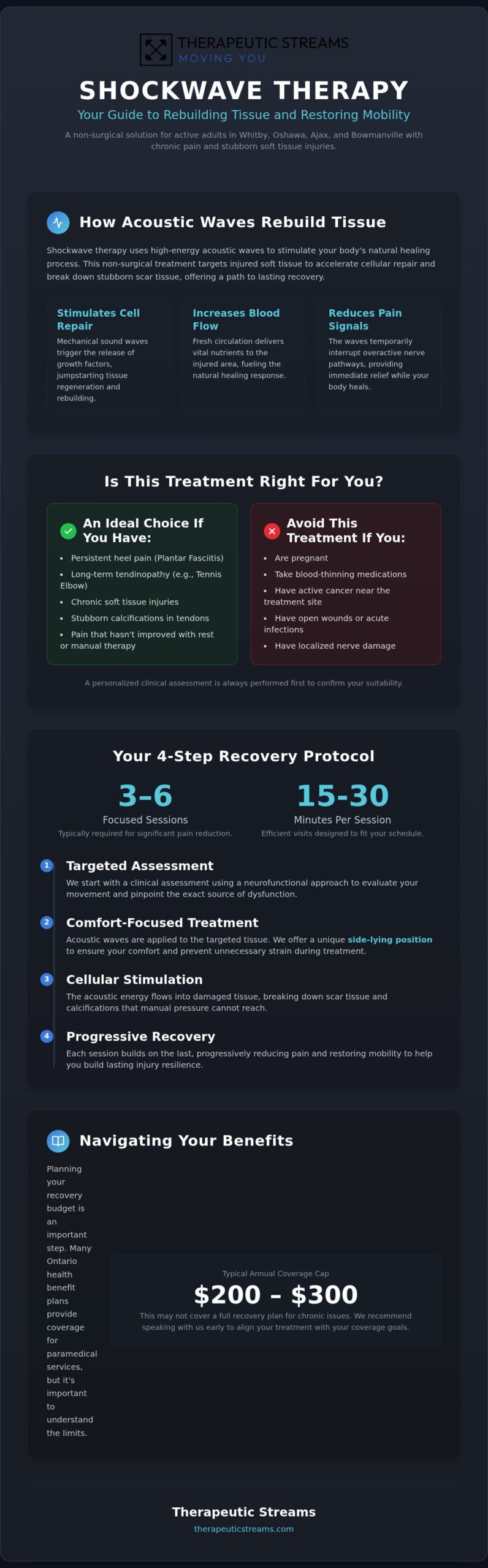
Key Takeaways: Shockwave therapy in Whitby uses acoustic waves to trigger cellular repair in chronic tendons, typically requiring three to six 15-minute sessions for recovery.
- Most chronic tendon conditions achieve significant pain reduction within 3 to 5 localized sessions.
- Avoid this treatment if you are pregnant, take blood thinners, or have active cancer.
- Best for active adults with persistent heel pain or calcifications that manual therapy cannot reach.
- Ontario health benefits often cap at $200–300 yearly, which may not cover full recovery.
Your pain level points you to gentle hands-on care or acoustic waves
Your pain severity directly guides whether non-surgical (non-invasive) care should begin with gentle manual therapy or targeted acoustic waves. Acute discomfort often responds best to light hands-on care, whereas stubborn conditions need deeper stimulation. Gentle mobilization calms freshly inflamed tissues safely.
Typical paths we see in clinic:
- Fresh, reactive soreness after a new strain: start with light hands-on care so inflamed tissue can settle before stronger input.
- Persistent heel pain (plantar fasciitis) or long-term tendinopathy that no longer shifts with rest: move to advanced acoustic treatments that break down dense scar tissue and restart stalled repair.
- Benefits capped near $200–300 yearly for rehab: plan the sequence early so each visit advances healing instead of exhausting coverage on care that cannot reach deeper tissue.
Persistent discomfort needs a firmer approach to trigger healing, much as a sudden spring thaw breaks up stubborn river ice. Choosing targeted acoustic treatment helps break down dense scar tissue and jumpstart stalled recovery when lighter care stalls. More on this: Shockwave Therapy in Whitby.
Reserve a 15-minute complimentary strategy session. Our multidisciplinary team performs a clinical assessment to pinpoint your exact stage of healing and crafts personalized treatment plans using a neurofunctional approach so you can rebuild injury resilience. If your benefits plan provides $200–300 yearly for rehab, that total is rarely enough to resolve long-term soft tissue injuries completely, so speak with us early to align coverage with your recovery goals.
Shockwave therapy whitby rebuilds tissue through targeted acoustic waves
Shockwave therapy delivers high-energy sound pulses directly to affected tendons and muscles, triggering rapid cellular repair and reducing chronic discomfort.
This non-surgical process relies on mechanotransduction: mechanical sound waves stimulate your body to release growth factors. These acoustic waves travel deep into injured tissues, break down calcified deposits, release tight muscles (muscle tension), and increase blood flow to stubborn areas. Fresh circulation brings vital nutrients that jumpstart your natural healing response.
Targeted waves temporarily interrupt pain signals along local nerve pathways. By calming these overactive nerves, acoustic energy offers immediate relief while your body rebuilds stronger tissue. A clinical assessment ensures we direct every pulse with precision. Choosing a targeted treatment plan over temporary home remedies helps build lasting injury resilience. Our clinic combines advanced technology with a compassionate, neurofunctional approach so you receive precise care. For broader rehab context, explore our advanced sports recovery guide.
Tip: Prioritize a neurofunctional approach during your clinical assessment to ensure acoustic waves target the exact site of tissue dysfunction.
Chronic heel pain and stubborn tendons respond when acoustic care fits your profile
You can benefit from shockwave therapy if you suffer from soft tissue injuries or persistent heel pain.
Acoustic waves offer a strong non-surgical route to jumpstart healing in stagnant, chronic conditions. This targeted technology breaks down stubborn calcifications and promotes rapid blood flow straight to damaged areas.
Postural imbalances often create hidden mechanical stress that keeps soft tissue inflamed long after an initial injury. Addressing these alignment shifts alongside local shockwave care prevents recurring strain. Active adults, runners, and office workers across Whitby, Oshawa, and Ajax frequently find relief through this approach. You might also integrate visits with massage therapy to keep surrounding tissues pliable and relaxed.
This treatment is not suitable for everyone. You must avoid acoustic wave applications if you are pregnant, take blood thinners, or have active cancer near the targeted site. Open wounds, acute infections, and localized nerve damage also serve as clear contraindications.
A personalized clinical assessment always comes first to confirm your suitability. Our dedicated practitioners advocate for your health and align every session with your recovery goals. Book a no-cost 15-minute appointment to start your path toward lasting comfort.
Your 4-step protocol delivers three to six focused visits
Your non-surgical treatment plan typically requires three to six visits, with each session lasting fifteen to thirty minutes.
In our clinical practice, therapeutic positioning improves patient outcomes during acoustic care. Resting on a treatment table lets your body relax completely. We offer side-lying positions for patient comfort during application, which prevents unnecessary strain on your spine. Acoustic energy then flows into damaged tissue to stimulate natural cell repair.
- Targeted Assessment: We evaluate your movement and locate precise trigger points.
- Gel Application: A conductive gel goes on your skin to transfer sound waves smoothly.
- Acoustic Delivery: The therapist applies acoustic waves to reduce heel pain.
- Integration: We combine care with a Swedish massage session to calm tight muscles.
Targeted acoustic sessions fit active individuals who need rapid tissue recovery without medication downtime. If you worry that sound wave application might feel overwhelming, our therapists adjust the intensity instantly for your comfort. Claim your complimentary 15-minute session and begin your recovery.
Acoustic waves reach calcifications that manual pressure cannot
Shockwave therapy (a non-invasive modality using acoustic waves) targets chronic tissue problems directly where manual pressure cannot reach.
Hands-on manual techniques clear surface strain quickly, yet stubborn calcifications require deeper mechanical waves to break down. Targeted acoustic energy stimulates rapid cellular repairs in persistent injuries. Soft tissue work reduces superficial muscle tension (tightness or guarding) across broad areas. A neurofunctional approach using neurofunctional acupuncture targets specific nerve pathways to restore neurological communication across irritated segments.
| Modality | Primary Focus | Ideal Application |
|---|---|---|
| Shockwave Therapy | Chronic tendon remodeling | Deep micro-trauma and calcifications |
| Soft Tissue Work | Superficial muscle tension | Generalized soreness and stiffness |
| Neurofunctional Acupuncture | Nerve-muscle communication | Persistent neuromuscular firing issues |
When choosing your recovery path, soft tissue care fits generalized tightness, while targeted wave therapy suits calcified chronic tendons. Our clinical assessment evaluates your exact movement needs to build your personalized plan. Schedule a FREE 15 minute consultation.
Ontario benefits and direct billing stretch your Whitby rehab budget
Extended health benefits across Ontario typically cover shockwave therapy (a non-invasive treatment using acoustic waves) through physiotherapy or chiropractic provisions.
Checking your specific annual cap before starting care prevents unexpected out-of-pocket expenses. If you are dealing with heel pain, shin splints, or carpal tunnel, and your plan gives you $200–300 for the year, that amount is not enough to resolve the issue in a meaningful way. Clinics that combine treatments under a multidisciplinary approach help you stretch coverage further.
Situation: a long-standing soft tissue injury and a modest annual rehab maximum. Solution: we process claims directly for most private insurers, saving you administrative hassles, and for workplace injuries WSIB coverage pays for your clinical assessment and subsequent care plans without front costs. Numeric frame: plan around the $200–300 yearly band so sequenced visits support continuous healing rather than stopping mid-course.
Friendly front desk support and skilled hands create an inviting environment where financial planning and physical healing work together.
Details and inquiries: Therapeutic Streams Sport Rehab.
Frequently asked questions
What conditions can be treated?
Shockwave therapy (a non-invasive treatment using acoustic waves) addresses chronic soft tissue injuries like Achilles tendonitis and tennis elbow, plus heel pain, shoulder calcification, and stubborn sports injuries. Clinical trials demonstrate high success rates for stubborn tendon problems. Your therapist will conduct a clinical assessment to ensure it suits your injury. Standard insurance caps of $200–$300 annually may not fully cover complete care for severe conditions; we help you navigate coverage options for continuous healing.
Is it painful?
You will feel mild discomfort during the brief pulse delivery. People generally tolerate this sensation well, and your therapist adjusts the intensity to match your comfort level. Relief often follows as treatment progresses.
Does insurance cover shockwave therapy in Whitby?
Extended health benefits across Ontario typically cover shockwave therapy through physiotherapy or chiropractic provisions, and we process claims directly for most private insurers. For workplace injuries, WSIB coverage pays for your clinical assessment and subsequent care plans without front costs. Confirm your annual cap early, especially if it sits near $200–300, so your plan supports the full course you need.
Can I combine shockwave with massage or other care?
Yes. A neurofunctional, multidisciplinary plan can pair acoustic sessions with soft tissue work so surrounding tissues stay pliable while deeper waves address calcifications and chronic tendon changes. Your clinical assessment sets the sequence that matches your injury stage and coverage.
Who should avoid this treatment?
You must avoid acoustic wave applications if you are pregnant, take blood thinners, or have active cancer near the targeted site. Open wounds, acute infections, and localized nerve damage are also clear contraindications. A personalized clinical assessment confirms whether the approach suits you before care begins.
Begin Your Recovery Today
Three to five well-timed acoustic sessions, chosen after a clear pain-level decision, remain the practical path when chronic soft tissue injury no longer responds to lighter care. Our Therapeutic Streams Sport Rehab practitioners guide you past stubborn heel pain with precise acoustic waves. In 2026, we continue prioritizing tailored care plans that address root causes rather than temporary symptoms.
From clinical observations, restoring movement requires an assessment-first protocol tailored to your lifestyle. We blend advanced shockwave services with gentle care so you can rebuild long-term physical strength.
Are persistent soft tissue injuries limiting your active days? Connect with our team to discuss your goals and schedule your clinical assessment today.