
Chiropractor for Back Pain: A Step-by-Step Recovery Guide
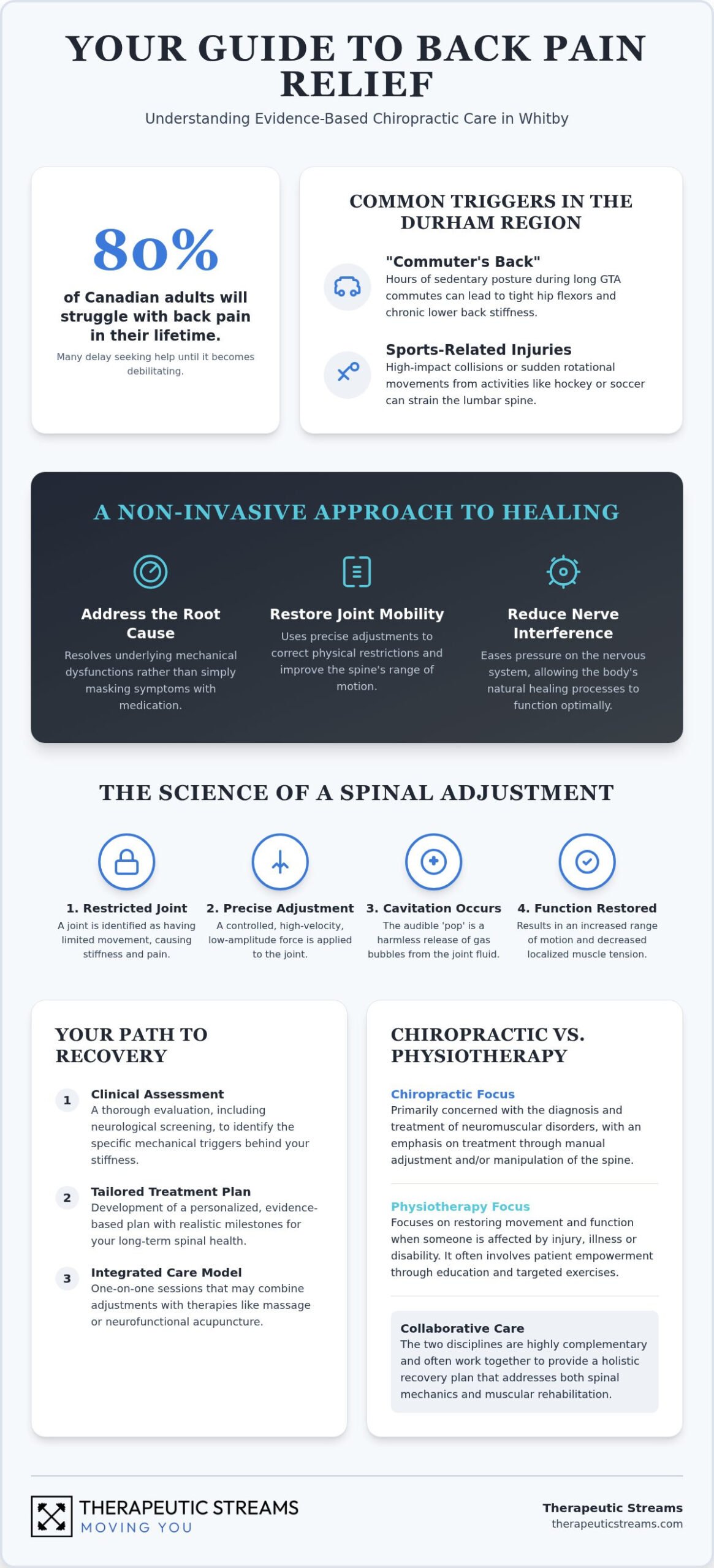
Did you know that 80 percent of Canadian adults will struggle with back pain at some point in their lives, yet many delay seeking help until the stiffness becomes debilitating? If you are currently waking up with a rigid lower back or worrying that your only options are invasive surgery and long-term medication, you aren’t alone. It’s frustrating to feel like your body is limiting your ability to enjoy your favourite sports or even simple daily activities in Whitby. Finding a qualified chiropractor for back pain is often the first step toward reclaiming your active lifestyle.
We understand the confusion that comes with choosing a rehabilitation provider, which is why we prioritize a transparent, research-driven approach. This guide will show you how evidence-based chiropractic care resolves underlying issues rather than just masking symptoms. You’ll learn the exact steps to take for a safer, faster recovery through a plan tailored to your specific needs. We will preview the clinical process, from the initial assessment to an integrated plan that combines adjustments with therapies like neurofunctional acupuncture or massage to ensure your long-term spinal health.
Key Takeaways
- Understand how a chiropractor for back pain acts as a regulated professional to restore the spine and nervous system, creating a stable foundation for movement.
- Learn how precise spinal adjustments facilitate a physiological response that improves joint range of motion while reducing persistent muscle tension.
- Distinguish between the specialized focuses of chiropractic care and physiotherapy to determine how these collaborative disciplines work together for your recovery.
- Gain a clear understanding of the clinical assessment process, including neurological screening, to identify the specific mechanical triggers behind your stiffness.
- Explore the benefits of our centre’s integrated, one-on-one treatment model that combines multiple clinical modalities to support long-term wellness in the Durham Region.
Why See a Chiropractor for Back Pain Relief?
A chiropractor for back pain is a highly regulated healthcare professional who specializes in the complex relationship between your spine, muscles, and nervous system. Think of this trio as the foundation of your entire movement system. When one element is compromised, the others inevitably suffer. Most persistent back pain originates from mechanical dysfunctions, which are physical restrictions or misalignments that manual therapy is specifically designed to correct. By choosing this drug-free and non-invasive path, you are opting to resolve the root cause of your discomfort rather than temporarily masking it with medication or facing the risks of invasive surgery.
Our approach focuses on the body’s natural ability to heal when structural barriers are removed. We look at the spine not just as a series of bones, but as the protective housing for your nervous system. When joints aren’t moving correctly, they can create localized inflammation and tension that radiates through the rest of the body. Professional chiropractic care aims to restore this balance, ensuring your musculoskeletal system operates as a cohesive unit.
Common Causes of Back Pain in Whitby and Durham
Living in the Durham Region presents unique physical challenges that often contribute to spinal stress. Long GTA commutes on the 401 or the GO Train are a primary culprit. These hours of sedentary posture often lead to “commuter’s back,” where hip flexors tighten and the lower back overcompensates, leading to chronic stiffness. We also frequently treat sports-related injuries from local hockey rinks and soccer fields, where high-impact collisions or sudden rotational movements can strain the lumbar spine. Even if your pain feels like simple age-related wear and tear, a thorough clinical assessment is vital to identify whether the issue is a joint restriction, a muscular imbalance, or a combination of both.
The Clinical Goal of Chiropractic Care
The primary objective of modern care is to restore optimal joint mobility and reduce nerve interference. One of the central tools used to achieve this is spinal manipulation, a precise technique that applies controlled force to specific joints to improve their function and range of motion. We define evidence-based care as the careful integration of clinical expertise with the most current peer-reviewed research. This ensures your treatment isn’t based on guesswork but on proven methodologies. Before any intervention begins, we conduct a personalized chiropractic care assessment to map out your recovery and set realistic milestones for your long-term spinal health.
How Chiropractic Adjustments Resolve Back Pain
When you visit a chiropractor for back pain, the most recognizable part of the treatment is the clinical adjustment. This procedure, formally known as spinal manipulation, involves a controlled and precise force applied to a specific joint that has become restricted in its movement. Chiropractic care for back pain focuses on restoring the natural mechanics of the vertebrae to ensure the spine can support your body weight effectively. The physiological response to this intervention is often immediate. Patients typically experience an increased range of motion and a significant decrease in localized muscle tension as the joint begins to move through its intended path.
Many people feel a sense of anxiety regarding the audible “popping” or “cracking” sound that sometimes accompanies an adjustment. It is helpful to understand that this sound is simply a release of gas bubbles, primarily nitrogen and carbon dioxide, from the synovial fluid within the joint. This process, known as cavitation, occurs because of a rapid change in pressure inside the joint capsule. It is not the sound of bones rubbing together or shifting out of place. While the sound can be surprising, it is a normal and painless byproduct of the treatment, though the true measure of success is the restoration of function rather than the volume of the release.
The Science of Spinal Manipulation
Spinal manipulation is a targeted technique used to restore joint play and optimize mechanoreceptor function within the spinal column. By correcting these mechanical restrictions, we reduce the physical load placed on surrounding soft tissues like ligaments and tendons. This structural shift also prompts the nervous system to dampen or “turn off” persistent pain signals, providing a neurological reset that facilitates a faster recovery. When the joints move correctly, the inflammation caused by friction and compensation begins to subside, allowing the body to enter a state of active healing.
Beyond the Adjustment: Soft Tissue and Mobilization
Modern practitioners realize that adjustments are only one tool in a comprehensive clinical kit. We frequently incorporate myofascial release to treat muscle knots and adhesions that may be contributing to your discomfort. For patients who are in an acute stage of pain or who prefer a gentler approach, we utilize low-force mobilization and therapeutic stretching to improve flexibility without the high-velocity thrust of a traditional adjustment. Our sports chiropractors often use these integrated tools to help athletes in the Durham Region maintain peak performance and prevent future injuries. If you are interested in exploring how an assessment-driven plan can address your specific stiffness, you can view our available clinical sessions to begin your journey toward better mobility.
When to Choose a Chiropractor vs. a Physiotherapist
Residents in the Durham Region often face a dilemma when deciding which professional is best suited for their recovery. While both are regulated healthcare providers in Ontario, their primary clinical focuses differ. A chiropractor for back pain typically prioritizes the mechanics of the spine and joints, looking at how structural alignment influences the nervous system. In contrast, a physiotherapist focuses on movement patterns, functional mobility, and the rehabilitation of the soft tissues that support those joints. Understanding when to see a chiropractor for back pain often depends on the nature of your symptoms. Sharp, localized joint pain that feels like a physical “blockage” often responds best to chiropractic intervention, while generalized muscle weakness or poor gait may require a physiotherapy-led approach.
Choosing an integrated clinic removes the guesswork for the patient. Instead of having to decide on your own, you benefit from a professional triage process where experts from both fields collaborate on your care. This ensures that whether your issue is a joint restriction, a muscular imbalance, or a combination of both, you receive the most effective modality at the right time.
Key Differences in Treatment Philosophy
Chiropractic care often utilizes a “top-down” neurological focus, emphasizing how spinal health dictates the body’s overall ability to process pain and move efficiently. Physiotherapy takes a functional approach, focusing on how the muscles, tendons, and ligaments coordinate to produce movement. Both disciplines are evidence-based and require extensive clinical training, but they tackle the problem from different angles. If you are unsure which starting point is right for your specific condition, reviewing a detailed chiropractor vs physiotherapist comparison can help you understand which philosophy aligns with your current recovery goals.
The Power of Collaborative Care
At Therapeutic Streams, we’ve found that the most successful recoveries happen when these professions work in tandem. Consider a scenario where a patient has a chronic lumbar issue. A chiropractor for back pain can perform a precise adjustment to restore mobility to a restricted joint. Once that joint is moving freely, a physiotherapist can immediately step in to prescribe targeted exercises that strengthen the supporting core muscles. This ensures the joint remains stable and reduces the likelihood of the pain recurring. When you add Registered Massage Therapy to this cycle to address chronic muscle guarding, you create a comprehensive healing environment that addresses the joint, the muscle, and the movement pattern simultaneously.
Your Step-by-Step Guide to Managing Back Pain
Recovery is rarely a single event; it is a methodical process that transitions you from acute discomfort back to your peak physical function. Choosing a chiropractor for back pain ensures that your journey follows a logical, clinically validated path. By breaking your recovery into manageable stages, we remove the anxiety of the unknown and replace it with a transparent plan for long-term health. This structured approach allows us to address the immediate pain while simultaneously building a foundation that prevents future relapses.
Step 1: Professional Assessment and Diagnosis
A thorough assessment is the most critical part of chiropractors in Whitby visits. During this initial meeting, you should provide a comprehensive health history and any available diagnostic imaging, such as X-rays or MRIs from previous consultations. We conduct a detailed neurological screening and postural analysis to rule out “red flags,” such as progressive muscle weakness or sensory changes that might indicate a more serious underlying condition. This investigative phase is essential for ensuring that every subsequent treatment is both safe and effective for your specific spinal mechanics.
Once the assessment is complete, we move into Step 2: Diagnosis and Education. We believe that an informed patient achieves better outcomes, so we take the time to explain the “why” behind your pain. Whether it is a disc-related issue or a joint restriction, understanding the root cause empowers you to participate actively in your healing. Step 3: The Treatment Phase then begins, where we combine precise spinal adjustments with active rehabilitation. This phase focuses on reducing inflammation and restoring the natural movement of your vertebrae.
Step 4: Empowering Your Home Recovery
Clinical sessions are only one part of the equation. What you do between appointments determines the speed of your progress. We focus on three actionable tips for maintaining a “back-safe” environment at your desk:
- Keep your feet flat on the floor to maintain a neutral pelvic position.
- Adjust your monitor height so the top third of the screen is at eye level, preventing postural strain.
- Utilize a lumbar support or a small rolled-up towel to preserve the natural curve of your lower back.
Incorporate simple daily movements, such as gentle pelvic tilts or walking breaks, to prevent joints from locking up during long periods of sitting. We also emphasize the role of core stability. Think of your core as a natural brace; when these muscles are engaged and strong, they absorb the mechanical stress that would otherwise fall on your spine. Finally, Step 5: Maintenance and Prevention helps you transition from pain relief to a state of wellness, where periodic check-ins ensure your spine remains resilient against the stresses of daily life. If you are ready to start this process, you can schedule your comprehensive assessment with our clinical team today.
Integrated Back Pain Care at Therapeutic Streams in Whitby
Choosing the right chiropractor for back pain involves more than finding someone to perform a quick adjustment. It requires a dedicated partner who understands the nuances of your lifestyle in the Durham Region. At Therapeutic Streams, we’ve built our practice around the philosophy that every patient deserves a personalized, assessment-driven plan. We’ve moved away from the high-volume, assembly-line model of care to prioritize one-on-one sessions. This ensures that your clinician has the time to listen, assess, and treat your specific mechanical issues with the precision they deserve.
Our Whitby location serves as a central hub for residents across Oshawa and Ajax, providing a professional environment where multiple disciplines converge. You won’t find our chiropractors working in a vacuum. Instead, they operate as part of a collaborative team, frequently consulting with our Registered Massage Therapists and Physiotherapists to ensure your recovery is comprehensive. This integrated model means that if your back pain requires a mix of joint mobilization, soft tissue work, and functional strengthening, all those services are available under one roof. This synergy allows us to address the “foundation” of your movement from every clinical angle.
Our Evidence-Based Chiropractic Methodology
We pride ourselves on a methodology that is rooted in clinical results and patient advocacy. Our “Empowering Expert” persona isn’t just a brand trait; it’s a daily commitment to your success. We use specialized tools, including neurofunctional acupuncture, to address the neurological components of pain that traditional adjustments might not reach. By treating the individual rather than just the symptom, we can identify why a specific movement pattern is failing and how to correct it for the long term. This evidence-informed approach ensures that every technique we use is backed by modern research and tailored to your unique musculoskeletal profile. We want you to feel like an informed participant in your own healing journey.
Booking Your Initial Assessment in Whitby
Starting your journey toward a pain-free life is simpler than you might think. In Ontario, you don’t need a referral from a medical doctor to see a chiropractor for back pain, which means you have direct access to professional spinal care whenever you realize you need it. We’ve streamlined our process to be as accessible as possible, offering a convenient online booking system that allows you to choose a time that fits your busy schedule. We invite you to join the Therapeutic Streams community and experience a higher standard of integrated health care. Your recovery is our priority, and we’re ready to act as your partner in reclaiming your mobility and wellness.
Take the First Step Toward a Pain-Free Lifestyle
Persistent back pain doesn’t have to be your daily reality. Throughout this guide, we’ve explored how evidence-based chiropractic care addresses the mechanical root causes of stiffness rather than just masking the discomfort. By choosing a chiropractor for back pain who prioritizes a thorough clinical assessment, you’re investing in a structured recovery that restores joint mobility and optimizes your nervous system. Whether your pain stems from a long GTA commute or a sports injury, an integrated approach ensures every facet of your musculoskeletal health is supported.
At Therapeutic Streams, we’re dedicated to your long-term success through personalized one-on-one treatment sessions. Our integrated team of Chiros, Physios, and RMTs works collaboratively to provide assessment-driven care that empowers you to move with confidence again. You don’t have to navigate this journey alone. Book Your Chiropractic Assessment at Therapeutic Streams in Whitby today to begin your transition from discomfort to wellness. Your body is resilient, and with the right evidence-based plan, you can return to the activities you love most with a renewed sense of vitality.
Frequently Asked Questions
Is it safe to see a chiropractor for lower back pain?
Yes, seeking a chiropractor for back pain is a safe and evidence-based choice for managing musculoskeletal issues. Serious complications from spinal manipulation are exceptionally rare, with research estimating the rate at approximately 1 in 1 million visits. Our practitioners conduct a thorough neurological and physical screening during your initial assessment to ensure that treatment is appropriate for your specific condition, prioritizing your safety and comfort at every stage of the recovery process.
How many sessions will I need before my back pain improves?
The number of sessions required depends entirely on your specific diagnosis, the duration of your symptoms, and your overall health goals. While many patients experience a noticeable reduction in pain and improved mobility within 4 to 6 sessions, chronic conditions may require a longer-term management plan. We provide a clear, assessment-driven timeline after your first visit so you know exactly what to expect as you transition from acute relief to functional wellness.
Do I need a doctor’s referral to see a chiropractor in Whitby?
You don’t need a medical doctor’s referral to book an appointment with a chiropractor in Ontario. Chiropractors are regulated, primary contact healthcare professionals, which means you can access our services directly. This allows for faster intervention and a quicker start to your recovery journey. While some specific insurance policies might request a note for reimbursement, the vast majority of residents in Whitby can self-refer without any external paperwork.
Does insurance cover chiropractic care for back pain in Ontario?
Chiropractic services are not covered by the Ontario Health Insurance Plan (OHIP), but they are covered by almost all extended health insurance plans. Since 80 percent of Ontarians rely on private coverage for these services, we recommend checking your specific workplace benefits. Most plans in the Durham Region provide an annual allotment for chiropractic care, making it an accessible option for those seeking a drug-free approach to managing persistent lower back stiffness.
What is the difference between a ‘crack’ and a clinical adjustment?
A “crack” is simply the audible release of gas from a joint, whereas a clinical adjustment is a precise, high-velocity, low-amplitude thrust designed to restore joint play. The sound itself, known as cavitation, is a harmless byproduct of pressure changes within the joint fluid. The true value lies in the adjustment’s ability to improve mechanoreceptor function and reduce muscle guarding, which are the primary clinical goals of your treatment session.
Can a chiropractor help with sciatica or radiating leg pain?
Yes, chiropractors are highly effective at managing sciatica and other types of radiating leg pain. These symptoms often stem from nerve root compression or irritation in the lumbar spine. By using targeted adjustments and soft tissue therapy, we can reduce the mechanical pressure on the affected nerves. This process helps decrease the “shooting” sensations and numbness, allowing you to return to daily activities with improved comfort and mobility.
Will I be sore after my first chiropractic treatment?
It is common to experience some mild muscle soreness or stiffness for 24 to 48 hours following your first adjustment. This sensation is very similar to the “good” soreness you might feel after starting a new exercise routine. It occurs because your body is adapting to improved joint alignment and the release of long-standing muscle tension. We typically recommend staying hydrated and performing gentle movements to help your system process these positive changes.
Can I see a chiropractor if I am also seeing a physiotherapist?
You can absolutely see both professionals concurrently, and in many cases, this integrated approach leads to superior results. At our Whitby centre, we encourage collaborative care where a chiropractor focuses on joint mechanics while a physiotherapist addresses functional movement and core strengthening. This ensures that every aspect of your spinal health is covered, from the foundation of the joint to the muscles that protect and move your body.