Does Insurance Cover Sports Rehab? Here’s the Truth Nobody Tells You
Does Insurance Cover Sports Rehab? Here’s the Truth Nobody Tells You
If you’ve ever typed this question into Google before booking an appointment, you’re not alone. It’s one of the most common questions we hear at the front desk — right before someone hands over their insurance card and hopes for the best.
The honest answer? It depends — but not in the vague, cover-my-tracks way that phrase usually implies. It depends on specific, knowable things: who you see, what your plan actually says in the fine print, and how realistic your expectations are about what a handful of covered sessions can actually accomplish.
I run a sports rehab clinic, and I want to walk you through what we actually see, day in and day out, when real patients try to use real insurance to get real results.
The Short Answer: It’s About the Provider, Not the Label "Sports Rehab"
Here’s the first misconception to clear up: "sports rehab" isn’t a job title, and it’s not a separate insurance category.
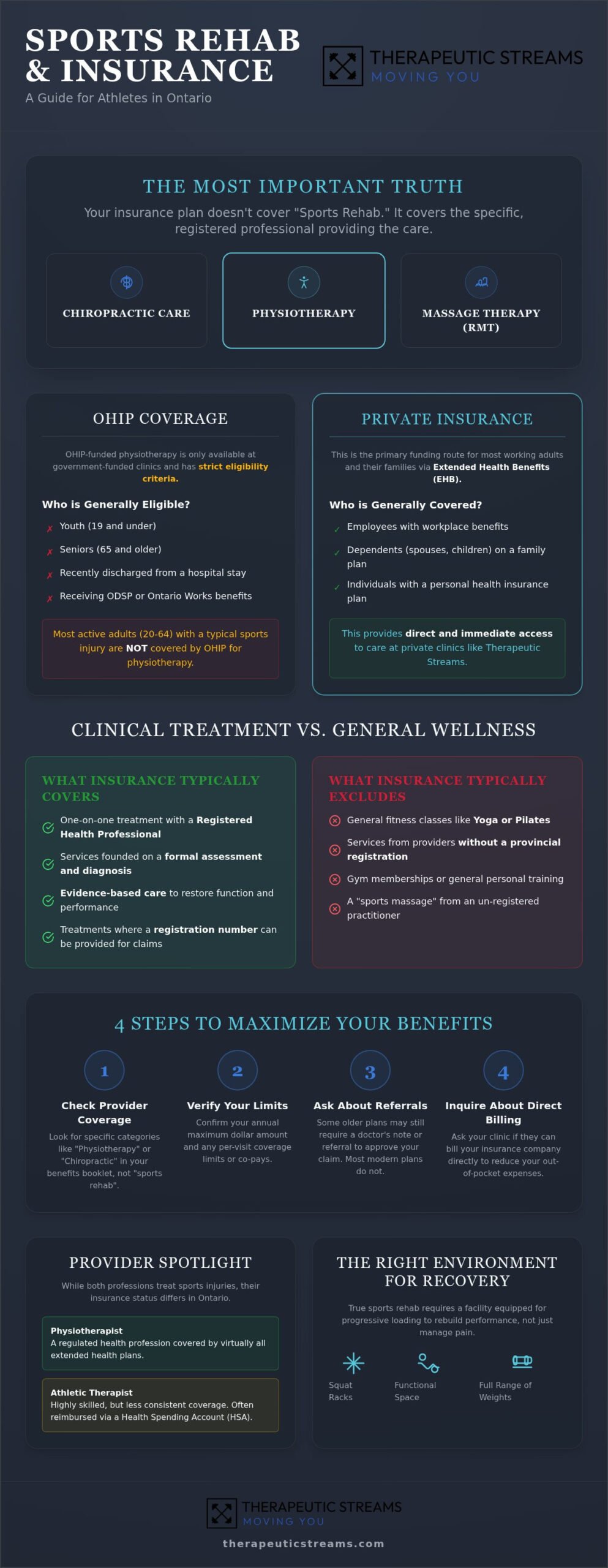
Most extended health benefits don’t have a line item called "sports rehab." What they cover is chiropractic care and physiotherapy care. Whether that care is sports rehab depends entirely on the practitioner — their training, their additional credentials, and honestly, their facility.
At our clinic, every practitioner — whether they’re a chiropractor or a physiotherapist — is trained in progressive exercise, loading protocols, and return-to-sport programming. That’s the actual skill set that makes rehab "sports rehab." It’s not the letters after someone’s name.
And it goes further than training. You genuinely can’t deliver real sports rehab without the right space. If a clinic doesn’t have a gym — squat racks, a real range of weights from 5 lbs up to 60+ lbs, room to move — they can’t progress an athlete or a weekend warrior past the basics. So when you’re evaluating whether a clinic can help you, the question isn’t "do they do sports rehab" — it’s "do they have the training and the equipment to actually build you back up, not just calm you down."
What this means for you: if your plan covers chiropractic or physiotherapy, it very likely covers sports rehab-style care — as long as you’re seeing the right practitioner in the right setting.
Where Insurance Falls Short: WSIB and Motor Vehicle Accident (MVA) Claims
If your injury is work-related (WSIB) or from a car accident (MVA), don’t assume the same rules apply. In our experience, these types of coverage rarely fund true sports rehab or performance-focused care.
WSIB and MVA coverage are built around acute and subacute care — the goal is pain management and getting you back to daily living, period. They’re not designed to get someone back to competitive sport or peak performance. If that’s your situation, it’s worth knowing upfront that you may need to look at extended health benefits, out-of-pocket options, or a hybrid approach once the acute phase is done.
A Real Example: What $500 in Coverage Actually Buys You
Let’s talk numbers, because this is where things get real.
We regularly see patients — often athletes — with only about $500 of coverage for the year for chiro or physio care. That typically works out to 4–5 sessions.
Here’s the problem: tissue takes time to change. Progressive loading — the actual process of rebuilding strength and resilience — routinely takes up to 12 weeks. Four or five sessions barely gets you past the six-week mark, let alone through a full rehab arc.
Compare that to a patient with $1,000+ in coverage. With that kind of runway, we can actually run a full three-stage protocol:
- Stage 1: Baseline assessment and pain reduction (if needed)
- Stage 2: Functional strategy work — strengthening the basics, building the foundation
- Stage 3: Advanced functional integration — putting it all together and pushing toward true performance-level recovery
That’s the difference between "starting rehab" and "finishing it."
Case in Point: How We Plan Around Limited Coverage
Say a patient — we’ll call her Julie — comes in and we already know her employer, her insurance carrier, and roughly what her max coverage looks like (this happens more than you’d think; certain employers and carriers come up again and again, and after years of doing this, we just know the patterns).
If Julie only has 4–5 sessions available, we don’t run the same plan we’d run for someone with a full year of coverage. We pre-plan around the clock. That might mean:
- Less time on manual/hands-on modalities
- More emphasis on self-care, stretching, and home exercises she can do without us
- A tighter, more targeted use of in-clinic time for the things she truly can’t do herself
It’s not the ideal plan. It’s the realistic plan. And knowing the difference — and being upfront about it — is part of what good rehab planning actually looks like.
The Conditions Where the Math Really Doesn’t Work
Some injuries are simply going to take longer than most people’s coverage lasts, no matter how you plan around it.
True tendinopathies — Achilles tendinopathy, tennis elbow, golfer’s elbow — are a great example. Done properly, rehabbing these conditions can take up to 12 weeks. Most insurance plans run out well before that.
In these cases, we typically see patients get creative: dipping into a spouse’s extended health benefits, stacking multiple smaller pots of coverage, or accepting that some portion of care will be paid out of pocket. It’s not a fun conversation, but it’s an honest one.
An Honest Opinion (With a Disclosure)
I’ll be upfront: I’m a chiropractor, so take this with a grain of salt — if I were a massage therapist, I’d probably be making the case that physiotherapy gets preferential treatment instead. But in my experience, insurance coverage does tend to lean toward physiotherapy over other paramedical professions.
More broadly, though, I think the real issue isn’t which profession gets favoured — it’s how thin some plans are relative to what real recovery costs. If you’re dealing with something like plantar fasciitis, shin splints, or carpal tunnel, and your plan gives you $200–300 for the year, that’s just not enough to meaningfully resolve the issue. It’s not a personal failing on the patient’s part, and it’s not usually the clinic’s fault either — it’s a structural gap.
I think it comes down to an economic decision employers are making, whether consciously or not: is paramedical coverage a checkbox benefit, or is it a genuine investment in employees’ physical health? The plans reflect which one a company chose.
What to Do Before Your First Appointment
If you’re about to book your first sports rehab appointment, here’s what I’d actually tell you to do:
- Shop around first. Not all clinics are the same, even if their websites and reviews look similar. Take advantage of a free consultation (ours is 15 minutes) to sit down with the practitioner, see the facility, and get a feel for how they work. Do they treat you personally, or hand you off? Do they use hands-on care, or just heat and stim in a room by yourself? You’ll learn more in 15 minutes in person than from any amount of scrolling.
- Call your insurance company before you book. Don’t assume "covered" means "fully covered." We’ve seen patients walk in thinking they have "100% coverage," only to discover in the fine print that it’s 100% coverage up to $20. If your assessment costs $120 and your plan covers "100% up to $20," you’re paying $100 out of pocket — and that’s not the clinic being misleading, that’s the policy being vague. Know your annual max, know if you need a doctor’s note, and know the actual dollar caps before you’re sitting in the waiting room.
- Remember that fit matters, both ways. Not every practitioner is right for every patient, and that’s normal. If a clinic or provider doesn’t feel like the right match after your consultation, that’s useful information — use it.
The Bottom Line
Sports rehab coverage isn’t a mystery once you know what to look for. It comes down to three things: who you see (their training and facility, not just their title), what your plan actually pays (read the fine print on caps and percentages), and how realistic your treatment plan is given the coverage you have.
Whether you’re a competitive athlete, a parent of a young athlete, a weekend warrior, or someone who’s been burned by a clinic or an insurance company before — the goal is the same: walk in informed, ask the right questions, and don’t assume "covered" means what you think it means.
You have more choice than you probably realize. Use it.
Have questions about your specific coverage or condition? Book a free 15-minute consultation — it’s one of the most underused resources patients have, and it costs you nothing to find out if we’re the right fit.
Frequently Asked Questions (FAQs)
Does Canada Life cover sports rehab at Therapeutic Streams?
Yes, Canada Life and most other major insurers cover the services we offer, provided your specific plan includes benefits for Physiotherapy, Chiropractic Care, and/or Registered Massage Therapy. We offer direct billing for Canada Life to simplify the process.
Is sports physiotherapy covered by OHIP for adults in Whitby?
No, sports physiotherapy for adults aged 20-64 is not covered by OHIP. OHIP-funded physiotherapy is only available at specific public clinics for individuals aged 19 and under, 65 and over, or those recently discharged from a hospital.
Do I need a doctor’s referral to use my insurance for massage therapy?
While you don’t need a referral to see an RMT in Ontario, some specific insurance plans may require one for reimbursement. It’s always best to check your policy booklet or online portal to confirm your plan’s requirements.
What is the difference between a Health Spending Account and regular benefits?
Regular benefits have set dollar amounts for specific services (e.g., $500 for physio). A Health Spending Account (HSA) is a flexible pool of funds that you can use for a wider range of Canada Revenue Agency-approved medical expenses, including topping up regular benefits or paying for services not otherwise covered.
Can I use my insurance for BikeFIT or concussion vestibular therapy?
Vestibular therapy for concussions is performed by a physiotherapist and is billed under your Physiotherapy benefits. A BikeFIT is a specialized assessment that is not typically covered by standard insurance but may be eligible for reimbursement through a Health Spending Account (HSA).
How does direct billing work at your Whitby sports injury clinic?
With your permission and insurance information, we submit your claim directly to your insurer online after your session. The insurer pays us their covered portion, and you are only responsible for paying the remaining balance out-of-pocket.
What happens if my insurance only covers a portion of the session fee?
You are responsible for paying the remaining portion of the fee at the time of your appointment. This is often called a "co-payment." For example, if the session fee is $100 and your plan covers 80%, you would pay the remaining $20.
Can I combine my chiropractic and physiotherapy benefits in one day?
Yes, you can absolutely have separate appointments with a chiropractor and a physiotherapist on the same day. Each service will be billed separately to its respective benefit category, allowing you to make efficient use of your time and coverage.