Sports Massage Treatment in Whitby: A 2026 Athlete’s Buying Guide
If you believe a sports massage treatment is simply a more intense version of a traditional spa day, you’re likely leaving significant performance gains on the table. For athletes across Whitby and the Durham Region, the line between a productive training cycle and a nagging overuse injury often comes down to how you manage your recovery. It’s frustrating to feel your progress stall because of persistent muscle soreness, especially when you’re unsure if your current therapy is actually addressing the root cause of the tension.
We recognize that you don’t just want to feel relaxed; you want to move better and train harder. This guide will help you navigate the 2026 landscape of clinical care so you can choose a sports massage treatment that prioritizes your biomechanical function and long-term musculoskeletal health. You’ll learn how to distinguish between general relaxation and assessment-based therapy, what specific credentials to look for in a local RMT, and how an integrated approach to recovery can help you reach your next athletic milestone with confidence.
Key Takeaways
- Learn why a clinical sports massage treatment is distinct from a relaxation session and how it specifically targets soft tissue to improve your range of motion.
- Understand why an assessment-first approach is essential for identifying the root cause of your muscle tension rather than just treating symptoms.
- Discover the physiological differences between pre-event and post-event sessions to strategically time your therapy for maximum athletic benefit.
- Gain clarity on the patient journey, from initial intake to personalized post-care advice, ensuring you feel comfortable and informed throughout your visit.
- Realize the performance advantages of an integrated care model where RMTs, physiotherapists, and chiropractors collaborate on your specific recovery plan.
Understanding Sports Massage Treatment: More Than Just a Rubdown
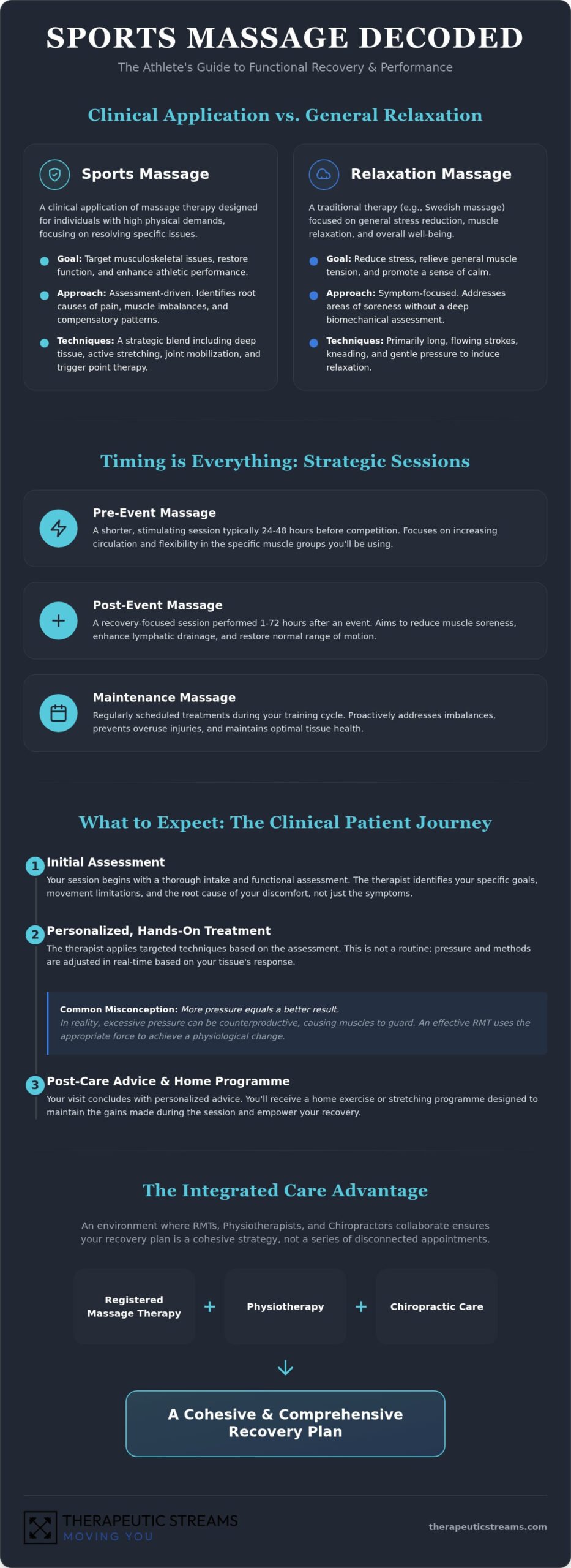
A sports massage treatment isn’t just an indulgence; it’s a critical component of your athletic toolkit. While a standard Swedish massage focuses on general stress reduction and relaxation, sports massage is a clinical application of massage therapy designed specifically for individuals with high physical demands. It targets the musculoskeletal system with precision, aiming to resolve specific issues caused by repetitive training or acute injury.
Physiologically, these sessions focus on improving the health of your soft tissues by increasing local circulation and enhancing lymphatic drainage. By incorporating various Manual Therapy Techniques, your therapist works to restore optimal range of motion and reduce the internal friction that leads to inflammation. This isn’t about general pampering; it’s about ensuring your body can withstand the rigours of your specific sport.
Sports Massage vs. Deep Tissue: What is the Difference?
Many athletes confuse deep tissue massage with sports massage, but they serve different purposes. Deep tissue is a specific technique used to reach the deeper layers of muscle and fascia. In contrast, a sports massage treatment is a comprehensive strategy that might include deep tissue work, but also incorporates active stretching, joint mobilization, and trigger point therapy.
There’s a common misconception that more pressure equals a better result. In a clinical setting, excessive pressure can actually cause your muscles to guard or seize up, which is counterproductive. An effective session uses the appropriate amount of force to achieve a physiological change without causing unnecessary trauma to the tissue.
The Role of the RMT in Your Athletic Recovery
In Ontario, the Registered Massage Therapist (RMT) designation is your guarantee of professional standards. RMTs are licensed by the College of Massage Therapists of Ontario (CMTO) and undergo extensive training in anatomy, physiology, and pathology. This education allows them to look beyond the surface of your pain.
Instead of just rubbing where it hurts, an RMT assesses your body for muscle imbalances and compensatory patterns. If your knee is sore, they might find the root cause in a tight hip or an immobile ankle. This high level of assessment-driven care is why we encourage athletes to understand the benefits of regular RMT in Durham. It’s about building a proactive plan for your long-term health rather than just reacting to pain.
Key Criteria for Choosing a Sports Massage Provider in Whitby
Selecting a provider in the Durham Region requires more than a quick search for the nearest clinic. Your sports massage treatment is a significant investment in your performance, and the value of that investment depends on the clinical philosophy of the centre you select. For athletes, the most critical factor is a commitment to one-on-one care. You should never feel like a number in a high-volume facility. Instead, look for a practice where the therapist remains in the room for the entire duration of your session to monitor your tissue response and adjust techniques in real-time.
The clinical environment also plays a vital role in your success. A facility that offers integrated services, such as physiotherapy and chiropractic care, provides a significant advantage. When your RMT can consult directly with your physiotherapist, your recovery plan becomes a cohesive strategy rather than a series of disconnected appointments. This collaborative approach ensures that every facet of your musculoskeletal health is being addressed with precision. If you are looking for a team that prioritizes this level of detail, you can explore our approach to athletic recovery at our Whitby location.
Vetting Your Therapist: Questions to Ask Before Booking
Before you commit to a session, ask specific questions to gauge the therapist’s expertise. Inquire if they have experience with your specific sport, whether that involves long-distance running or high-intensity interval training. A qualified professional should be prepared to provide a home exercise or stretching programme to maintain the gains made during the session. You should also ask how they track progress over multiple visits. A clinic that uses digital records to monitor your improvements shows a dedication to evidence-based results.
The Importance of Assessment-Driven Care
A high-quality sports massage treatment must begin with a thorough physical evaluation. We recommend looking for clinics that dedicate at least 15 minutes of the initial visit to functional movement screening. This process allows the therapist to identify “silent” issues, such as restricted joint mobility or muscle imbalances, before they escalate into training-ending injuries.
By using these assessments, therapists can tailor the pressure and technique to your specific needs. Clinical research on sports massage benefits confirms that this targeted approach is highly effective at reducing delayed onset muscle soreness (DOMS) and improving flexibility. By focusing on the root cause of your tension rather than just the symptoms, your therapist helps you maintain a clear path toward your long-term health goals.
Timing Your Treatment: Pre-Event, Post-Event, and Maintenance
Strategic timing is the cornerstone of a successful sports massage treatment plan. Booking a session without considering your training calendar is a missed opportunity to leverage physiological cycles for better results. For athletes in Whitby, the frequency of care should mirror the intensity of your training blocks. During heavy volume phases, maintenance sessions every two to four weeks help prevent minor tightness from evolving into a full-scale injury. In lighter phases, a monthly check-in is often sufficient to maintain tissue health and identify emerging imbalances.
Listening to your body’s signals is paramount for effective scheduling. If you notice a persistent heaviness in your limbs or a slight decrease in your usual range of motion, it’s time to schedule. Ignoring these early warning signs often leads to compensatory patterns that are much harder to correct later. A proactive approach ensures that your musculoskeletal system remains resilient throughout the entire season.
Pre-Event Massage: Preparing for Peak Performance
Pre-event sessions are about readiness, not repair. These treatments focus on stimulating blood flow and preparing the nervous system for high-intensity effort. Because the goal is to leave you feeling light and energized, the techniques used are typically faster and less invasive than a standard clinical session. We recommend a window of 24 to 48 hours before your competition. It’s vital to avoid deep, structural work during this time. Aggressive pressure can cause localized muscle soreness, which may temporarily decrease your power output and affect your psychological focus on game day.
Post-Event Recovery: Flushing Out Metabolic Waste
Post-event recovery focuses on down-regulating the nervous system and facilitating the removal of metabolic waste products. Intense physical exertion often leads to Delayed Onset Muscle Soreness (DOMS), which can peak two days after your event. Scheduling your sports massage treatment 24 to 72 hours after your finish line provides the best results for tissue repair. During this phase, your RMT uses rhythmic, flushing strokes to encourage lymphatic drainage and reduce inflammation. This proactive approach helps you return to your regular training schedule faster, ensuring you don’t lose precious momentum during your recovery week.
What to Expect During Your Sports Massage Session
Entering a professional rehab centre should feel like stepping into a partnership focused on your athletic success. At our Whitby facility, your sports massage treatment is designed as a collaborative process where your input is as valuable as our clinical expertise. It is common to feel a bit of anxiety regarding what to wear or how much pressure to expect. We recommend wearing comfortable athletic shorts or a tank top, as this allows for the movement assessments and active techniques that define a clinical session. You’ll find the atmosphere is professional and outcome-oriented, mirroring the high standards of the athletes we serve.
Step 1: The Clinical Assessment
We begin with a thorough discussion of your injury history, current training volume, and specific pain points. This isn’t just paperwork; it is the foundation of your care plan. Your therapist performs a postural analysis and range of motion testing to see how your body moves in real-time. Orthopaedic testing is a tool for identifying specific tissue pathologies. By isolating different structures, we can determine whether your discomfort stems from a muscle strain, a ligament issue, or a joint restriction.
Step 2: The Treatment Phase
The application of a sports massage treatment involves more than static pressure. We apply targeted techniques like trigger point therapy and myofascial release to address the specific restrictions identified in your assessment. Feedback is essential during this phase. We need to know if the pressure feels productive or if it causes you to hold your breath. To maximize results, we often integrate active stretching or muscle activation. This helps re-educate your nervous system and improves how your muscles function during your next training session.
Step 3: Post-Treatment Recommendations
Your recovery continues after you leave the table. We provide specific hydration advice and explain what you might feel in the 24 hours following your session. You may experience some mild lethargy or localized tenderness, which is a normal physiological response to deep tissue work. To maintain the gains made during the visit, we provide simple corrective exercises or a stretching programme tailored to your findings. We’ll also discuss a follow-up schedule that aligns with your upcoming races or training blocks. If you are ready to experience this level of clinical care, you can book your sports massage session in Whitby today.
The Therapeutic Streams Advantage: Integrated Sports Rehab in Whitby
Choosing a sports massage treatment at a multidisciplinary clinic offers a level of continuity that standalone studios cannot provide. At Therapeutic Streams, our RMTs don’t operate in a vacuum. They work alongside our physiotherapists and chiropractors to ensure your recovery plan is cohesive and goal-oriented. This integrated approach means that if a soft tissue restriction is rooted in a joint alignment issue, your therapist can consult with a colleague immediately to adjust your care pathway.
Having all your rehab records in one clinical centre eliminates the frustration of repeating your history to multiple providers. It allows for a unified assessment where every specialist is working toward the same performance outcomes. This results-driven model is designed specifically for Durham athletes who require efficient, evidence-based care to stay at the top of their game.
Beyond Massage: Chiropractic and Physiotherapy Integration
A chiropractic adjustment can often complement soft tissue work by addressing the structural alignment that allows your muscles to function with less effort. For a deeper look at how these disciplines overlap, read our Whitby chiropractic care guide. While a sports massage treatment is excellent for maintenance, there are times when you may need to transition to physiotherapy for more intensive injury rehab. Our team helps you navigate these transitions, ensuring you’re always receiving the most appropriate modality for your current state of recovery.
Supporting the Whitby and Oshawa Athletic Community
We’ve spent years supporting the Whitby and Oshawa athletic community, from local hockey and soccer clubs to dedicated running groups. We understand the specific rigours of Durham Region sports, whether you’re navigating the trails at Heber Down or the explosive requirements of competitive ice sports. Each treatment is tailored to the biomechanical needs of your discipline, focusing on the specific muscle groups you rely on most. If you’re ready to experience a more sophisticated standard of recovery, book your sports massage assessment in Whitby today.
Elevate Your Athletic Recovery in the Durham Region
Investing in a clinical sports massage treatment is a strategic decision that separates high-performing athletes from those who struggle with recurring setbacks. By prioritizing assessment-driven care and timing your sessions to align with your training phases, you’re not just managing pain; you’re actively enhancing your body’s resilience. You now understand that true recovery involves more than just deep pressure; it requires a collaborative approach that addresses the root cause of your physical restrictions.
At our integrated clinic, our Registered Massage Therapists are licensed by the CMTO and work alongside a multi-disciplinary team to ensure your health plan is seamless. We’ve made it easy for you to prioritize your wellness with online booking and direct billing options available. It is time to move past temporary fixes and embrace a long-term plan for your musculoskeletal health. We invite you to book your clinical sports massage assessment in Whitby and take the first step toward your most successful season yet. Your body has the potential to thrive; we’re here to provide the professional expertise to help you get there.
Frequently Asked Questions
Is sports massage treatment painful?
No, a clinical session should not be painful, though you may feel what athletes often call “productive discomfort.” During trigger point therapy or myofascial release, you might experience some intensity as restricted tissues begin to release. Our RMTs prioritize constant communication to ensure the pressure remains within your tolerance, as causing you to tense up would be counterproductive to your recovery goals.
How is sports massage different from a regular RMT massage?
The primary difference lies in the clinical, assessment-driven focus of the session. While a traditional RMT massage often prioritizes general relaxation and stress reduction, a sports massage treatment is specifically designed to address the physiological demands of your sport. It incorporates functional movement screens and targeted techniques to improve biomechanical efficiency and resolve specific muscle imbalances that could lead to injury.
How often should an athlete get a sports massage?
Most active individuals in the Durham Region benefit from a session every two to four weeks during their peak training blocks. This frequency helps manage the cumulative fatigue of high-volume workouts. If you’re in a maintenance or off-season phase, a monthly check-in is typically enough to maintain tissue health and catch minor issues before they escalate into persistent pain.
Will my extended health insurance cover sports massage in Ontario?
Yes, your sessions are typically covered if your policy includes Registered Massage Therapy. In Ontario, “sports massage” is a technique used by RMTs rather than a separate licence, so as long as your therapist is registered with the CMTO, it qualifies for reimbursement. We offer direct billing to many major insurance providers at our Whitby clinic to simplify your claims process.
What should I wear to a sports massage session?
We recommend wearing flexible athletic clothing, such as gym shorts and a tank top or sports bra. This attire allows your therapist to perform postural assessments and range of motion tests easily. It also facilitates the use of active stretching and movement-based techniques during the treatment phase, which are essential components of a clinical sports-focused session.
Can I workout immediately after a sports massage?
It is generally best to wait at least 24 hours before returning to high-intensity training or heavy lifting. Your muscles need time to recover from the manual manipulation and physiological changes induced during the session. Engaging in a light walk or gentle mobility work is encouraged, but avoid maximal efforts to ensure your body fully integrates the benefits of the treatment.
Is sports massage only for professional athletes?
No, this clinical approach is beneficial for anyone with an active lifestyle, including weekend warriors and hobbyists. Whether you’re training for your first 5K or playing in a local soccer league, your body faces repetitive stresses that can lead to imbalances. Anyone looking to optimize their movement and reduce the risk of overuse injuries can benefit from this targeted therapy.
Do I need a doctor’s referral for massage therapy in Whitby?
You don’t need a physician’s referral to book an appointment at our facility, as massage therapy is a direct-access health service in Ontario. You can book your assessment whenever you feel it’s necessary. However, you should check your specific insurance policy requirements, as some providers still ask for a referral to process your reimbursement claims successfully.