Chiropractors for Cyclist
What if the “wall” you hit during a steep climb isn’t a lack of cardiovascular fitness, but a biomechanical bottleneck in your hips or spine? Many riders across the Durham Region accept persistent lower back stiffness or that frustrating numbness in their hands as a mandatory tax for long days in the saddle. You shouldn’t have to realize your limits through pain or an asymmetrical pedal stroke that feels “blocked” no matter how much you train. When you examine the connection between cycling, chiropractic, Whitby sports medicine, and clinical assessment, you move from simply managing discomfort to mastering your performance.
We believe that a bike is only as efficient as the body operating it. You deserve a professional assessment that recognizes the unique postural demands of your discipline, whether you’re navigating technical trails or local road routes. This guide explores how specialized chiropractic care and integrated assessments like BikeFIT help you eliminate persistent pain and improve power output through better hip mobility. By focusing on your biomechanical efficiency and nervous system health, we’ll show you how to stay on the trails longer and achieve a truly pain-free ride.
Key Takeaways
- Learn how pelvic misalignment can lead to a functional leg length discrepancy, which sabotages your pedal stroke and causes persistent lower back stiffness.
- Understand why the technical terrain of the Durham Region necessitates a targeted approach to cycling, chiropractic, Whitby sports therapy, and performance optimization.
- Recognize the five specific physical indicators that suggest your body has reached a biomechanical bottleneck and requires a professional clinical assessment.
- Discover the value of an integrated sports rehab model that combines evidence-based adjustments with active strengthening to build long-term physical resilience.
- Explore how a specialized BikeFIT assessment aligns your body’s unique anatomy with your equipment to maximize power and eliminate numbness during long rides.
The Intersection of Cycling and Chiropractic Care in Whitby
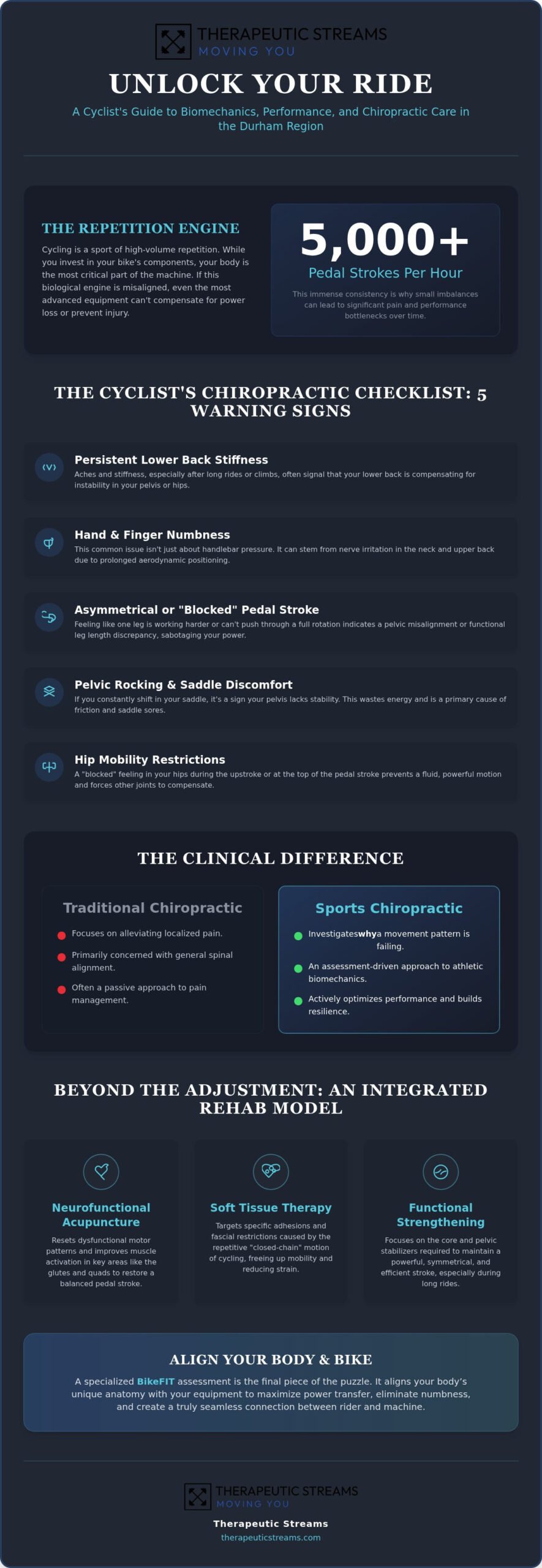
Cycling is a sport defined by high-volume repetition. Over the course of a single hour, an average rider may complete over 5,000 pedal strokes. This mechanical consistency is exactly why the synergy between cycling, chiropractic, Whitby sports therapy, and the rider’s unique anatomy is so vital. While many enthusiasts invest heavily in lightweight carbon frames or precision components, the body remains the most critical part of the cycling machine. If the biological engine is misaligned, even the most advanced bike cannot compensate for the resulting power loss or joint strain. We view the rider and the bicycle as a single, integrated system where the health of the musculoskeletal system dictates the efficiency of the ride.
Why Durham Region Cyclists Seek Specialized Care
The diverse landscape of the Durham Region offers everything from the steady cadences of the Waterfront Trail to the demanding, technical climbs of the north Durham hills. Each terrain profile places specific stresses on your body. Road cyclists often battle persistent stiffness in the thoracic spine from prolonged aerodynamic positioning, while mountain bikers deal with impact-related imbalances from technical descents. Local athletes frequently ignore these minor discomforts, realizing too late that a small pelvic tilt has evolved into a chronic hip issue. Seeking care at a dedicated sports injury clinic in Durham Region ensures these patterns are identified before they force you to shorten your season.
The Clinical Difference: Sports vs. Traditional Chiropractic
Traditional chiropractic care often focuses on spinal alignment to alleviate localized pain. In contrast, sports chiropractic is an assessment-driven approach to athletic biomechanics. We don’t just look at where it hurts; we investigate why the movement pattern is failing in the first place. This involves analyzing sports biomechanics to understand how force is transferred from your core through your hips and into the pedals. Our integrated model moves beyond the standard adjustment by incorporating advanced clinical modalities.
- Neurofunctional Acupuncture: This is used to reset dysfunctional motor patterns and improve muscle activation in the glutes and quads.
- Soft Tissue Therapy: We target the specific adhesions and fascia restrictions caused by the repetitive “closed-chain” motion of cycling.
- Functional Strengthening: We focus on the core and pelvic stabilizers required to maintain a powerful, symmetrical stroke during long durations.
This shift from passive pain management to active performance optimization is the core of our “Empowering Expert” philosophy. By educating you on your physical mechanics, we help you transition from simply managing discomfort to thriving on the trails. We want you to understand your body with the same precision you use to maintain your bike’s drivetrain.
Understanding the Cyclist’s Biomechanics: Why Alignment Matters
The bicycle is a fixed environment that demands your body adapt to its specific geometry. To achieve an efficient, aerodynamic profile, riders must maintain a posture defined by thoracic kyphosis (rounding of the upper back) and a forward pelvic tilt. While this position is excellent for reducing wind resistance, it creates a significant biomechanical challenge for the kinetic chain. If your joints cannot handle this sustained compression, your body will find the path of least resistance. This usually manifests as a functional leg length discrepancy, where a rotated pelvis makes one leg reach further than the other, resulting in an uneven and inefficient pedal stroke.
Understanding the synergy between cycling, chiropractic, Whitby sports performance, and your specific anatomy is the first step toward correcting these imbalances. When your alignment is optimized, the force you generate travels directly into the drivetrain rather than being absorbed by your lower back or knees. By addressing the “blocked” feeling in your hips, you can realize a more fluid movement that feels natural even during the final kilometres of a long ride.
The Role of the Pelvis in Pedal Stroke Efficiency
Your pelvis acts as the primary anchor for the powerful muscles of the lower body. If it lacks stability, you’ll likely experience “rocking” in the saddle, which wastes significant energy and causes friction-related discomfort. A sports chiropractor uses detailed assessments to identify pelvic rotations that cause one hip to sit higher than the other. Correcting these shifts ensures that your power output remains symmetrical and consistent. In many cases, we integrate this care with pelvic floor physiotherapy. This collaborative approach strengthens the deep stabilizers of the core, providing a solid foundation that prevents the pelvis from shifting under heavy loads.
Thoracic Mobility and Neck Comfort
Maintaining a low position on the handlebars requires significant extension of the neck so you can see the road ahead. If your mid-back is stiff, your cervical spine must overcompensate, often leading to the numbness or tingling many riders feel in their hands. Beyond comfort, thoracic mobility is a physiological necessity. A “locked” thoracic spine restricts the expansion of the rib cage, which directly limits your lung capacity. Clinical adjustments in this region improve breathing mechanics, allowing you to take deeper, more efficient breaths during high-intensity climbs. If you’ve noticed your performance plateauing or your recovery slowing down, a comprehensive biomechanical review at Therapeutic Streams can help identify the structural bottlenecks holding you back.
The Cyclist’s Chiropractic Checklist: 5 Warning Signs to Watch For
Pain is often a lagging indicator of physical dysfunction. By the time you feel a sharp ache in your lower back during a climb, your body has likely been compensating for structural imbalances for weeks. To stay on the trails longer, you must realize that a lack of pain does not necessarily mean you are moving with optimal efficiency. This self-assessment framework helps you identify biomechanical bottlenecks before they become season-ending injuries. Integrating the principles of cycling, chiropractic, Whitby sports medicine, and proactive assessment allows you to focus on “pre-hab” rather than reactive recovery.
Sign 1: Unilateral Fatigue or “One-Sided” Soreness
If you finish a ride and notice that your left quad is significantly more fatigued than your right, or that one side of your lower back feels “tighter,” you are likely experiencing a pelvic shift. This asymmetry means one side of your body is doing more work to maintain the same power output, which leads to premature exhaustion and potential strain. These persistent imbalances are a primary reason to consult chiropractors in Whitby. A clinical adjustment can restore symmetry to the musculoskeletal system, ensuring your force is distributed evenly across both pedals.
Sign 2: Persistent Knee Tracking Issues
Watch your knees as you pedal during your next session. If one knee consistently “dives” inward toward the top tube at the top of the stroke, the issue often stems from the sacroiliac (SI) joint or hip stabilizers rather than the bike itself. When the pelvis is misaligned, it alters the tracking of the entire lower limb, placing undue stress on the knee ligaments. Many riders attempt to fix this by adjusting their pedal cleats, but this often just masks the underlying structural problem. A professional assessment identifies whether the root cause is a structural misalignment that requires clinical intervention to protect the joint.
Signs 3-5: Numbness, Neck Stiffness, and Power Plateaus
Numbness in the hands, often called “cyclist’s palsy,” is frequently a sign of nerve entrapment originating in the neck or thoracic spine. If you find yourself constantly shaking out your hands during a ride, your posture is likely compromising your neural pathways. Similarly, persistent neck stiffness that limits your ability to look behind you safely indicates a loss of segmental mobility in the upper spine. Finally, consider your performance data. A power plateau is a biomechanical bottleneck where your cardiovascular fitness exceeds your structural ability to transfer force efficiently. If your Watts/kg have stalled despite consistent training, your body’s alignment might be the limiting factor preventing you from reaching the next level of performance.
Beyond the Adjustment: Integrated Sports Rehab for Durham Riders
Our Whitby clinic operates on the principle that the most effective recovery comes from a multi-disciplinary perspective. While a spinal adjustment is a powerful tool for restoring joint mobility, it’s rarely the only solution for a dedicated athlete. We utilize an integrated model that combines the strengths of various clinical disciplines to ensure we are treating the athlete, not just a localized injury. This approach relies on detailed, one-on-one sessions where we can accurately assess how your body moves under the specific stresses of cycling. By focusing on the individual rather than a generic diagnosis, we create a pathway for you to thrive.
The recovery journey typically moves through two distinct phases. Initially, we focus on passive care to reduce inflammation and restore basic movement. However, the true transformation occurs as we transition you into active care. This involves targeted strengthening and stability exercises designed to correct the root cause of your discomfort. Moving from the treatment table to functional movement helps you build the physical resilience needed to handle technical trails or high-cadence intervals with confidence. This collaborative environment ensures that every aspect of your musculoskeletal health is addressed by a team that understands the intersection of cycling, chiropractic, Whitby sports medicine, and long-term performance.
Neurofunctional Acupuncture and Soft Tissue Release
Poor cycling posture can lead to muscle inhibition, where certain muscle groups essentially “turn off” due to chronic strain or nerve compression. Neurofunctional acupuncture is a precise clinical tool we use to “reset” these neural pathways, encouraging inhibited muscles to engage properly once again. This is particularly effective when paired with soft tissue release techniques to address the psoas tightness commonly referred to as “cyclist’s hip.” To support these interventions, we often incorporate registered massage therapy in Whitby to manage fascia restrictions and promote systemic recovery between your training sessions.
Shockwave Therapy for Chronic Cycling Injuries
Stubborn, chronic conditions like Achilles tendonitis or plantar fasciitis can be incredibly frustrating for riders who have tried traditional stretching or rest without success. Shockwave therapy offers a non-invasive solution that uses acoustic pressure waves to stimulate a healing response in damaged tissues. It is a game-changer for chronic cycling injuries because it targets localized pain points that have become resistant to other forms of therapy. This advanced technology is available at our sports injury clinic in Durham Region, providing a professional pathway for riders to overcome long-term hurdles. If you are ready to move past chronic discomfort and return to peak performance, book an assessment with our clinical experts today.
Optimizing Your Ride with Therapeutic Streams
The clinical journey at Therapeutic Streams culminates in the integration of your physical alignment with your equipment. While we’ve discussed the internal mechanics of the musculoskeletal system, the final piece of the performance puzzle is our specialized BikeFIT service. This is where we bridge the gap between clinical care and on-road execution. We believe that a body that is “straight” and a bike that is properly “fitted” creates a synergy that is impossible to achieve through training alone. Your first visit is designed to be thorough and invitational. It begins with a comprehensive assessment that covers your injury history, current training volume, and specific performance goals. We take the time to understand the nuances of your riding style, whether you’re navigating technical descents or maintaining a steady cadence on flat terrain. This data-driven approach ensures that every adjustment we make is rooted in your unique biology and the specific demands of your discipline.
The Synergy of Chiropractic Care and BikeFIT
A professional bike fit is only as effective as the rider’s current range of motion. If a cyclist has a restricted thoracic spine or a rotated pelvis, forcing them into an “ideal” aerodynamic position will only lead to further injury. This is why our approach is distinct from a standard retail fit. We don’t just adjust the bike to the body; we work to adjust the body to the bike through targeted clinical treatments. By integrating cycling, chiropractic, Whitby, and sports performance principles, we ensure that your equipment supports your anatomical strengths rather than exploiting your structural weaknesses. This holistic view allows us to identify if a saddle height issue is actually a hip mobility restriction in disguise. You can explore the technical details of our process and how we utilize clinical data on our Professional BikeFIT in Whitby page.
Next Steps: Booking Your Assessment in Whitby
Realizing your full potential on the road or trail requires a commitment to evidence-based, results-driven care. Our “Empowering Expert” philosophy means we act as your collaborative partner, providing the tools and knowledge you need to maintain your musculoskeletal health long after you leave our clinic. We want you to feel informed and confident in your body’s ability to perform. Starting your journey is straightforward and designed to fit your schedule. You can access our online booking portal or contact our team directly by phone to schedule your initial clinical assessment. Don’t let biomechanical bottlenecks or persistent discomfort hold back your ride for another season. By addressing the synergy between your body and your bicycle today, you ensure a more resilient and enjoyable riding experience. Our team is ready to help you transition from managing pain to mastering your performance.
Elevate Your Performance on the Durham Trails
We’ve explored how a balanced body is the foundation of every powerful pedal stroke. Achieving your peak potential requires more than just endurance; it demands a musculoskeletal system that is perfectly aligned with your equipment. By understanding the synergy between cycling, chiropractic, Whitby sports medicine, and your specific anatomy, you can finally move past persistent stiffness and realize a more efficient ride. From identifying structural bottlenecks to integrating advanced modalities like shockwave therapy, the path to pain-free performance is both clinical and comprehensive.
As Whitby’s premier sports injury clinic, we’re dedicated to helping you thrive through evidence-based BikeFIT assessments and one-on-one clinical sessions. Whether you’re navigating technical descents or preparing for a long-distance road season, our team acts as your collaborative partner in health. You don’t have to accept discomfort as a part of your sport. Book your specialized cycling assessment at Therapeutic Streams today and take the first step toward a more resilient, powerful future on the bike. We look forward to helping you stay on the trails longer.
Frequently Asked Questions
How often should a competitive cyclist see a chiropractor?
Competitive cyclists typically benefit from a maintenance schedule that aligns with their training volume, often ranging from once every two to four weeks. During peak competition or heavy training blocks, more frequent visits may be necessary to address acute biomechanical stresses. This proactive approach ensures that minor pelvic shifts or spinal stiffening are corrected before they evolve into chronic injuries that could derail your competitive season.
Can chiropractic care help with hand numbness (Cyclist’s Palsy)?
Yes, chiropractic care can effectively address hand numbness by identifying and relieving nerve entrapment in the cervical or thoracic spine. While many riders assume the issue is solely in the wrists, it often originates from postural strain in the neck that compromises neural pathways. By restoring segmental mobility and improving your aerodynamic posture, we can reduce the pressure on these nerves and eliminate the tingling sensations during long rides.
Is it better to get a bike fit or see a chiropractor first?
We generally recommend a clinical assessment first to ensure your body has the necessary range of motion to sustain an “ideal” riding position. A bike fit is only as effective as the rider’s physical capabilities. By addressing structural limitations in the hips and spine first, your BikeFIT can be more aggressive and precise. This order ensures the bike is fitted to a functional body rather than a compromised one.
Will a chiropractic adjustment help my lower back pain during climbs?
A chiropractic adjustment can significantly reduce lower back pain during climbs by correcting pelvic rotations and restoring spinal joint function. Climbing requires high torque and stable core engagement. If your pelvis is misaligned, the lumbar spine absorbs excessive force, leading to the “blocked” feeling many riders experience. Realizing better alignment allows your glutes and core to handle the load more efficiently, protecting your back from strain.
What is the difference between a general chiropractor and a sports chiropractor?
A sports chiropractor focuses on functional movement and athletic performance rather than just localized pain relief. While a general practitioner might focus on spinal adjustments, a sports-focused expert integrates cycling, chiropractic, Whitby sports performance, and soft tissue therapy. We analyze the specific biomechanical demands of your sport to identify how structural issues impact your power output and endurance, providing a more targeted and comprehensive rehab plan.
Does insurance cover chiropractic care at Therapeutic Streams?
Most extended health benefit plans in Ontario cover chiropractic care and specialized services like BikeFIT when performed by a registered clinician. Our Whitby clinic provides the necessary medical documentation to facilitate your claims. It’s advisable to check your specific policy details for annual limits and coverage percentages. We prioritize transparency and can help you understand how your benefits apply to your integrated treatment plan during your initial visit.
Can chiropractic care improve my power output on the bike?
Chiropractic care can improve your power output by optimizing the kinetic chain and ensuring symmetrical force transfer. When your hips and pelvis are properly aligned, every watt you generate travels directly into the drivetrain instead of being lost to biomechanical compensations. By improving joint mobility and muscle activation, we help you break through performance plateaus and maintain a more consistent, efficient pedal stroke throughout your entire ride.