Reduce knee pain while cycling in Bowmanville with fit tips
Knee pain on a bike can point to a fit or training-load issue, so pushing harder may make it worse. To reduce knee pain while cycling in Bowmanville, note where the discomfort occurs and when it starts, then review saddle height, cleat position, cadence and recent changes to your rides. At the bottom of the pedal stroke, your knee should keep a slight bend when your foot is clipped in.
If cycling brings on pain, it’s understandable to wonder whether rest, a bike adjustment or a change in effort will help. Small setup changes can matter, but the right adjustment depends on how you move and where strain may be developing.
This guide explains how knee-pain location may relate to your bike setup, how saddle height and cadence can affect your pedal stroke, and why a sudden increase in riding can challenge your knees. You’ll also learn when ongoing or worsening pain may need closer assessment, so you can make considered changes and work towards more comfortable rides.
Key Takeaways
- Notice whether pain is at the front, inside, or behind your knee; its location can help guide which fit factors to review.
- For inner-knee discomfort, cleat angle and stance width may be worth assessing before making major equipment changes.
- A saddle that is too high can contribute to pain behind the knee; look for a slight bend in your knee at the bottom of the pedal stroke.
- If pain appears after increasing your riding, ease back on intensity and duration rather than pushing through sharp or worsening discomfort.
- Persistent pain, swelling, instability, or limited knee movement can signal that it’s time for a professional assessment.
1. What Is Causing Your Knee Pain Cycling?
Inner-knee pain can relate to how your foot tracks through each pedal stroke. Outwardly rotated cleats, limited cleat movement, or a stance that feels too narrow may contribute to strain around the knee joint. These factors don’t identify the cause on their own, but they give you specific fit details to assess.
Start by looking at cleat alignment. For medial, or inner-knee, discomfort, straight cleats are a useful starting point; a cleat angled outward can encourage the knee to follow an uncomfortable path. Check both shoes while clipped into the pedals and compare their angles. A professional bike fit can assess cleat position, rotational float and stance width together, rather than changing one setting without considering the others.
Rotational float is the small amount your foot can turn while clipped in. If the cleat restricts your natural foot movement, your knee may absorb more rotational stress with every revolution. Moving a cleat slightly towards the heel is suggested as a first adjustment for some cyclists with knee pain, but the right position depends on your foot and pedalling pattern. Avoid forcing your toes straight if that feels unnatural.
Footwear matters, too. A shoe that’s too large can place the pedal axle several millimetres ahead of the big-toe joint; one reported fit example measured 3-4 millimetres. That mismatch can affect cleat placement and the way pressure travels through your foot. Check that the shoe holds your foot securely, then assess whether the cleat sits in line with the ball of your foot. A narrow saddle can also limit your natural stance, so consider saddle width alongside your cleats.
Stance width describes the distance between your feet on the pedals. One cyclist reported adding 16 mm pedal spacers to widen their stance, but that example isn’t a universal prescription. Spacers change the position of your feet relative to your hips, so a bike fitter should assess your alignment before you make that change. Strength work may support control, but it can’t correct a cleat angle or footwear mismatch by itself.
For off-bike mobility and strength, try gentle quadriceps, hamstring and calf stretches, holding each for 15-30 seconds. Clamshells, single-leg glute bridges and side-lying leg raises can target hip and glute strength; a cycling guide suggests doing them two to three times a week.
No route near Bowmanville is automatically low-impact for every sore knee. For a return ride, choose a short, level stretch with a familiar surface and traffic conditions, and keep the effort comfortable.
2. How can I tell if my saddle height is the cause of my knee pain?
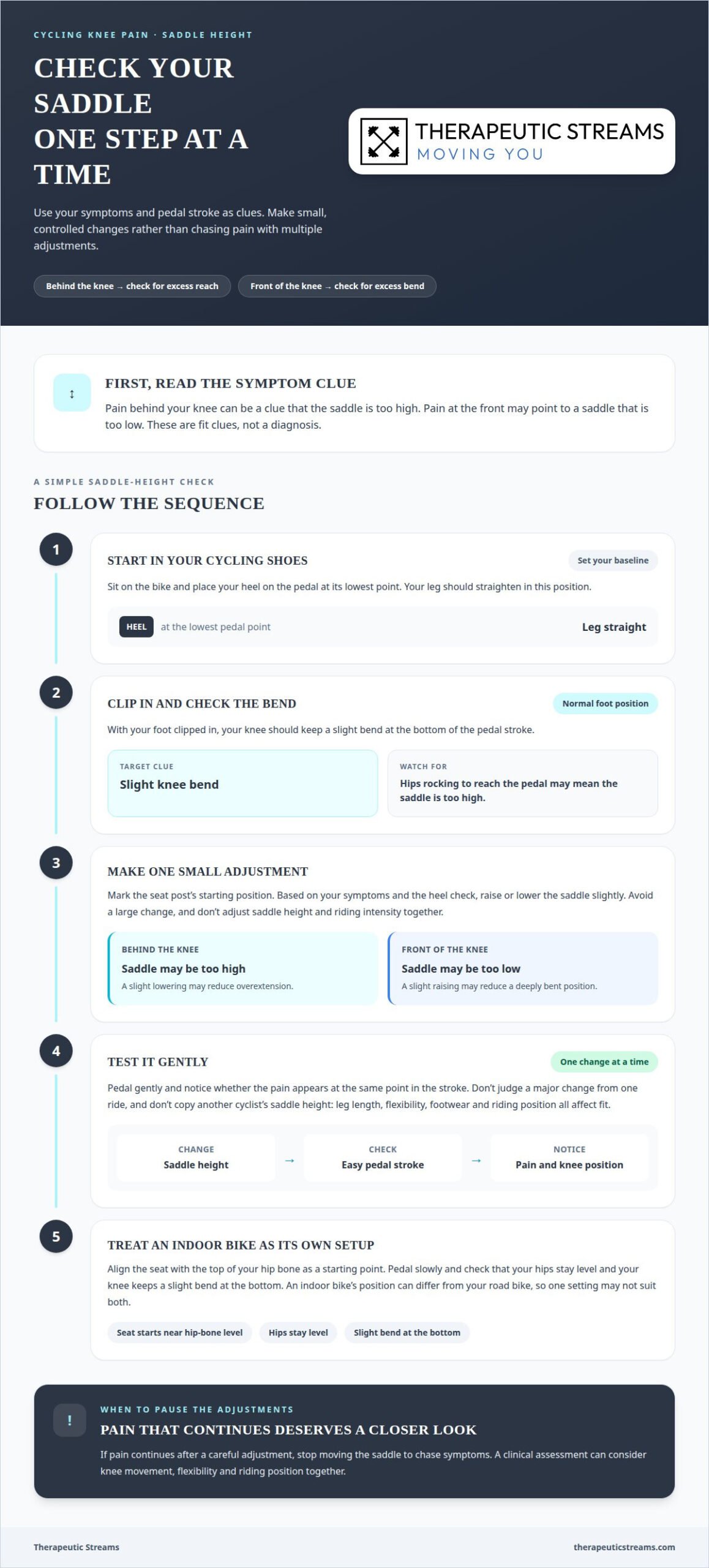
Pain behind your knee can be a clue that your saddle sits too high. At the bottom of each pedal stroke, your leg may reach too far, repeatedly loading tissues behind the knee. Lowering the saddle slightly can reduce that overextension. Add hamstring mobility work if tightness limits comfortable movement, and assess how your knee responds during an easy ride.
Front-of-knee pain may point to the opposite setup issue: a saddle that sits too low. A deeply bent knee works through a compressed position on every rotation, which can increase stress during longer rides or harder efforts. Raise the saddle slightly, then reassess your pedal stroke. Make one adjustment at a time, since changing height and riding intensity together makes it harder to tell what helped.
Try a simple saddle-height check while wearing your cycling shoes. Sit on the bike and place your heel on the pedal at its lowest point. Your leg should straighten in that position. When you clip in normally, your knee should retain a slight bend at the bottom of the stroke. If your hips rock from side to side to reach the pedal, the saddle may be too high; if your knee remains deeply bent, it may be too low. Treat this as a starting check, not a full bike fit.
Road-bike adjustments need to be small and controlled. Mark the seat post’s starting position, then lower or raise the saddle slightly based on your symptoms and the heel check. Ride gently and notice whether pain appears at the same point in the pedal stroke. Avoid making a large change based on one ride or copying another cyclist’s height: leg length, flexibility, footwear and riding position all affect fit.
For an indoor bike, align the seat with the top of your hip bone as a starting point. Then sit on the saddle and pedal slowly, checking that your hips stay level and your knee keeps a slight bend at the bottom. A stationary bike’s position can differ from your road bike, so don’t assume one seat-height setting suits both. Resistance matters too: heavy effort can make a poor fit more noticeable.
If the pain continues after a careful adjustment, don’t keep moving the saddle to chase symptoms. A clinical assessment can consider knee movement, flexibility and riding position together. A physiotherapist can help assess persistent cycling-related discomfort and guide a suitable plan. Explore physiotherapy care if you need support connecting your symptoms with practical next steps.
3. Training load, continued riding, and recovery
Knee symptoms can follow a sudden jump in ride duration, intensity, hills or resistance. If discomfort is mild to moderate, temporarily reduce both intensity and ride length for one to two weeks while addressing possible fit issues. Don’t push through sharp or worsening pain. If pain starts during a ride, stop and consider what changed, such as a longer route, harder gears or fewer rest days.
Returning to riding works best as a gradual test of tolerance. Once everyday movement and easy pedalling feel comfortable, begin with a short, gentle ride. Increase either distance or effort at a time, not both together, and observe how your knee feels during the ride and afterwards. If symptoms return, ease back rather than trying to regain your previous training load immediately. A professional bike fit can help identify setup factors that may be adding stress.
Rest days give tired muscles time to recover between rides. They don’t have to mean complete inactivity: comfortable daily movement can help you avoid staying in one position for long periods. Strength training can support the muscles that help control your knee, but match the exercises and effort to your symptoms. If an exercise increases pain, pause it rather than treating discomfort as a sign of productive training.
A standing desk doesn’t automatically make recovery easier. Standing in one position for a long stretch can also feel uncomfortable, so alternate between sitting, standing and brief walks as your knee allows. For example, change position when you notice stiffness building instead of staying at the desk until your work block ends. Keep your desk choice separate from your cycling plan: it won’t correct excessive riding or a poor bike setup.
After a long ride, gradually reduce your effort before stopping. Replenish fluids and choose a balanced snack or meal with protein and carbohydrates. Gentle stretching may help ease post-ride stiffness, while foam rolling can target tight muscles. If your knee feels warm, swollen, or acutely sore, ice during the first 24 to 48 hours may help manage pain. Compression can support a swollen joint, but it doesn’t address the underlying cause.
Resume longer or harder rides only when easier sessions remain comfortable, then build steadily according to your response. There isn’t a single distance or pace that suits every cyclist; symptoms, recent training, recovery and proper bike setup all matter. If pain persists despite reduced riding and fit changes, a physiotherapist can assess your movement and help shape a return-to-sport plan.
4. Bike-fit adjustments and cycling cadence
A proper bike fit considers how your whole body moves, not just the saddle. At the bottom of the pedal stroke, a bike fitter may look for about 25 to 35 degrees of knee flexion. That means your knee remains slightly bent rather than locking straight or folding deeply. A fit also considers saddle position, cleat alignment, reach to the handlebars, and how your knee tracks through each rotation.
To set seat height and fore-aft position, assess your knee at the bottom of the stroke and observe how it moves over the pedal. The saddle should let your knee retain a slight bend without your hips rocking to reach the pedal. Fore-aft position affects where your knee sits over the pedal during the stroke; adjust it in small increments and reassess your movement. There isn’t one position that suits every rider, so avoid copying another cyclist’s measurements.
Cadence and resistance can change the force your knees handle. A high gear with heavy resistance demands more force on each downstroke. Shifting to a lower gear and pedalling at a higher cadence can reduce that force while maintaining movement. On an indoor bike, try reducing resistance first, then adjust cadence and riding position separately. If anterior knee pain increases, ease off rather than forcing the pedals around.
An e-bike may help you moderate hard efforts on hills or during a return to riding. Assistance can make a demanding climb feel less strenuous, but it doesn’t remove the need for comfortable positioning or controlled effort. Choose a level of assistance that lets you pedal smoothly, and avoid using a difficult gear simply because the motor is helping. If pain worsens, stop and reassess rather than relying on assistance to ride through it.
Pay attention to the full pedal stroke. Your knee should track smoothly instead of repeatedly drifting inward or outward, and your pelvis should stay steady on the saddle. If your foot position feels constrained, the cleats, shoes or stance width may affect how your knee moves. Changes to one setting can alter another, so record the starting position and adjust one element at a time.
Indoor bikes can require a different setup from road bikes. A typical indoor fit leaves the knee bent around 20 to 30 degrees at the bottom of the rotation. Before long-distance cycling or intensive training, a professional bike fit can assess your position, cadence, resistance, and cleat placement together. This can help identify adjustments that suit your movement and riding demands.
5. Chronic knee pain and cycling
Knee pain that keeps returning deserves more than another round of saddle changes. It is the second most common cycling overuse injury, after lower-back pain, and estimates suggest 36 to 62 percent of cyclists experience it during their cycling careers. If you want to reduce knee pain while cycling in Bowmanville, look beyond the moment symptoms start. Pain that settles between rides can still return when contributing factors remain, such as training load, cleat position, movement control, or muscle weakness.
Track the pattern across your rides. Note where pain appears, when it begins and what changed beforehand. For example, recurring outer-knee pain may relate to iliotibial band irritation and weak hip or glute muscles. Pain behind the knee can have different causes, including excessive reach at the bottom of the pedal stroke. These clues can guide assessment, but pain location alone cannot diagnose an injury.
Research adds useful context. A systematic review by van der Worp and colleagues, “Injuries in recreational adult road cyclists,” examines injury patterns in recreational cyclists. It reinforces the value of taking recurring symptoms seriously, while a review cannot determine what causes pain in an individual rider.
Long-lasting symptoms may involve more than the bike. Reduced strength around your hips and legs can affect how your knee tracks as you pedal. Off the bike, a clinician may assess movement, strength, flexibility and your response to cycling. Squats, lunges and leg presses can strengthen muscles supporting the knee. Hamstring and calf mobility may be relevant when discomfort sits behind it. Match exercises to your symptoms; don’t push through a movement that increases pain.
Use clear thresholds to decide when to seek help. Seek medical attention if pain is greater than five out of ten and lasts more than 24 hours. Significant swelling, limited movement, instability, painful unusual sounds, or numbness and tingling also warrant professional evaluation. If symptoms haven’t improved after two to three weeks of reduced riding and fit adjustments, arrange an assessment instead of repeatedly testing the same setup.
Persistent knee pain doesn’t always mean you must give up cycling, but sharp or worsening pain is a reason to stop and reassess. A clinical assessment can connect your training history with joint movement, leg strength, and bike position. That can help distinguish a fit concern from other causes and guide a gradual return to riding. To reduce knee pain while cycling in Bowmanville, seek support if ongoing symptoms limit daily movement or riding. Request support for persistent knee pain.
Therapeutic Streams Sport Rehab
Therapeutic Streams Sport Rehab can help when cycling-related knee pain persists, returns with each ride or limits your everyday movement. Physiotherapy can assess how your knee moves and how strength, flexibility and riding demands may relate to your symptoms. Chiropractic Care may also form part of your care when it suits your needs. Your treatment plan starts with your presentation, not a generic set of exercises.
Registered Massage Therapy may support muscle tension and recovery alongside a broader plan. If knee discomfort continues despite easing your riding and reviewing your bike position, a personalized clinical assessment can help identify practical next steps. Contact Therapeutic Streams Sport Rehab to discuss support for your cycling-related knee pain.
Make your next ride a considered step
To reduce knee pain while cycling in Bowmanville, let your next step be guided by what your body is telling you, rather than pressure to return to your previous pace. A clear plan can connect your cycling goals with the movements and daily activities that matter to you. If pain keeps interrupting your rides, a personalized clinical assessment can help you decide what support fits your needs.
At Therapeutic Streams Sport Rehab, Physiotherapy and Chiropractic Care can address musculoskeletal concerns, while Pelvic Floor Physiotherapy supports pelvic health needs. The right approach depends on your symptoms and goals, so care can focus on the concerns affecting your movement and confidence on the bike.
When you’re ready to discuss a next step, contact Therapeutic Streams Sport Rehab. You can work towards a return to riding that feels steadier, more comfortable, and shaped around you.
Frequently Asked Questions
What Is Causing Your Knee Pain Cycling?
The cause isn’t always visible in your bike setup. Note whether the same discomfort appears during everyday activities, such as climbing stairs, as well as during rides. Record when it begins, how it changes afterwards and whether it affects one or both knees. Bringing those observations to a clinical assessment can help distinguish a cycling-related pattern from symptoms that need a broader review.
Can Biking Make Knee Pain Worse?
It can, especially if each ride repeatedly brings on the same discomfort. The effect may depend on your current symptoms and the demands of that ride. Compare how you feel after a relaxed spin with how you feel after a session with sustained effort. Avoid treating a temporary reduction in discomfort as proof that the original training demand is suitable to resume unchanged.
Can I cycle with a sore knee?
Consider whether soreness changes how you pedal. If you favour one leg, shift your hips or alter your usual movement to keep riding, stop the session rather than reinforcing that pattern. Also consider whether pain affects walking after the ride. These functional changes offer more useful guidance than a simple yes-or-no rule; persistent or worsening symptoms deserve professional attention.
How can I tell if my saddle height is the cause of my knee pain?
Saddle height is harder to isolate if you also changed shoes, pedals or riding position. Keep a note of the bike’s current setup and the conditions of each ride, including terrain and effort. If symptoms change after several adjustments, it becomes difficult to tell which factor mattered. A bike-fit assessment can review your complete riding position rather than judging saddle height alone.
Is IT band syndrome (ITBS) common in cyclists?
ITBS is one possible explanation for outer-knee symptoms, but don’t assume it based on location alone. Similar discomfort can arise from other structures or movement demands, and a symptom description can’t establish a diagnosis. An assessment can consider your activity history, strength and movement patterns before identifying what may be contributing. That distinction matters when choosing an appropriate recovery plan.
Why does my knee hurt on the inside when I bend it cycling?
Bending your knee while pedalling may reveal discomfort that isn’t noticeable with a straight leg, but that detail alone doesn’t identify the cause. Notice whether the sensation occurs during other bent-knee activities, such as stepping down or rising from a chair. Sharing those examples helps clarify whether symptoms are specific to cycling or appear across different movements.
What cycling adjustments can reduce knee pain?
Keep a simple record of each change and your response before making another. Include the bike used, footwear, route conditions and how the ride felt afterwards. This gives a fitter more useful context than a list of adjustments without outcomes. If changing several settings at once makes it difficult to identify a helpful change, return to the last comfortable setup before reassessing.
What causes front, back, or side knee pain while cycling?
Pain location can help describe a symptom, but it doesn’t confirm which tissue or movement is involved. Note whether the discomfort feels sharp, dull or stiff, and whether it starts during pedalling or after you dismount. Also describe any effect on daily activities. A clear account of these details helps a health professional decide what to assess instead of relying on location alone.