Tennis Elbow Treatment in Oshawa: A Personalised Path to Recovery
What if the right next step for elbow pain is not simply resting it, but understanding what may be contributing? If gripping a mug, lifting at work, playing sport, or handling everyday tasks has become uncomfortable, it can be hard to know whether tennis elbow is the cause or what to do next. For tennis elbow treatment Oshawa residents can access care at Therapeutic Streams Sport Rehab’s clinic in Whitby, which serves Oshawa and nearby communities.
Your symptoms and goals are personal, so care should begin with a clinical assessment rather than a standard routine. A clinician can assess your elbow and movement, consider whether another cause may explain the pain, and shape a progressive plan around your needs. This may include physiotherapy and, when appropriate, other clinic services. If your symptoms are related to work, WSIB may also be relevant to your care.
This article explains how tennis elbow is assessed, what a personalised treatment plan may involve, and how progress can be reviewed. You’ll also learn when to consider another source of elbow pain and what to know about WSIB care. Research, including a 2006 randomised trial published in the BMJ, has compared different approaches to tennis elbow care. The findings can inform treatment discussions, but they cannot predict your individual response.
Key Takeaways
- Tennis elbow can affect people who don’t play tennis. Learn which everyday movements may bring on outer-elbow pain and when another cause may need consideration.
- For tennis elbow treatment Oshawa residents can visit Therapeutic Streams’ clinic in Whitby, where a clinical assessment helps shape care around your symptoms, work or sport demands, and goals.
- A personalised plan may combine exercise, gradual activity changes, manual approaches, or other suitable treatment options rather than relying on a single method.
- Track how your elbow responds during gripping, lifting, and daily tasks. This can help guide progress and activity adjustments without defaulting to prolonged rest.
- If your elbow symptoms are work-related, learn how WSIB may fit into the care process.
Tennis elbow treatment in Oshawa: understand the pain before choosing care
If gripping, lifting, or moving your wrist has started to bother your elbow, ordinary tasks can feel unexpectedly difficult. Tennis elbow doesn’t only affect tennis players. Repeated gripping, tool use, computer work, or sport can place ongoing load on the forearm muscles and the tendon where they attach near the outside of the elbow. Over time, that load may contribute to soft tissue injuries and muscle tension.
In brief: Tennis elbow is pain linked to an overloaded tendon on the outer side of the elbow. It can make gripping, lifting, and wrist movements uncomfortable. The clinical term is lateral elbow tendinopathy. The overview of tennis elbow (lateral epicondylitis) describes common causes and symptoms, but a general description can’t determine what’s causing your pain. Elbow symptoms may also come from other muscles, joints, nerves, or areas of the arm.
What does tennis elbow feel like during everyday activities?
You might notice discomfort while carrying a bag, turning a door handle, lifting a light object, or holding a tool. Pain may sit near the outer elbow or travel into the forearm. Its location and intensity can vary, and some wrist or gripping movements may feel more challenging than others. These examples can help you describe what you’re experiencing, but they don’t confirm the cause.
When should you seek a clinical assessment for elbow pain?
Consider a clinical assessment if pain persists, limits your work or daily activities, or keeps returning. Seek prompt medical attention for sudden, severe, or unusual symptoms. An assessment can explore when the pain began, which activities affect it, how your elbow and wrist move, and which tasks are difficult. If you’re considering tennis elbow treatment Oshawa, Therapeutic Streams’ Whitby clinic serves patients from Oshawa and can use this information to guide care.
Symptoms are useful clues, not a diagnosis on their own. A careful assessment helps clarify what may be contributing to your pain and which next steps suit your function and goals.
How a clinical assessment guides tennis elbow treatment
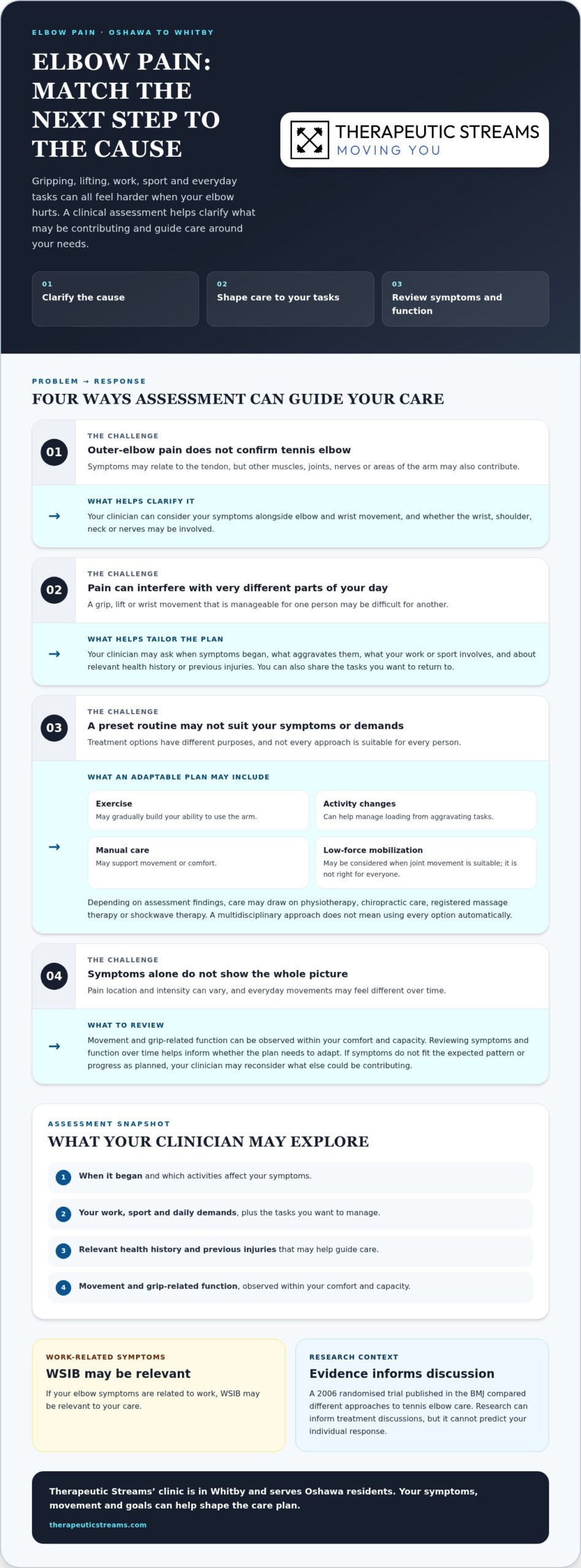
A useful plan starts with your experience, not a preset series of treatments. A clinical assessment is a conversation and physical evaluation that helps a clinician understand your symptoms, daily demands, and goals. It can guide treatment choices, but it doesn’t guarantee a particular diagnosis or outcome.
A clinical assessment should guide treatment because the same elbow symptom can have different causes and call for different next steps. Pain may relate to the outer-elbow tendon, but a clinician may also consider other structures or contributing factors, such as the wrist, shoulder, neck, or nerves. The Mayo Clinic’s guide to tennis elbow treatment also describes how assessment findings inform care. If symptoms don’t fit the expected pattern or progress as planned, that can prompt a review of what else may be contributing.
What may happen during an assessment for tennis elbow?
Your clinician may ask when symptoms began, which tasks aggravate them, what your work or sport involves, and whether you have relevant health history or previous injuries. Share what you’d most like to get back to, whether that’s lifting at work, training, or managing household tasks. Your clinician may observe movement and grip-related function within your comfort and capacity. You can describe what feels difficult as the assessment progresses.
These findings help shape an individual plan rather than placing you into a predetermined treatment package. They also provide a starting point for reviewing changes in symptoms and function over time.
How can the plan adapt to your symptoms and daily demands?
Your care can reflect what your arm needs to do each day. A clinician may discuss adjustments to aggravating activities and adapt treatment as your symptoms and function change. If joint movement is suitable, low‑force mobilization may be considered as one option. It isn’t necessary or appropriate for everyone.
A multidisciplinary approach means coordinating relevant care, not automatically using every available modality. Depending on assessment findings, a plan may draw on physiotherapy, chiropractic care, registered massage therapy, or shockwave therapy. Each option has a purpose, and your clinician can explain why it may suit your situation.
If you’re exploring tennis elbow treatment Oshawa, Therapeutic Streams’ Whitby clinic serves Oshawa residents with care guided by your assessment and goals. Learn more about clinical assessment and personalised care as you consider your next step.
Tennis elbow treatment options: what may help, and what to expect
Care may combine active rehabilitation with hands-on approaches or an adjunct treatment, each serving a different purpose. Exercise can gradually build your ability to use the arm, while changes to aggravating activities help manage loading. Manual care may support movement or comfort. No single option suits everyone, and passive treatment doesn’t replace active rehabilitation when exercise is appropriate.
Harvard Health’s advice on tennis elbow management discusses activity changes and other care measures. Your clinician can help adapt activities without assuming that complete rest is the answer. Shockwave therapy may be considered when a clinical assessment supports it, but it isn’t a guaranteed solution or a necessary part of every plan.
| Approach | Potential role | Why assessment matters |
|---|---|---|
| Exercise and activity adjustment | Build arm capacity gradually and manage aggravating loads. | Exercises and changes should match your symptoms, function, and daily demands. |
| Manual approaches | May support movement or help address related muscle and joint restrictions. | Findings help determine whether hands-on care is suitable and what it should target. |
| Shockwave therapy | An adjunct option that may be considered for some presentations. | Suitability depends on assessment and how your symptoms and function respond. |
What does research say about tennis elbow treatment?
Step-by-step exercise protocol for tennis elbow
A progressive loading programme is a central part of evidence-informed care for lateral elbow tendinopathy. The sequence below reflects exercise principles used in randomised research, including the eccentric wrist-extensor protocol studied by Tyler and colleagues. Your clinician can adjust the starting resistance, repetitions, and frequency to match your assessment, symptoms, and work or sport demands.
- Establish a starting point. Identify the gripping, lifting, or wrist movements that currently challenge your elbow and record how your arm responds during the activity and afterwards. Keep the early programme focused on a manageable level of loading rather than complete rest.
- Begin with supported wrist-extensor loading. Rest your forearm on a surface with your hand over the edge. Use the other hand to help position the wrist, then slowly lower the affected wrist from extension towards neutral against light resistance. A commonly studied eccentric format is three sets of 15 repetitions, with resistance increased gradually as the movement becomes easier.
- Progress to lifting and lowering with the affected arm. Once the controlled lowering phase is manageable, use the affected arm to raise the wrist and lower it slowly. Perform controlled sets of 10 to 15 repetitions, with the load and frequency progressed according to your response.
- Add gripping and functional practice. Introduce light gripping, carrying, tool handling, or sport-specific movements that resemble your goals. Increase one variable at a time, such as resistance, repetitions, duration, or task demands.
- Review and progress. Track grip function, lifting tolerance, and the tasks you want to regain. If the elbow responds well, progress the resistance or activity demand; if symptoms remain difficult, your clinician can modify the exercise selection, dose, or related activity load.
The exercise dose is not a fixed prescription for every person. Research supports progressive strengthening, while the assessment determines which variation, resistance, and progression best fit your presentation. Exercise can be combined with activity modification and other suitable care, as in the physiotherapy research discussed below.
In a 2006 BMJ randomised trial, Bisset and colleagues compared mobilisation with movement and exercise, corticosteroid injection, and a wait-and-see approach in people with tennis elbow. The study followed participants over time, including at 52 weeks. Injection offered faster short-term improvement, but recurrence was more common; outcomes later favoured the physiotherapy and wait-and-see groups over injection. These findings describe a study group, not a prediction of your individual response. Read the Bisset et al. trial in the BMJ.
Is shockwave therapy or hands-on care right for everyone?
No. The choice depends on your assessment, goals, symptoms, and response as care progresses. Your clinician can review whether a treatment remains useful as function changes and adjust the plan if it isn’t supporting your agreed goals. For tennis elbow treatment Oshawa residents can access personalised care at Therapeutic Streams’ Whitby clinic.
Your tennis elbow recovery plan: activity, progress, and practical questions
Recovery is rarely a straight line. Your clinician can review how your arm responds to treatment and everyday activity, then adjust your plan as your function changes. Useful measures might include whether you can complete agreed work or sport tasks, how your grip feels, and whether symptoms settle after activity. Progress is personal, so a fixed timeline or promised result wouldn’t reflect your needs.
For example, you might discuss breaking up a repetitive task, changing how you hold a tool, or temporarily adjusting training load. The aim is to find tolerable ways to stay active while symptoms are addressed, not to prescribe complete or prolonged rest. Tell your clinician what you need your arm to do, then work together on gradual changes guided by your symptoms, function, and goals.
How can you stay active while symptoms are being addressed?
Ask your treating clinician which activities you can continue comfortably and how to modify those that repeatedly aggravate your elbow. A gradual return to heavier work, sport, or exercise can be planned around your response rather than a generic schedule. An exercise routine should also match your assessment and capacity; the right starting point may differ from person to person.
Notice how your arm responds during an activity and afterwards. That information can help you and your clinician decide whether to maintain, adjust, or progress the task. Speak up if symptoms change or an agreed activity becomes difficult.
What should Oshawa patients know about WSIB and insurance?
For a work-related elbow injury, WSIB’s Musculoskeletal Program of Care may apply to suitable injuries. The program runs for eight weeks in two four-week blocks. Eligibility includes being within eight weeks of the injury date and having a mild to moderate Grade I or II injury. For a single zone of injury, the first block is pre-approved while a claim is pending. These criteria don’t guarantee approval or coverage; WSIB determines eligibility under its current process.
Therapeutic Streams provides WSIB care. For private insurance, coverage depends on your individual plan and its terms. Review your policy for applicable services, requirements, and claim steps; don’t assume reimbursement. Keep relevant claim or plan information available when discussing your care.
If you’re considering tennis elbow treatment Oshawa, Therapeutic Streams’ clinic in Whitby serves patients from Oshawa. Explore care at Therapeutic Streams and take a considered next step towards a plan shaped around your work, sport, and daily activities.
Tennis elbow treatment near Oshawa: starting care at Therapeutic Streams
If you live in Oshawa and are looking for tennis elbow treatment nearby, Therapeutic Streams’ clinic is in Whitby and serves patients from Oshawa. Your care starts with a clinical assessment, not a preset treatment package. The clinician considers your symptoms, movement, daily demands, and goals, then discusses a plan based on those findings.
How does local care work if you live in Oshawa?
Appointments take place at the Whitby clinic. During your assessment, share what you want your arm to manage, whether that’s work tasks, exercise, or everyday activities. This gives your care a practical focus. The first visit is a chance to talk through what you’re experiencing and understand possible next steps, rather than assume every case calls for the same treatment.
What can you expect from a personalised care plan?
Your plan is shaped around what the assessment reveals and the goals you set with your clinician. Physiotherapy may be part of care, while chiropractic care, registered massage therapy, or shockwave therapy may be considered when clinically appropriate. These options aren’t automatic additions. Your clinician can explain the purpose of any recommended approach and review whether it remains suitable as symptoms, function, and priorities change.
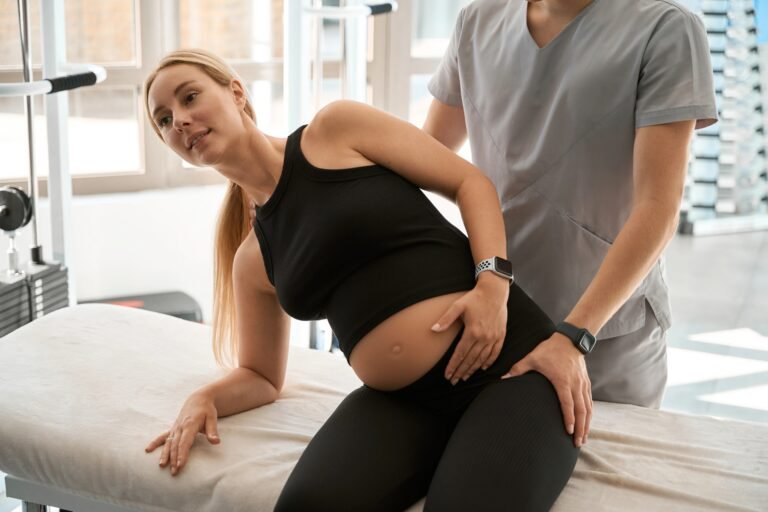
Comfort and positioning also matter. Side-lying positioning may be used when it suits you and the treatment being provided. Your clinician can take your comfort and capacity into account as care progresses, helping you take part in a plan that feels manageable.
Choosing care is a step towards understanding your elbow pain and finding a considered way forward. For tennis elbow treatment Oshawa residents can access the Whitby clinic, where the focus is a personalised plan guided by assessment findings, not a promise of a particular result. If you’re ready to take that next step, Book your next step with Therapeutic Streams.
Take a considered next step towards easier movement
Elbow pain can make everyday tasks and the activities you value feel harder. A clinical assessment can help clarify what may be contributing and guide a personalised plan based on your symptoms, function, and goals. Treatment may include physiotherapy, chiropractic care, registered massage therapy, or shockwave therapy when clinically appropriate. Progress can be reviewed and care adjusted as your needs change.
For tennis elbow treatment Oshawa residents can visit Therapeutic Streams’ clinic in Whitby. The clinic serves people from Oshawa, Ajax, Bowmanville, and nearby communities. It also provides WSIB care, and side-lying positioning may be used when it suits you and your treatment. Your next step can begin with a conversation about what you’re experiencing and what you hope to do more comfortably.
Book an assessment and take your next step towards easier movement. With a thoughtful plan and steady guidance, you can move forward with greater clarity and confidence.
Frequently Asked Questions
Can I get tennis elbow treatment in Oshawa at Therapeutic Streams?
Therapeutic Streams serves people from Oshawa, but appointments take place at its clinic in Whitby. Care begins with a clinical assessment to understand your symptoms and how they affect work, sport, or daily tasks. From there, your clinician can discuss a personalised plan based on the findings. If you’re considering tennis elbow treatment Oshawa, the Whitby clinic is a local option for assessment and care.
What happens during a clinical assessment for tennis elbow?
A clinical assessment usually begins with a conversation about when your symptoms started, what aggravates them, your health history, and what you want to do more comfortably. Your clinician may observe arm movement and grip-related function within your comfort and capacity. These findings help guide next steps and consider whether another source of elbow pain may be involved. The assessment informs a plan, but it can’t promise a particular diagnosis or outcome.
How long does tennis elbow take to improve with treatment?
There isn’t a set recovery timeline for tennis elbow. How symptoms change can depend on their duration, the demands placed on your arm, your overall health, and how your function responds to care and activity adjustments. Your clinician can review progress over time using practical goals, such as returning to a work task or sport activity. If improvement stalls or symptoms change, the plan can be reassessed rather than relying on a fixed schedule.
Can physiotherapy help with tennis elbow pain?
Physiotherapy may help address tennis elbow by supporting gradual exercise, movement, and changes to activities that aggravate symptoms. Your clinician can tailor the plan to your assessment findings, current function, and work or sport demands. The aim is to build capacity in a manageable way, not to give everyone the same routine. Your response helps guide progression, so share which tasks feel easier or remain difficult as care continues.
Is shockwave therapy used for tennis elbow?
Shockwave therapy may be considered for tennis elbow when a clinical assessment supports its use. It’s one possible treatment option, not a required step or a guaranteed solution. A clinician can explain its intended role alongside active rehabilitation and other suitable approaches. Your symptoms, goals, and response to care help determine whether it remains appropriate. Treatment can be reviewed as your function changes, keeping the plan connected to what you need to do.
Does Therapeutic Streams accept WSIB cases for tennis elbow?
Therapeutic Streams provides WSIB care for work-related injuries, including care under Ontario’s WSIB framework for suitable musculoskeletal injuries. WSIB determines claim eligibility and coverage, so treatment isn’t a guarantee of claim approval or payment. If your elbow symptoms are work-related, share the relevant claim information during care discussions. Your clinician can consider your work demands and functional needs while the WSIB process and your treatment plan are addressed separately.
Is the Therapeutic Streams clinic located in Oshawa or Whitby?
The clinic is located in Whitby and serves patients from Oshawa and nearby communities, including Ajax and Bowmanville. Therapeutic Streams has one physical clinic. Knowing where appointments take place can help you plan your visit from Oshawa. At the Whitby clinic, care for elbow pain starts with a clinical assessment and a plan shaped around your findings, symptoms, and personal goals.