Physiotherapy for Hockey Players in Whitby: Peak On-Ice Recovery
Groin injuries account for up to 43% of all muscle strains in competitive hockey, yet players are constantly told to simply sit out and rest until the ache fades. You already know how frustrating that advice feels when an explosive stride or quick crossover at Iroquois Park Sports Centre reignites sharp adductor strain. Passive rest cannot rebuild dynamic power or restore functional stability under high skating loads. Choosing dedicated physiotherapy for hockey players Whitby athletes trust means working with clinicians who understand that recovery succeeds by correcting rotational mechanics, not by keeping you off the ice indefinitely.
No skater should have to fear missing critical league games or playoff runs due to lingering shoulder discomfort after a check or an unresolved hip pull. Discover how targeted therapy tailored to skaters restores explosive power, resolves groin and shoulder pain, and keeps you performing at your peak. We examine how an assessment-first approach identifies underlying stride flaws, how restoring functional balance builds lasting injury resilience, and how sports rehabilitation clinicians guide your clear return to full competition.
Key Takeaways
- Explore why standard rest fails to heal adductor strains and how rotational stride biomechanics guide effective recovery.
- Learn how targeted physiotherapy for hockey players Whitby skaters rely on resolves joint restrictions and deep tissue tension.
- Discover advanced modalities like shockwave therapy and neurofunctional acupuncture that accelerate tendon and nerve repair.
- Review the structured 4-stage progression that tests on-ice stability before clearing you for hard board contact and game action.
- Find out how coordinated local care near Whitby arenas keeps your return-to-play timeline precise and secure.
Biomechanical Demands of Hockey: Why Standard Rehab Falls Short on the Ice
Skating looks effortless when watching players glide across the ice at McKinney Centre, but the physics beneath those strides tell a far more demanding story. Unlike linear running, skating requires your lower body to generate propulsion through lateral extension and external rotation. This rapid push-off forces your adductor muscle groups to endure intense, repetitive eccentric contractions simply to decelerate the leg and pull the skate back beneath your centre of mass. Generic exercise routines built for track runners or field athletes completely miss these non-linear loads. Skaters competing across Whitby and Oshawa need tailored physiotherapy for hockey players Whitby clinics provide to isolate and rebuild these sport-specific movement patterns.
The forward skating posture itself presents an ongoing structural dilemma. Maintaining a deep knee bend and forward chest lean places continuous musculoskeletal stress across the lumbar spine and anterior hip capsules. When you combine this static lean with repeated directional shifts, passive rest protocols only encourage stiff scar tissue formation. Muscles tighten like coiled springs, failing to retrain the dynamic rotational power you need to win battles in the offensive zone.
The Kinetic Chain of the Modern Skating Stride
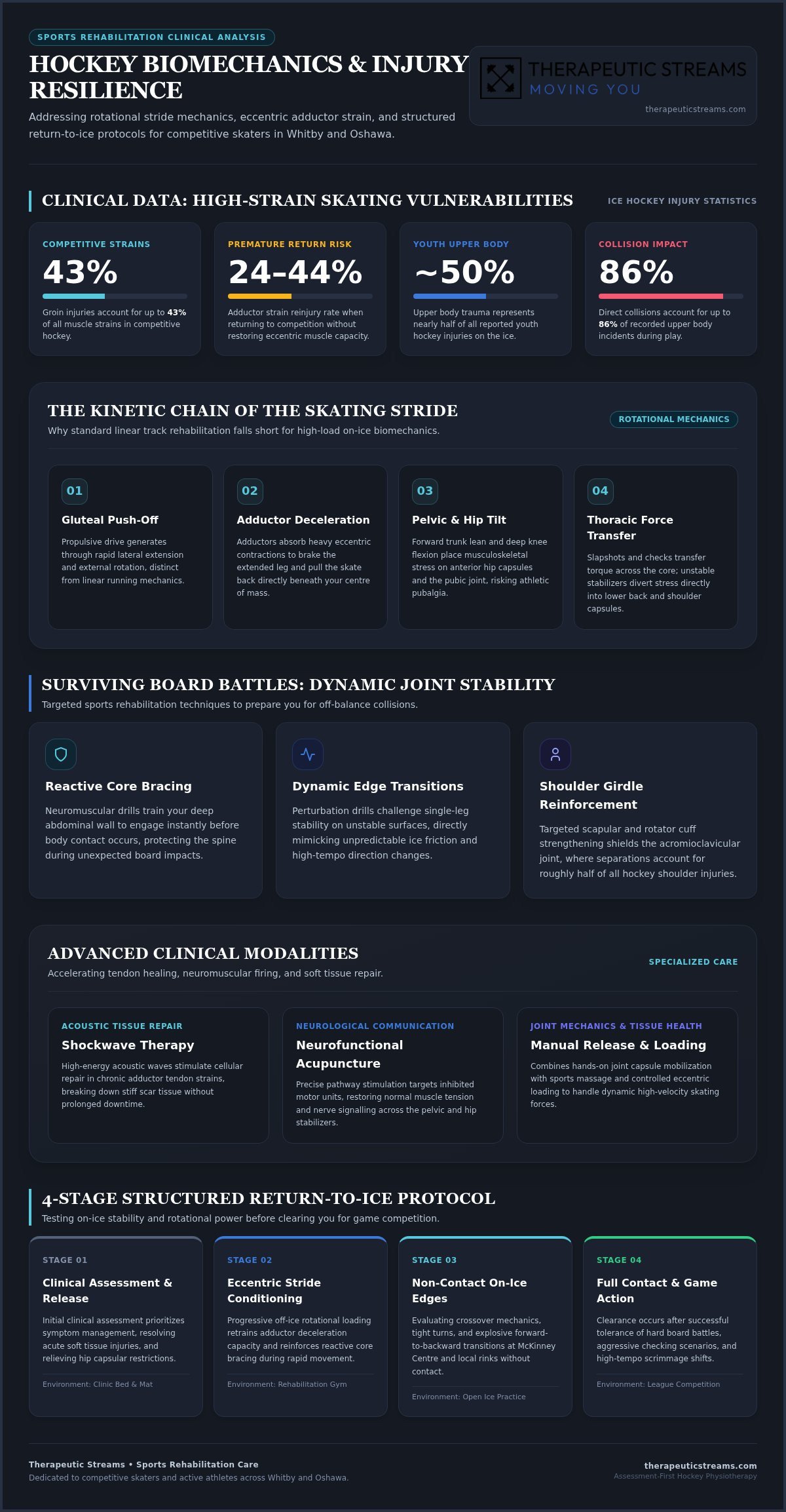
Power originates in the gluteal complex during the propulsive phase, but the adductors work double duty during recovery. When deep pelvic imbalances develop, they tilt your acetabulum and restrict hip internal rotation. This friction creates chronic pubic joint stress and can lead to conditions such as athletic pubalgia, where shearing forces irritate the lower abdominal wall and adductor tendons. Upward along the kinetic chain, rotational torque from hard slapshots requires smooth force transmission through the thoracic spine. If your core stabilizers fail to coordinate that rotation, your lower back and shoulder capsules absorb the destructive shock wave.
Addressing Off-Balance Collisions and Board Battles
Game play rarely happens under predictable conditions. Surviving a hard check along the boards requires lightning-fast balance reflexes and muscular pre-activation. Here is how specialized rehabilitation restores your stability:
- Reactive core bracing: We train your deep abdominal wall to engage instantly before body contact occurs.
- Dynamic edge transitions: Perturbation drills challenge single-leg balance on unstable surfaces, mimicking slippery ice friction.
- Shoulder girdle reinforcement: Targeted scapular work shields the delicate acromioclavicular joint from collision trauma.
Absorbing high-speed contact requires fine-tuned neuromuscular timing. Clinicians who understand hockey mechanics evaluate how your joints absorb force during off-balance movements. Through dedicated physiotherapy for hockey players Whitby athletes regain the confidence and resilience needed to step straight into game contact without hesitation.
Common Hockey Injuries Treated with Physiotherapy in Whitby
Stepping back onto the ice with lingering pain turns every shift into a calculated risk. While generic clinics often hand out basic stretch bands and tell you to wait out the season, a detailed clinical assessment looks much deeper. Our goal is to identify the precise structural vulnerabilities behind your symptoms. By treating soft tissue injuries, joint capsular restrictions, and nerve irritation simultaneously, targeted sports therapy builds true injury resilience that withstands high-tempo tournament weekends across Ontario.
Groin Pulls, Sports Hernias, and Hip Impingement
The adductor longus endures tremendous force during hard strides on rutted ice. Research reveals that adductor strains carry a steep reinjury rate of 24% to 44% when skaters return without restoring eccentric muscle capacity. Deep hip flexion in an aggressive hockey stance also accelerates femoroacetabular impingement, pinching anterior joint structures. We introduce hands-on manual techniques to release stubborn hip joint restrictions, followed by controlled eccentric loading to ensure your adductors can smoothly absorb high-velocity skating forces.
Acromioclavicular Joint Sprains and Rotator Cuff Strains
Upper body trauma represents nearly half of all youth hockey injuries, with collisions accounting for up to 86% of reported incidents. In fact, acromioclavicular joint separations account for roughly half of all hockey shoulder trauma. When a body check drives your shoulder directly into the rink boards, your AC joint ligaments take the brunt of the collision. Slapshots and forceful stick checks can also overload rotator cuff tendons. Gentle low-force mobilization restores natural gleno-humeral rhythm while protecting healing tissues, aligning with proven safe return-to-play guidelines.
Lower Back Muscle Tension and Sacroiliac Dysfunction
Sustained forward trunk lean tightens hip flexors, leaving your spinal erectors exhausted by the third period. This posture frequently leads to distinct mechanical challenges:
- Sacroiliac joint shearing: Uneven push-off mechanics create rotational torsion across your pelvic base.
- Persistent muscle tension: Quadratus lumborum and deep spinal stabilizers lock up to guard the spine.
- Loss of shot velocity: Restricted lumbar-pelvic rotation bleeds power before your stick blade meets the puck.
Correcting these rotational strain patterns protects your spine throughout the regular season. If you are struggling with recurring aches after games at Luther Vipond or McKinney Centre, booking specialized physiotherapy for hockey players Whitby athletes rely on helps you correct these mechanical issues before playoff action begins.
Advanced Modalities: Building Your Hockey Recovery Toolkit
Quick recovery from rigorous ice sessions demands more than ice packs and waiting on the bench. Athletes needing top-tier physiotherapy for hockey players Whitby rinks rely on benefit when clinical treatments match specific biological tissue injuries. Rather than treating every ache the same way, modern sports therapy pairs focused modalities that calm irritated nerve pathways, renew dense collagen, and free guarded joints. By uniting manual therapy with active loading, our clinic cuts downtime while rebuilding game-ready conditioning.
Our multidisciplinary approach combines clinical physiotherapy, registered massage therapy, and chiropractic adjustments under one roof on Sawdon Drive. This unified care model shifts seamlessly with your season calendar. Whether you need mid-season groin preservation or intense post-injury reconditioning before regional tournaments, your care plan adapts directly to your game schedule.
Neurofunctional Acupuncture for Explosive Muscle Firing
Skating trauma frequently causes protective neurological shut-down in deep stabilizers. A neurofunctional approach targets inhibited motor units along the femoral, obturator, and gluteal nerves. By delivering controlled microcurrent electrical stimulation to these specific neural targets, clinicians restore fluid neuromuscular communication. Restoring active muscle recruitment helps skaters immediately regain lateral push-off power and balanced edge control, preventing compensations that strain vulnerable joints.
Shockwave Therapy for Stubborn Tendonitis and Scar Tissue
Chronic adductor tendon pain and patellar irritation rarely respond to simple rest. High-energy acoustic pulses from shockwave therapy introduce focused mechanical sound waves directly into stubborn scar tissue, triggering renewed cellular repair and vascular growth. According to clinical research on the physical therapy management of ice hockey injuries, targeted non-invasive tissue stimulation alongside progressive loading programs helps renew tendon elasticity. This acoustic intervention revitalizes compromised tendons, allowing them to tolerate tight turns and hard stops without recurring irritation.
Sports Massage and Soft Tissue Mobilization
Sustained forward trunk angles and heavy body checks leave dense fascial tightness across your spinal erectors and hip rotators. Collaborating with a registered massage therapist allows skaters to systematically resolve this restriction:
- Targeted sports massage: Frees restricted fascia and flushes metabolic waste between back-to-back games.
- Side-lying joint unloading: Relieves lumbar and hip pressure during soft-tissue releases, keeping vulnerable joints comfortable.
- Restored flexibility: Increases usable range of motion without dampening the explosive muscle stiffness needed for hard shots.
Coordinating skilled hands-on releases with corrective movement bridges the gap between passive relief and resilient on-ice execution. Through integrated physiotherapy for hockey players Whitby athletes regain optimal movement mechanics, allowing them to compete without holding back.
4-Stage Return-to-Ice: From Clinic Bed to Full Contact
Arbitrary timelines like resting for three weeks create a false sense of security. Tissues may stop aching during everyday walking, but the sheer torque of a hard hockey stop requires verified mechanical integrity. Our assessment-first approach relies on measurable physical criteria rather than calendar dates to determine when you advance. Athletes who choose specialized physiotherapy for hockey players Whitby clinics offer follow an objective 4-stage continuum, ensuring every joint can withstand high-velocity stress before game day arrives.
Stage 1 & 2: Acute Protection and Off-Ice Power Restoration
Stage 1 focuses on eliminating resting discomfort, reducing joint effusion, and restoring pain-free gait mechanics off the ice. As acute swelling recedes, Stage 2 shifts focus toward building multiplanar strength and functional tolerance:
- Single-leg stability tests: Athletes establish balanced control during dynamic lateral hops, ensuring the injured leg matches the healthy side.
- Slide-board conditioning: Replicating the lateral push-off and adductor deceleration mechanics of skating without joint-jarring impact.
- Low-impact cardiovascular conditioning: Stationary cycling maintains aerobic capacity while offloading healing connective tissues.
Research indicates that players with adductor strength below 80% of their abductor strength face significantly greater odds of recurring groin strains. We verify your strength symmetry reaches at least 90% to 95% before allowing skate blades onto the ice.
Stage 3 & 4: Non-Contact Edge Work and Game Simulation
Stage 3 transitions your recovery onto the rink for solo, non-contact edge drills. You practice forward and backward crossovers, tight figure-eights, and explosive linear stops. Clinicians monitor your recovery for post-skate inflammation or biomechanical compensations. Once non-contact drills are effortless, Stage 4 introduces high-tempo practice conditions:
- Shooting mechanics: Testing thoracic rotation and scapular stability under the load of heavy slapshots and quick wrist shots.
- Physical board battles: Absorbing controlled lean-ins and checks along the boards to confirm reactive trunk bracing.
- Full-contact scrimmages: Ensuring complete competitive confidence before regular league participation resumes.
This structured progression bridges the gap between clinical healing and arena performance. If an adductor strain or shoulder separation has sidelined you, schedule your assessment with Therapeutic Streams Sport Rehab to start your customized return-to-ice plan today.
Choosing Whitby Sports Physiotherapy: Why Local Players Trust Therapeutic Streams Sport Rehab
Navigating demanding league schedules requires a clinical team that understands the true physical reality of hockey. At Therapeutic Streams Sport Rehab, our clinicians treat skating injuries with a single purpose: developing durable movement mechanics that keep you skating pain-free shift after shift. When seeking reliable physiotherapy for hockey players Whitby athletes choose our coordinated clinic, uniting physiotherapy, chiropractic care, and sports massage under one roof on Sawdon Drive. We craft personalized rehabilitation programs centered around your specific mechanical needs rather than relying on quick, short-term fixes.
Administrative hurdles should never delay your physical care. Our staff simplifies your recovery process by coordinating direct billing through major private insurance providers, alongside handling documentation for approved WSIB claims. This straightforward support lets you direct all your focus toward regaining strength, restoring joint balance, and preparing for your next game.
Convenient Care Tailored to Whitby Hockey Schedules
Early morning practices and evening league commitments leave little room for rigid appointment windows. Located conveniently near Highway 401 and Thickson Road, our clinic provides quick access for players traveling from home, school, or work across Whitby, Oshawa, and Ajax. Whether you are stepping off the ice after training at Iroquois Park Sports Centre or wrapping up an intense tournament game at the McKinney Centre, our flexible appointment options adapt to your calendar. We actively support local athletes, providing passionate advocacy for minor hockey teams and adult recreation skaters alike.
Your First Hockey Assessment: What to Expect
Your initial appointment begins with an assessment-first approach focused on finding the root cause of your pain. During this clinical assessment, we analyze your joint mobility, skating posture, core strength, and injury history. We explain your diagnosis in clear terms, detailing how your joint mechanics interact on the ice and outlining a structured return-to-play roadmap. Ready to build lasting durability and dominate your next shift? Book your clinical assessment online with Therapeutic Streams Sport Rehab today.
Step Back onto the Ice with Lasting Confidence
Successful recovery comes from actively restoring rotational stride mechanics and building balanced eccentric strength, not waiting on the sidelines for symptoms to fade. By addressing the root cause of pelvic stress, shoulder strain, and joint restrictions, you protect your body against the intense physical collisions and quick edge transitions of competitive play.
At Therapeutic Streams Sport Rehab, our multidisciplinary team coordinates physiotherapy, chiropractic care, and registered massage therapy under one roof. Centrally situated in Whitby near major arenas like Iroquois Park Sports Centre, we make your care straightforward through direct billing for private insurance plans and approved WSIB claims. Choosing dedicated physiotherapy for hockey players Whitby athletes trust gives you a clear, objective path back to game action.
Don’t let lingering groin pulls or rotator cuff discomfort keep you in the stands during crucial league match-ups. Schedule your hockey injury assessment at Therapeutic Streams Sport Rehab today and step onto the ice with complete power, agility, and resilience.
Frequently Asked Questions
Can I continue skating while undergoing physiotherapy for a minor groin pull?
Skating through active groin pain usually delays healing and risks turning an acute strain into a persistent tendon problem. During your initial clinical assessment, your therapist evaluates your single-leg stability and stride tolerance. We may permit light, linear gliding drills if they cause zero discomfort, but explosive stops and hard edge crossovers are paused until tissue capacity returns.
How many physiotherapy sessions does a typical hockey injury require?
Rehabilitation timelines depend on your tissue diagnosis, severity grade, and individual healing response. Minor muscle strains often resolve within four to six targeted visits paired with consistent home exercises. Complex joint separations or recurring adductor tears may take eight to twelve weeks of progressive care to restore full stability. We review your measurable milestones at every appointment.
Do I need a physician referral before booking sports physiotherapy in Whitby?
Physiotherapists in Ontario are primary care practitioners, meaning you do not need a medical doctor’s referral to schedule an appointment. However, certain extended health benefit policies require a doctor’s note for reimbursement. It is always wise to review your specific insurer details beforehand. If you were injured at work or in sanctioned team employment, our staff coordinates directly with WSIB.
What makes hockey physiotherapy different from standard physical therapy?
Specialized physiotherapy for hockey players Whitby athletes choose targets the unique biomechanics of skating rather than standard walking patterns. Our clinicians analyze asymmetrical lateral extension, deep trunk lean, and high-velocity eccentric loads on adductor muscles. We combine manual adjustments, sports massage, and rotational core drills to ensure your body can withstand sudden checks and fast edge transitions.
Can sports physiotherapy help improve my skating speed and shot power?
Therapy directly enhances your on-ice performance by eliminating joint restrictions and firing up inhibited muscle groups. When your pelvis and thoracic spine move freely, rotational force transfers smoothly from your skates up through your stick blade. Correcting muscle imbalances allows your glutes and deep core stabilizers to generate maximum explosive drive without leaking power.
Does Therapeutic Streams Sport Rehab direct bill private insurance for sports physiotherapy?
Yes, our clinic provides direct billing for most major Canadian extended healthcare providers to keep your focus entirely on recovery. We also manage documentation and reporting for approved WSIB musculoskeletal claims. Our administrative team assists you with claim submissions during your visit so you avoid stressful insurance paperwork between games and practices.
What should I wear to my hockey injury assessment at the clinic?
Wear loose, athletic clothing such as gym shorts and a lightweight t-shirt or tank top. Skaters dealing with hip, groin, or knee concerns need shorts so your therapist can observe joint alignment and palpate muscle tissues. If you are recovering from a shoulder separation, bring a sleeveless top to allow an unobstructed evaluation of your scapular mechanics.