Physiotherapy for Running Injuries in Whitby: Your Comprehensive Recovery FAQ
What if the standard advice to “just rest” is actually delaying your return to the pavement? For many local athletes, seeking specialized physiotherapy for running injuries Whitby is the turning point between a chronic setback and a successful season. We understand the frustration of watching your mileage drop while you worry if that nagging ache will ever truly disappear. You want to be on the Waterfront Trail, not on the sidelines, yet the conflicting advice about whether to run through pain or stop entirely only adds to the confusion.
We’re here to provide the clinical clarity you need to move forward with confidence. By focusing on your unique biomechanics and load tolerance, we can resolve your pain and optimize your gait for long-term performance. This guide answers your most pressing questions about recovery timelines, diagnostic precision, and how to improve your running economy. You’ll discover a professional pathway that doesn’t just patch up injuries but builds a more resilient version of the runner you already are. Let’s explore how evidence-based care can get you back to the sport you love.
Key Takeaways
- Learn why a specialized biomechanical approach is more effective for resolving persistent pain than the standard advice to simply rest.
- Discover how professional physiotherapy for running injuries Whitby targets the root causes of common issues like Runner’s Knee and Achilles Tendinopathy.
- Understand the clinical value of video gait analysis in identifying subtle power leaks that hinder your performance on local trails.
- Realize the benefits of dedicated one-on-one sessions that prioritize evidence-based care over high-volume, assistant-led treatments.
- Explore how an integrated recovery plan, including Registered Massage Therapy, can accelerate your return to peak running form.
What Is Specialized Physiotherapy for Running Injuries in Whitby?
Running is a unique athletic endeavour that places repetitive, high-impact demands on the musculoskeletal system. Specialized physiotherapy for running injuries Whitby is not merely about managing pain; it is a biomechanical deep dive into how your body absorbs and distributes force with every stride. Unlike contact sports that involve unpredictable collisions, running injuries are often the result of cumulative load and subtle movement inefficiencies. We treat the body as an integrated system, realizing that a persistent ache in the knee often originates from a lack of stability in the hip or limited mobility in the ankle.
Modern sports rehabilitation centres rely on evidence-based practice to guide your recovery. This means your treatment plan is rooted in the latest clinical research rather than outdated “wait and see” approaches. In Whitby, our local environment presents specific challenges that influence injury patterns. The undulating trails at Heber Down Provincial Park, for instance, require significant eccentric control to manage downhill braking forces. Without a specialized assessment, these terrain-specific stresses can lead to chronic issues that keep you off the trails for months.
The Difference Between General and Sports Physiotherapy
General physiotherapy often focuses on restoring basic daily function, but runners require a much higher ceiling for performance. Our approach emphasizes load management and return-to-run programming that bridges the gap between walking pain-free and sprinting with confidence. We prioritize eccentric strength, which is the muscle’s ability to lengthen under tension, and plyometric readiness to ensure your tendons can act like efficient springs. Telling a dedicated athlete to “just rest” is rarely the best advice. Instead, we identify the optimal level of activity that promotes healing without causing further irritation, keeping your cardiovascular fitness intact while we repair the underlying issue.
Why Whitby Runners Seek Professional Assessments
Many athletes wait until a “niggle” becomes a debilitating sharp pain before seeking physiotherapy for running injuries Whitby. However, early intervention is the most effective way to prevent season-ending setbacks. A professional assessment is particularly crucial during transition periods, such as moving from the controlled environment of a winter treadmill to the unforgiving concrete and asphalt of the Whitby Waterfront Trail. The change in surface density and wind resistance can quickly expose power leaks in your gait. By utilizing a one-on-one clinical environment, we can dedicate the time needed to analyze these complex gait issues. This personalized focus ensures we aren’t just treating your symptoms but are actively improving your running economy for the long term.
Common Running Injuries Treated at Our Whitby Clinic
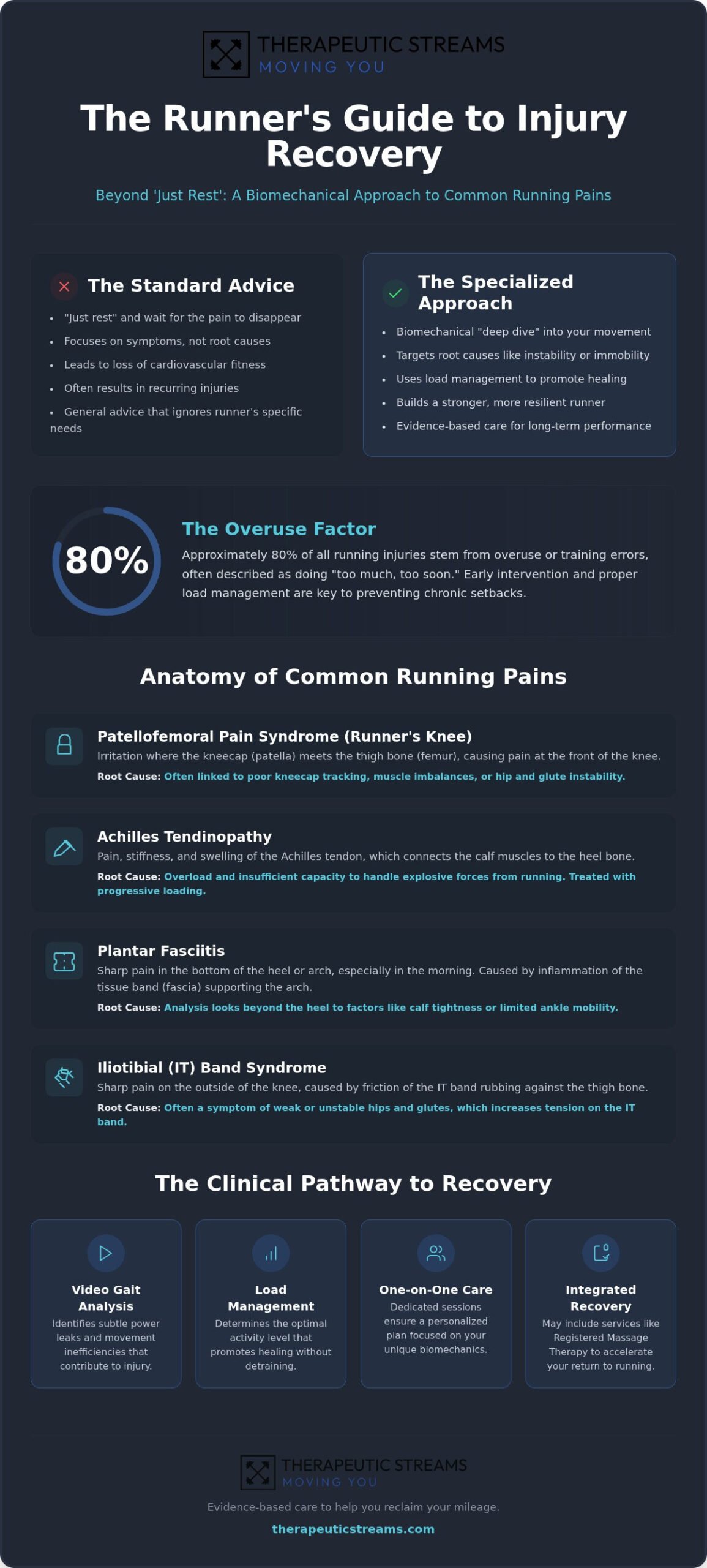
Understanding the specific pathology of your discomfort is the first step toward a resilient recovery. At our clinic, we frequently address Patellofemoral Pain Syndrome, commonly known as Runner’s Knee. This condition involves irritation where the kneecap rests on the thigh bone, often exacerbated by poor tracking or muscle imbalances. We also specialize in managing Achilles Tendinopathy. Instead of passive rest, we utilize progressive loading strategies to strengthen the tendon’s capacity to handle the explosive forces of each stride.
For distance athletes, Plantar Fasciitis is a frequent hurdle. We look beyond the heel to identify root causes like calf tightness or limited ankle mobility that force the fascia to overwork. Similarly, Iliotibial (IT) Band Syndrome is often a symptom of hip and glute instability rather than a problem with the band itself. By stabilizing the pelvis, we reduce the lateral friction that causes that characteristic sharp pain on the outside of the knee. If you are struggling with these persistent issues, our team provides targeted physiotherapy for running injuries Whitby to help you reclaim your mileage.
Overuse Injuries vs. Acute Strains
Research indicates that approximately 80% of running injuries stem from overuse or training errors, often described as doing “too much, too soon.” Recognizing early warning signs is vital for long-term health. Morning stiffness in the heel or a dull ache along the shin bone can signal the onset of Medial Tibial Stress Syndrome, or Shin Splints. Our rehab protocols for these conditions focus on bone stress management and gradual re-entry into impact activities, ensuring your tissues have the time they need to adapt and strengthen.
The Role of Biomechanics in Injury Prevention
Biomechanics play a decisive role in how your body manages stress during a run. Your foot strike pattern and cadence directly influence joint load; for example, increasing your step rate by a small margin can significantly reduce the impact on your knees and hips. Core stability also ensures proper lower limb alignment, preventing the “collapsing” inward of the knee during the stance phase. An excessive anterior pelvic tilt can decrease gluteal activation and negatively impact your overall running economy. By addressing these movement patterns, we help you build a foundation that supports higher performance with less risk of breakdown. Runners who experience persistent joint discomfort alongside their training may also benefit from exploring dedicated knee pain physiotherapy in Whitby to address the mechanical root causes before they escalate.
Choosing the Best Physiotherapy Near Me for Running Rehab
Selecting the right provider for physiotherapy for running injuries Whitby involves more than a quick search for the closest clinic. For an athlete, the quality of the clinical relationship directly impacts the speed and safety of your return to sport. You need an environment that prioritizes evidence-based, one-on-one care rather than high-volume models where your time is split between multiple patients. This dedicated focus allows for a deeper investigation into your specific movement patterns and ensures that every minute of your session is spent on targeted rehabilitation. It’s the difference between a generic treatment and a professional intervention designed for your unique physiology.
Integrated care is another hallmark of a sophisticated sports injury clinic in the Durham Region. When Physiotherapy is paired with Chiropractic Care and Registered Massage Therapy, the results are often more comprehensive. This team-based approach allows different disciplines to address various aspects of your recovery, from joint mobility to soft tissue tension, under one roof. Additionally, look for clinics that offer advanced modalities such as Shockwave Therapy for chronic tendon issues or Neurofunctional Acupuncture to address persistent nerve-related discomfort. These evidence-based tools, when applied within a structured rehab plan, can significantly accelerate the healing process for complex running injuries.
Questions to Ask Your Potential Physiotherapist
Before committing to a treatment plan, it’s essential to interview your provider to ensure their expertise aligns with your needs. Ask if they have direct experience working with marathoners or trail runners, as the demands of these disciplines differ from general fitness. Inquire whether your initial assessment will include a functional movement screen to identify biomechanical vulnerabilities. Finally, confirm how they intend to integrate your specific running goals, such as a target race date or mileage milestone, into the clinical progression. A transparent provider will welcome these questions and provide clear, research-backed answers.
Red Flags in High-Volume Clinics
Not all clinics operate with the same level of patient advocacy. A major red flag is the practice of “double-booking,” where a therapist manages multiple patients simultaneously or leaves you with an assistant for the majority of your visit. If you find yourself left on a machine for 20 minutes without professional supervision, your recovery is not being prioritized. Another warning sign is the lack of a clear, written progression for your return to sport. You should never leave an appointment with a generic exercise sheet that hasn’t been tailored to your specific biomechanics. Effective physiotherapy for running injuries Whitby requires a personalized roadmap that evolves as you get stronger.
The Running Assessment: What Happens During Your Appointment?
Understanding why your body is reacting to stress requires more than just a physical exam. A professional assessment for physiotherapy for running injuries Whitby begins with a deep dive into your training history, shoe wear patterns, and specific pain triggers. We examine your joint range of motion and tissue sensitivity to build a complete clinical picture. This diagnostic phase is critical for distinguishing between a simple strain and a more complex biomechanical failure. It allows us to determine exactly how much load your tissues can currently handle before we begin the rebuilding process.
We use objective data to move beyond symptom management. By testing your functional strength, we can uncover muscle imbalances that often go unnoticed during daily activities. For many athletes, a weak gluteus medius causes the pelvis to tilt during the stance phase, leading to a cascade of issues down the leg. Quantifying these weaknesses allows us to establish a precise baseline for your recovery. This ensures that your return-to-run protocol is based on objective physical readiness rather than guesswork or generic timelines. Runners who also experience lower back tightness or lumbar stiffness during or after training may find it helpful to review a dedicated resource on physiotherapy for back problems, as spinal mechanics can directly influence pelvic stability and running form.
Video Gait Analysis and Biomechanical Review
High-speed video gait analysis allows us to capture what the human eye cannot see in real time. By analyzing your stride on a treadmill, we can identify vertical oscillation and braking forces that contribute to joint stress. We look for “power leaks” that drain your efficiency and place unnecessary load on your tendons. Clinical research has shown that a 5% increase in your running cadence can reduce the mechanical load on your knee joints by as much as 20%. This type of biomechanical review is essential for making small, sustainable changes that lead to long-term performance gains on the trails.
Developing Your Personalized Treatment Plan
Your treatment plan integrates manual therapy with specific corrective exercises to address both symptoms and root causes. We work together to set SMART goals that align with your upcoming races in Whitby or the GTA, ensuring your rehab feels relevant to your lifestyle. For more insights on selecting the right level of care for your needs, explore our Sports Physiotherapy: A Buyer’s Guide. If you are ready to stop guessing about your recovery and start moving with precision, book your running assessment with our clinical experts today.
Integrated Recovery at Therapeutic Streams: The Whitby Advantage
Integrated recovery at Therapeutic Streams is built on the philosophy that no injury exists in isolation. When you seek physiotherapy for running injuries Whitby at our clinic, you gain access to a collaborative environment where multiple disciplines work toward your single goal of pain-free movement. Our team collaborates on complex cases to ensure that your recovery plan is seamless and comprehensive. By combining different clinical perspectives, we can address the multi-faceted nature of sports injuries more effectively than a siloed approach.
While physiotherapy focuses on biomechanical movement and load management, Registered Massage Therapy plays a vital role in managing the soft tissue tension that often accompanies high-mileage training. By reducing muscular hypertonicity, RMT allows for more effective joint mobilization and corrective exercise. We also utilize Neurofunctional Acupuncture to address the neurological component of injury. This modality helps “reset” inhibited muscles that may have stopped firing correctly due to pain or chronic strain, restoring the neuromuscular communication necessary for a powerful stride.
Recovery does not end when the pain disappears. We guide you through the transition from clinical rehab to long-term maintenance by integrating group fitness into your lifestyle. Options like Yoga and Pilates Classes are excellent for building the core stability and flexibility required to sustain your performance. This holistic approach ensures that you aren’t just recovering from an injury but are actively building a more resilient body for years to come.
Why One-on-One Care Matters for Athletes
The quality of your rehabilitation is often defined by the level of attention you receive. Having your therapist’s undivided attention for 30 to 60 minutes is essential for catching subtle movement errors that could lead to setbacks. This dedicated time allows us to ensure perfect form during corrective exercises, which is the most effective way to prevent secondary injuries caused by compensation. For a deeper look at these strategies, you can explore our clinical guide to staying active in Durham Region.
Booking Your Running Assessment in Whitby
We make the administrative side of recovery as smooth as the clinical side for our Durham residents. Booking a session for physiotherapy for running injuries Whitby is the first step toward professional clarity. Our clinic offers easy online booking and direct billing options to ensure your focus remains entirely on your health. To get the most out of your first visit, please bring the following items:
- Your primary running shoes to check wear patterns
- Comfortable athletic shorts for the physical assessment
- Your recent training log or race schedule
This information helps us understand the context of your injury and build a more accurate recovery timeline tailored to your ambitions. Book your one-on-one assessment at Therapeutic Streams today and take the first step toward reclaiming your place on the trail.
Reclaim Your Stride with Clinical Precision
Reclaiming your running routine requires more than just masking the pain; it demands a deep understanding of your body’s unique mechanics. We’ve explored how specialized assessments and integrated care can transform your recovery from a series of training interruptions into a clear path toward peak performance. By prioritizing evidence-based practices and assessment-driven care, you ensure that every mile is built on a foundation of strength and stability. This professional approach helps you move past the cycle of injury and toward your long-term athletic goals.
At Therapeutic Streams, we believe your health deserves undivided attention. Our commitment to no double-booking means you receive 100% one-on-one focus during every session. Our integrated clinic brings Physiotherapy, Chiropractic Care, and Registered Massage Therapy under one roof to provide a comprehensive solution for your musculoskeletal health. Whether you are navigating local trails or preparing for a personal best, our specialized physiotherapy for running injuries Whitby is designed to keep you moving with confidence. Don’t let a persistent ache dictate your training schedule any longer.
Schedule Your One-on-One Running Assessment in Whitby
We look forward to helping you thrive on the trails and achieve the resilient performance you deserve.
Frequently Asked Questions
How many sessions of physiotherapy will I need for my running injury?
The number of sessions required depends on the severity of your condition and your specific performance goals. Most runners with acute injuries see significant progress within four to six sessions, while chronic or complex biomechanical issues may require a longer duration of care. We focus on an assessment-driven approach to provide a clear, personalized timeline during your initial visit so you know exactly what to expect.
Should I stop running completely if I have a minor injury?
Complete rest is rarely the optimal solution for a minor running injury. We prioritize load management, which involves adjusting your mileage or intensity to a level that allows for tissue healing without causing further irritation. This approach keeps your cardiovascular fitness intact while we address the underlying cause of your discomfort through targeted physiotherapy for running injuries Whitby, ensuring you don’t lose your hard-earned progress.
Does provincial health insurance (OHIP) cover physiotherapy in Whitby?
Provincial health insurance (OHIP) does not typically cover services at private physiotherapy clinics in Ontario. Most residents in the Durham Region utilize their extended healthcare benefits from their employers to cover the costs of treatment. We offer direct billing to many major insurance providers to simplify the administrative process, allowing you to focus entirely on your physical recovery and return to the trails.
What is the difference between a sports physiotherapist and a general one?
A sports physiotherapist specializes in the high-impact demands of athletic performance rather than just basic activities of daily living. While a general therapist focuses on restoring everyday mobility, a sports-focused professional analyzes your gait, explosive strength, and plyometric readiness. This specialized expertise is essential for developing a return-to-run program that prevents the recurrence of injury during high-intensity training or competitive racing.
Can physiotherapy help me run faster or just fix injuries?
Physiotherapy can certainly help you run faster by optimizing your running economy and correcting biomechanical inefficiencies. By identifying power leaks in your stride and strengthening key muscle groups like the glutes and calves, you can produce force more efficiently. This transition from rehabilitation to performance enhancement is a core part of our evidence-based approach, helping you achieve new personal bests while staying injury-free.
Do I need a doctor’s referral to see a physiotherapist in Ontario?
You do not need a doctor’s referral to see a physiotherapist in Ontario because they are primary healthcare providers. You can book an assessment directly to begin your recovery immediately without waiting for a physician’s appointment. However, it is advisable to check with your private insurance provider, as some specific policies still require a physician’s note to process your reimbursement claims for the services provided.
What should I wear to my running injury assessment?
You should wear comfortable athletic clothing, such as running shorts and a t-shirt, that allows for a full range of movement and easy access to the injured area. It is also important to bring the running shoes you use most frequently so we can examine their wear patterns and fit. If you keep a training log, having that data available helps us understand your recent workload and injury context.
Is shockwave therapy effective for chronic running injuries like plantar fasciitis?
Shockwave Therapy is highly effective for chronic running injuries like Plantar Fasciitis and Achilles Tendinopathy that have not responded to traditional treatments. This non-invasive modality uses acoustic pressure waves to stimulate a healing response in persistent, scarred, or thickened tissues. It is a valuable tool within our integrated physiotherapy for running injuries Whitby protocols, often accelerating recovery for athletes struggling with long-term tendon or fascia pain.