
Sciatica Treatment in Whitby: Integrated Clinical Care for Lasting Relief
What if that sharp, shooting pain radiating down your leg isn’t just a back issue, but a complex signal that your entire kinetic chain requires a professional recalibration? For many residents seeking the high-quality sciatica treatment Whitby clinics provide, the daily reality involves more than just physical discomfort. It’s the anxiety of a long commute, the frustration of being unable to sit through a meal, and the confusion of whether to call a chiropractor, a physiotherapist, or a massage therapist. You want results that last, not just a temporary reprieve from the burning sensations that limit your mobility.
We understand that you’re looking for a path to recovery that avoids the operating table and returns you to the activities you love. Since sciatica is a symptom of an underlying condition rather than a standalone diagnosis, this article outlines how our multi-disciplinary, assessment-driven approach moves beyond surface-level discomfort to decompress the nerve and stabilize your spine. You’ll discover how a collaborative team of experts uses neurofunctional acupuncture, clinical massage, and evidence-based rehabilitation in one-on-one sessions to eliminate radiating pain. We’ll preview the journey from your initial thorough assessment to a personalized prevention programme designed to stop future flare-ups before they start.
Key Takeaways
- Learn why sciatica is a symptom of nerve root irritation rather than a standalone diagnosis, often triggered by local factors like long commutes or sedentary office work.
- Discover how a multi-disciplinary approach to sciatica treatment Whitby patients rely on combines clinical nerve decompression with functional stabilization.
- Explore advanced clinical modalities such as neurofunctional acupuncture and shockwave therapy to reset overactive muscle patterns and address chronic tissue adhesions.
- Understand the “motion is lotion” philosophy and how to implement ergonomic strategies at home to maintain mobility and prevent future nerve irritation.
- Realize the value of one-on-one, assessment-driven care that focuses on treating the whole person rather than just an imaging report.
Understanding Sciatica: Why Localized Pain Needs a Whitby Clinical Assessment
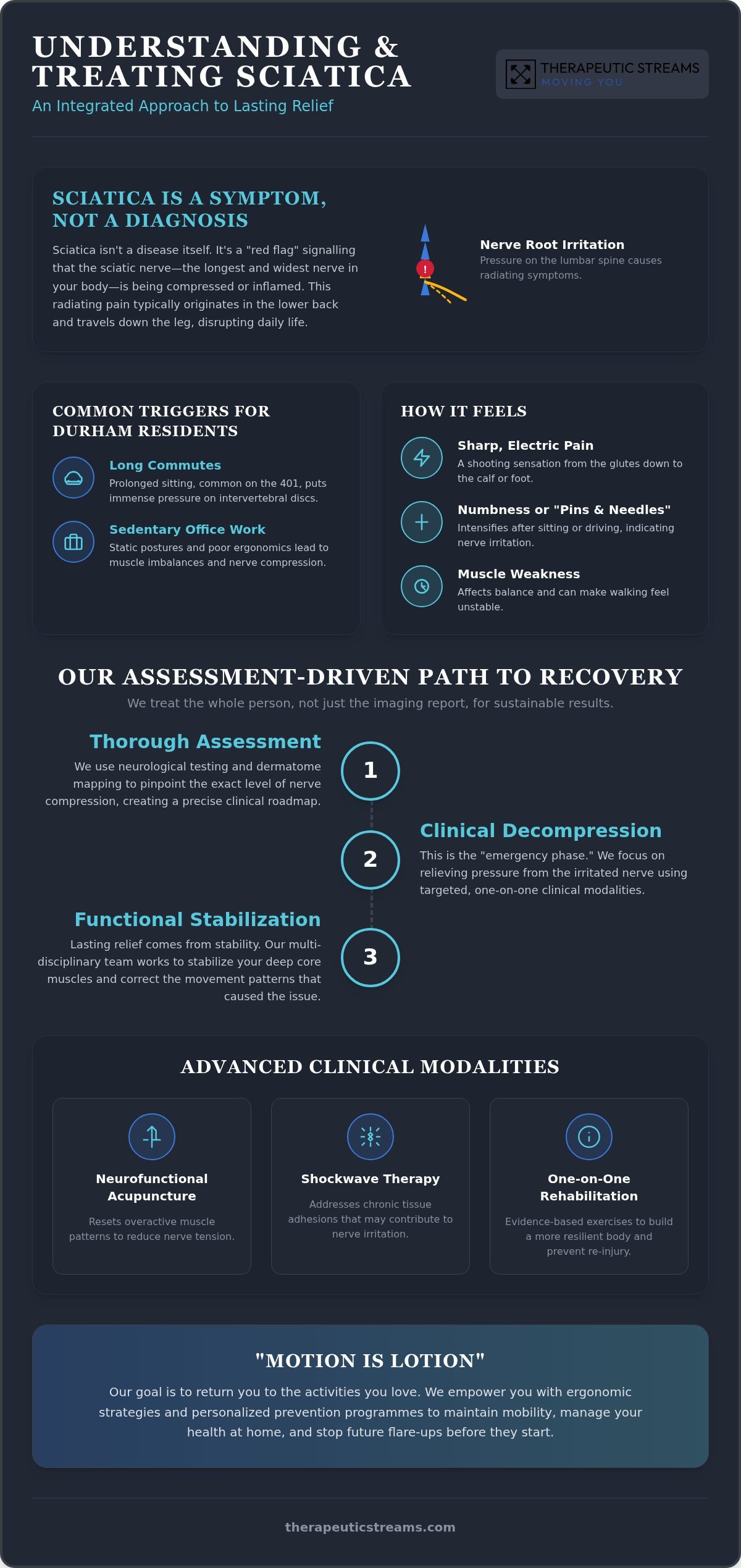
Sciatica isn’t a single disease. Instead, it’s a radiating symptom of underlying nerve root irritation within the lumbar spine. For those seeking sciatica treatment Whitby clinics provide, it’s vital to recognize that this pain is a clinical “red flag.” It signals that the sciatic nerve, which is the longest and widest nerve in your body, is being compressed or inflamed. For a comprehensive overview of sciatica, one can see how the condition typically originates from the lower back and travels through the hips down each leg.
Life in Durham Region often contributes to these mechanical stresses. Many of our clients face long, daily commutes on the 401, where prolonged sitting in a fixed position puts immense pressure on the intervertebral discs. Others struggle with sedentary office work or repetitive sports injuries from local athletics. These repetitive strains can lead to true sciatica, where a disc or joint directly affects the nerve root. However, some experience “pseudo-sciatica,” or piriformis syndrome, where a tight muscle in the gluteal region mimics nerve pain. Distinguishing between the two is the first step toward lasting relief. Choosing a “wait and see” approach often backfires. Your body develops chronic compensation patterns, like limping or leaning, which eventually cause secondary pain in the hips or the opposite leg.
Common Symptoms Experienced by Durham Region Patients
The experience of nerve pain is distinct from a typical muscle pull. Our patients often describe a specific set of sensations that disrupt their daily routines and cause significant anxiety about their long-term health:
- Sharp, electric-like pain that shoots from the glutes down to the calf or foot.
- Persistent numbness or “pins and needles” that intensify after sitting at a desk or driving.
- Noticeable muscle weakness in the leg that makes walking feel unstable or affects your balance.
The Importance of an Evidence-Based Diagnosis
Effective sciatica treatment Whitby residents deserve must begin with a precise clinical roadmap. We prioritize a thorough physical assessment over simply reviewing an MRI or X-ray. Research shows that many people have disc bulges on their scans but feel no pain, while others have severe pain with “clean” scans. Our clinicians focus on the person, not just the image. We use neurological testing, such as reflex checks and dermatome mapping, to determine the exact level of nerve compression. By identifying whether the issue stems from a specific disc, a narrow spinal canal, or a joint dysfunction, we can create a targeted recovery plan that addresses the root cause of your discomfort.
The Integrated Approach to Sciatica Treatment in Whitby
Most traditional clinics treat nerve pain through a single lens, focusing solely on the site of discomfort. We believe that effective sciatica treatment Whitby residents deserve requires an integrated model of care. Decompressing the irritated nerve is merely the emergency phase of recovery. To achieve lasting relief, our team utilizes a “Kinetic Chain” assessment. This process evaluates how your movement patterns from the feet up to the neck influence the mechanical stress on your lower back. By understanding Sciatica diagnosis and treatment standards, we realize that if a hip is restricted or a foot arch is collapsing, the lumbar spine often pays the price through increased nerve compression.
Our collaborative environment allows multiple specialists to work as a single unit. For example, our pelvic floor physiotherapists often consult on complex sciatica cases. They help stabilize the deep core muscles that provide the internal “brace” your spine needs to stay healthy. This comprehensive oversight ensures we treat the person, not just the scan. If you’re tired of temporary fixes, consider how our integrated clinical team can help you build a more resilient body.
Chiropractic Adjustments for Spinal Alignment
Restoring joint mobility is a cornerstone of our practice. When you seek professional chiropractic care in Whitby, our focus is on reducing the mechanical load on your intervertebral discs. We don’t rely on a one-size-fits-all approach. Depending on your assessment, we might use gentle spinal mobilization to calm an angry nerve or high-velocity adjustments to restore motion to a locked facet joint. These precise interventions help realign the spine, which directly reduces the pressure on the sciatic nerve roots.
Physiotherapy and Active Rehabilitation
Once the initial inflammation subsides, physiotherapy becomes the engine of your recovery. Our therapists design customized exercise programmes that prioritize the “posterior chain” and core stability. We teach you specific nerve gliding exercises. These movements help the sciatic nerve slide smoothly through its surrounding tissues rather than getting caught on adhesions. For Whitby office workers and commuters, we provide essential postural correction education to ensure your workspace doesn’t undo the progress made during your sessions.
Registered Massage Therapy (RMT) for Soft Tissue Relief
Clinical RMT is vastly different from a relaxing spa massage. In the context of sciatica, our RMTs focus on releasing compensatory muscle tension in the glutes, piriformis, and lower back. This targeted manual therapy improves blood flow to irritated nerve tissues, which accelerates the natural healing process. By addressing the “soft tissue armor” that often develops around a painful area, we create the space necessary for the nerve to recover without constant muscular impingement.
Advanced Modalities for Stubborn Sciatic Pain
When standard stretching and basic adjustments fail to provide lasting relief, it’s time to look toward advanced clinical tools. This is the level of sciatica treatment Whitby residents require when their pain has become chronic or resistant to traditional methods. By utilizing modern technology that targets the nervous system directly, we can often break the cycle of persistent discomfort. According to a clinical review of sciatica treatments, conservative care that incorporates varied, evidence-based modalities often yields the best long-term outcomes without the need for invasive surgery. Our clinic prioritizes these sophisticated interventions to address the complex, multi-site pain that often accompanies long-term nerve irritation.
We believe that these advanced tools are most effective when delivered in a focused environment. Our commitment to one-on-one sessions ensures that your clinician isn’t distracted by multiple patients or double-booking. This dedicated time allows us to monitor your response to treatments in real-time, adjusting the intensity to match your specific clinical needs. This level of precision is what differentiates a professional recovery plan from a generic list of exercises.
Neurofunctional Acupuncture for Nerve Desensitization
Unlike traditional acupuncture which focuses on energy meridians, our neurofunctional approach is rooted in modern anatomy and physiology. We use fine needles to target specific motor points and nerves, applying gentle electrical stimulation to “reboot” the communication between your brain and your muscles. This technique is remarkably effective for chronic radiating leg pain because it desensitizes the irritated nerve and resets overactive muscle patterns that may be contributing to spinal compression. By modulating the nervous system, we can reduce the intensity of your pain signals, which allows you to participate more fully in your active rehabilitation programme.
Shockwave Therapy: When to Consider It
Chronic sciatica often involves more than just a disc; it frequently includes thickened ligaments or tissue adhesions that have formed over months of physical compensation. Shockwave therapy uses high-energy acoustic waves to penetrate deep into these tissues, stimulating a pro-inflammatory response that jumpstarts the body’s natural healing process. It’s an ideal option for patients who have “plateaued” in their recovery or those dealing with stubborn soft tissue restrictions. During a typical session at our Whitby clinic, a handheld device delivers these pulses to the lumbar region or gluteal tissues, breaking down scar tissue and improving local circulation to the irritated nerve roots.
Managing Sciatica at Home: The Road to Prevention
Clinical intervention provides the foundation for recovery, but lasting relief depends on the habits you cultivate at home. We often tell our patients that “motion is lotion.” While your instinct might be to retreat to bed during a flare-up, complete rest is often counterproductive. Prolonged inactivity allows the muscles to stiffen and reduces blood flow to the irritated nerve tissues. Instead, gentle, controlled movement is essential to maintain the progress achieved during your sciatica treatment Whitby sessions. By keeping the joints mobile, you encourage the healing process and prevent the formation of new adhesions.
For the many remote workers in Whitby, your home office setup is a critical factor in your spinal health. A neutral spine position is non-negotiable. This means your ears should be aligned over your shoulders, and your hips should be slightly higher than your knees. If you’re a local athlete looking to return to the golf course or the cycling trails, a gradual re-entry is key. We focus on “graded exposure,” where we slowly increase the intensity of your activity to ensure your nervous system can handle the load without triggering a protective pain response.
Daily Strategies for Nerve Decompression
Small adjustments throughout the day can significantly reduce the cumulative stress on your lumbar spine. If you work at a desk, try simple decompression stretches every hour. Stand up, place your hands on your lower back, and perform a gentle extension to counteract the forward-slumping posture of computer work. When lifting anything from a grocery bag to a child, always hinge at the hips and use your legs rather than rounding your back. Sleep hygiene also plays a role. If you’re a side sleeper, placing a pillow between your knees can keep your pelvis neutral and prevent the sciatic nerve from being stretched or compressed overnight.
When to Seek Immediate Professional Help
While most cases of nerve irritation respond well to conservative care, you must be able to identify “red flag” symptoms that require urgent medical attention. If you experience sudden changes in bowel or bladder function, or if you notice significant numbness in the “saddle area,” seek emergency care immediately. More commonly, you might notice a progression from a stiff lower back to sharp, shooting pain. In cases where the pain extends further down the limb, our knee pain physiotherapy in Whitby can help determine if your leg discomfort is coming from the joint itself or is a referred symptom from your spine. Consistent maintenance care is the best way to monitor these patterns and prevent a minor ache from becoming a major setback. If you’re ready to take control of your recovery, book your assessment with our integrated team today.
Why Choose Therapeutic Streams for Sciatica Treatment in Whitby?
Choosing where to receive your sciatica treatment Whitby is a decision that impacts your long-term quality of life. At Therapeutic Streams, we’ve moved away from the traditional, fragmented model of care. Instead, we’ve built a collaborative environment where Chiropractors, Physiotherapists, and Registered Massage Therapists work as a single, cohesive unit. This means your recovery isn’t limited to the perspective of one discipline. If your nerve pain requires spinal mobilization, active rehabilitation, and soft tissue release, our team coordinates your care in real-time. We act as dedicated advocates for your well-being, ensuring that every session builds upon the last to create a foundation for lasting health.
We also realize that an informed patient is a more successful one. Education is a core pillar of our clinical practice. We don’t just provide treatments; we explain the mechanical “why” behind your symptoms. By understanding the root cause of your sciatic nerve irritation, you gain the confidence to manage your recovery between appointments. This transparency fosters a relationship of trust and empowers you to take an active role in your journey from discomfort to wellness. Our goal is to move you beyond simple pain management and toward a state where you can thrive in your daily activities.
Our Assessment-First Philosophy
Every successful recovery begins with a clear roadmap. We don’t believe in “one-size-fits-all” solutions or double-booking our clinicians. Your journey starts with a deep-dive clinical history and a comprehensive physical examination. We look past the symptoms to identify the specific mechanical triggers in your lifestyle, whether it’s your posture at work or your technique on the local trails. We then create a personalized plan that fits your specific goals, providing transparent communication about expected timelines and clinical outcomes. This assessment-driven approach ensures that every intervention is purposeful, evidence-based, and tailored to your unique physiology.
Convenient Care in the Heart of Whitby
We’ve designed our clinic to be a professional and welcoming pillar of the Durham Region health community. We prioritize your convenience by offering easy online booking for all our modalities and direct billing to most major insurance providers. Our Whitby location is easily accessible, providing a sophisticated environment where you can focus entirely on your recovery. You don’t have to navigate chronic nerve pain alone. Take the first step toward lasting relief and an active, pain-free lifestyle. Book your initial assessment at Therapeutic Streams today and experience the difference of integrated clinical care.
Reclaiming Your Mobility and Living Pain-Free in Whitby
Sciatic nerve pain doesn’t have to be a permanent fixture in your life. By moving beyond the “wait and see” approach and addressing the mechanical root of your discomfort, you can stop the cycle of radiating pain and chronic compensation. You’ve learned that effective sciatica treatment Whitby residents rely on involves more than just localized relief; it requires a comprehensive look at your movement patterns, ergonomic habits, and spinal health. Whether the cause is a long commute on the 401 or a sedentary workspace, identifying the source of nerve irritation is the first step toward lasting wellness.
Our integrated team of Chiropractors, Physiotherapists, and Registered Massage Therapists is ready to partner with you on this journey. We provide one-on-one, evidence-based sessions that prioritize your unique goals and lifestyle. By combining clinical expertise with advanced modalities like neurofunctional acupuncture, we focus on the person, not just the scan. Book Your Sciatica Assessment at Therapeutic Streams Today and take the first decisive step toward a resilient, active future. You deserve a recovery that lasts, and we’re here to help you achieve it.
Frequently Asked Questions
Do I need a doctor’s referral for sciatica treatment in Whitby?
No, you don’t need a physician’s referral to begin sciatica treatment Whitby residents can access our services directly. Chiropractors and physiotherapists are primary health care professionals in Ontario, meaning they can assess and diagnose your condition independently. While some private insurance plans still require a note for reimbursement, we can begin your clinical assessment and treatment plan immediately to address your pain and start the healing process.
How many sessions of physiotherapy or chiropractic will I need for sciatica?
The number of sessions required depends entirely on your specific assessment and how long you’ve been experiencing symptoms. Most patients notice significant relief within the first four to six visits as we work to decompress the nerve. However, a full recovery that includes stabilizing the spine and preventing future flare-ups often requires a few months of consistent, one-on-one care. We provide transparent timelines after your initial physical examination.
Is it better to see a chiropractor or a physiotherapist for sciatica?
Neither is objectively “better” because they address different aspects of the condition. Chiropractic care focuses on joint mobility and spinal alignment, while physiotherapy emphasizes active rehabilitation and muscle strengthening. Our integrated model combines both disciplines to ensure we treat the whole person. By resolving joint restrictions and then building a resilient core, we provide a more comprehensive solution than a single-modality approach could offer on its own.
Can registered massage therapy (RMT) actually help with nerve pain?
Registered Massage Therapy is a powerful tool for managing nerve pain when used clinically. While massage doesn’t treat the nerve directly, it releases the compensatory muscle tension in the glutes and lower back that often worsens compression. By relaxing the piriformis muscle and improving blood flow to the surrounding tissues, RMT creates an environment where the sciatic nerve can heal more effectively without constant muscular impingement.
What is the most effective exercise for sciatica relief at home?
There isn’t one universal exercise for everyone because the “best” movement depends on whether your pain is caused by a disc bulge or spinal stenosis. However, gentle nerve gliding exercises are frequently effective for restoring mobility. We prioritize the “motion is lotion” philosophy, encouraging controlled activity over bed rest. Your clinician will prescribe specific stretches and strengthening movements only after a thorough assessment to ensure they’re safe for your spine.
Will my extended health insurance cover sciatica treatments in Ontario?
Most extended health insurance plans in Ontario provide coverage for Chiropractic Care, Physiotherapy, and Registered Massage Therapy. Since sciatica is a clinical condition, these evidence-based treatments are typically eligible for reimbursement. We offer direct billing to most major insurance providers at our Whitby clinic, which simplifies the process for you. We recommend checking your specific policy details regarding annual maximums and any requirements for physician notes.
How do I know if my sciatica is getting better or worse?
You can track your progress through a process called “centralization.” If your pain moves from your foot or calf up toward your glutes or lower back, it’s a positive sign that the nerve compression is decreasing. Conversely, if the pain travels further down your leg or you notice new weakness, the condition may be worsening. We monitor these neurological markers during every session to ensure your sciatica treatment Whitby plan is on track.
Can a professional BikeFIT help if my sciatica flares up while cycling?
Yes, a professional BikeFIT is highly beneficial if cycling triggers your nerve pain. Sciatica often flares up during riding due to poor saddle positioning or an aggressive reach that puts the lumbar spine under excessive tension. By optimizing your bike’s geometry to match your unique anatomy, we reduce the mechanical load on your lower back. This allows you to enjoy your sport without the risk of irritating the sciatic nerve.