Chiropractic Care Checklist: Signs You Need an Assessment and What to Expect
What if that nagging stiffness in your lower back isn’t just a side effect of a long week, but a clear signal that your body’s structural balance needs professional attention? Many people in the Durham Region live with chronic discomfort because they’re unsure if their symptoms warrant clinical intervention. Professional chiropractic care is often misunderstood as being solely about loud adjustments. In reality, it’s a rigorous, evidence-based discipline focused on restoring your natural movement and optimizing musculoskeletal health.
It’s frustrating to feel sidelined by a body that won’t cooperate, especially when you’re trying to maintain an active lifestyle or excel in your sport. You deserve a clear path to recovery that replaces guesswork with clinical precision. This guide will help you identify the essential signs that your body needs a professional assessment and explain exactly what to expect during your first visit to a modern clinic. We’ll explore how integrated, assessment-driven treatments can reduce your pain and provide a transparent, evidence-led roadmap to better mobility. It’s time to move with confidence again.
Key Takeaways
- Understand the modern, evidence-based approach to chiropractic care that prioritizes clinical research and personalized assessments over outdated myths.
- Identify the specific physical signals, such as persistent joint stiffness or recurring tension headaches, that indicate your body requires a professional clinical evaluation.
- Learn how an integrated treatment model addresses both joint mobility and muscle health to provide a more comprehensive path to recovery.
- Prepare for your initial assessment by gathering relevant health records and choosing comfortable clothing to ensure a seamless and thorough diagnostic process.
- Discover the value of a dedicated, one-on-one clinical environment where your recovery plan is tailored to your unique musculoskeletal needs.
What is Chiropractic Care? Defining the Modern Clinical Approach
Chiropractic care represents a sophisticated branch of healthcare that focuses on the intricate relationship between your spine, nervous system, and overall musculoskeletal function. It’s a regulated, non-invasive profession that prioritizes manual therapy and rehabilitative exercises to restore movement. In Ontario, chiropractors are recognized as primary care providers. This status is significant because it allows you to access specialized assessment and treatment without requiring a referral from a family physician, making professional care more accessible when you need it most.
The modern clinical model isn’t based on tradition alone. It’s an evidence-based discipline that integrates the latest clinical research with hands-on expertise to ensure patient safety and efficacy. Instead of focusing solely on temporary relief, the goal is long-term wellness and functional optimization. Practitioners look at how your body moves as a whole system, identifying where restrictions or imbalances might be hindering your daily activities or athletic performance. This proactive approach helps you transition from a state of discomfort to a life of thriving movement.
The Education of an Ontario Chiropractor
Becoming a chiropractor in Canada requires an extensive academic commitment. Most practitioners complete at least seven years of post-secondary education, including a four-year professional program at an accredited institution. Their training involves rigorous study in anatomy, physiology, and neurology, with a heavy emphasis on radiology, orthopaedics, and neurofunctional assessments. They’re trained to interpret diagnostic imaging and perform complex physical exams to ensure every treatment plan is grounded in clinical reality. In Canada, the Doctor of Chiropractic (DC) designation signifies a practitioner who has met these stringent national competency standards and passed comprehensive board examinations.
Common Conditions Treated Beyond Back Pain
While many people seek help for spinal issues, the scope of practice extends far beyond the lower back. Modern assessments are designed to uncover the root cause of discomfort throughout the entire body. We frequently treat conditions that impact your quality of life, including:
- Sciatica and nerve impingement: Addressing the mechanical pressure points that cause radiating leg pain or numbness.
- Tension headaches: Reducing the cervical restrictions and muscular tension that often trigger chronic migraines.
- Repetitive strain injuries: Managing issues like carpal tunnel or tendonitis resulting from workplace ergonomics or repetitive tasks.
- Extremity joint health: Treating dysfunction in the hips, knees, and ankles to improve gait, balance, and athletic stability.
By analyzing your biomechanical imbalances, a clinician can identify why a specific joint isn’t functioning correctly. This comprehensive view ensures that we aren’t just masking symptoms; we’re actively working to improve your body’s structural integrity and overall resilience.
The Essential Checklist: 5 Signs You Need a Chiropractic Assessment
Your body is a master communicator. It rarely remains silent when structural imbalances begin to impact your daily life. While some discomfort is temporary, other signals indicate a deeper mechanical issue that requires professional attention. Recognizing these signs early allows you to address the root cause before a minor restriction evolves into a chronic limitation. Professional chiropractic care focuses on interpreting these signals through a clinical lens to restore your body’s natural resilience.
If you’re unsure whether your symptoms warrant a visit, use this checklist to evaluate your current musculoskeletal health:
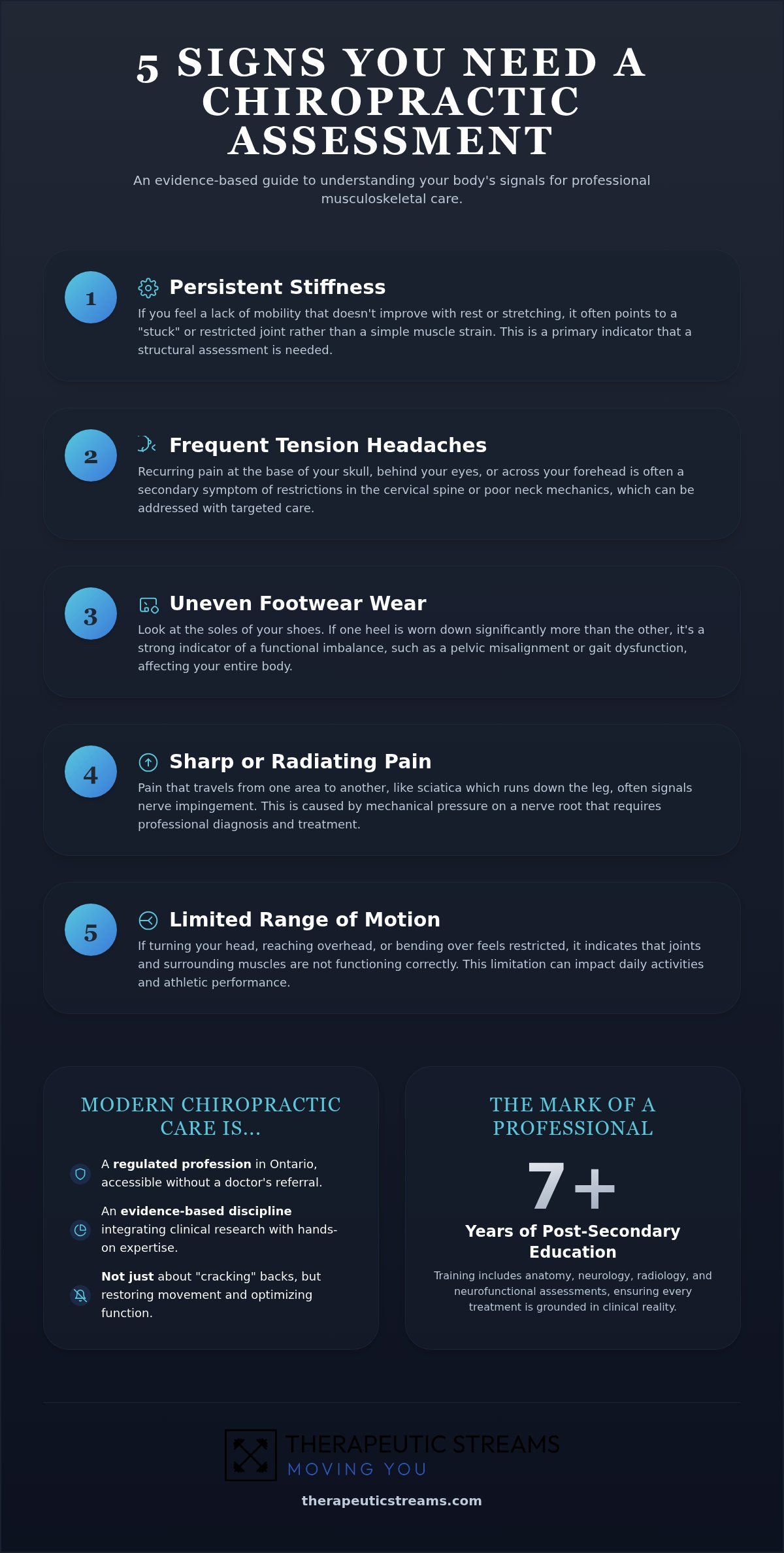
- Persistent stiffness: You feel a lack of mobility that doesn’t resolve with a full night’s rest or basic stretching. This often points to a “stuck” joint rather than a simple muscle strain.
- Frequent tension headaches: You experience recurring pain at the base of your skull or behind your eyes. These are often secondary symptoms of cervical spine restrictions or poor neck mechanics.
- Uneven footwear wear: Take a look at the soles of your favourite shoes. If one heel is worn down significantly more than the other, it’s a strong indicator of pelvic misalignment or a gait dysfunction.
- Sharp, shooting sensations: Pain that travels down your leg or numbness in your fingers suggests nerve impingement, commonly known as sciatica when it involves the lower back.
- Decreased athletic performance: Your range of motion has plateaued, or your movements feel heavy and unresponsive during your workouts.
Identifying Movement Restrictions
You can often spot movement limitations during mundane tasks. Notice if you struggle to turn your head fully to check your blind spot while driving. This restriction suggests a loss of segmental motion in the neck. Similarly, if certain joints feel “heavy” or require extra effort to move during exercise, your biomechanics may be compromised. Addressing these minor niggles early prevents the body from creating compensatory patterns that lead to more complex injuries. If you’ve noticed these subtle shifts, a comprehensive chiropractic assessment can provide the clarity you need to move forward.
Postural Warning Signs for Office Workers
Modern work environments often demand hours of sedentary focus, leading to what clinicians call “tech neck.” This occurs when the head shifts forward, placing immense strain on the cervical spine and upper back muscles. If you find yourself slouching or experiencing a dull ache between your shoulder blades by mid-afternoon, your workstation setup may be contributing to spinal misalignment. Early intervention is vital. By correcting these postural habits and restoring joint function now, you can prevent the long-term structural changes that often result from years of repetitive desk strain.
Integrated Recovery: How Chiropractic Care Works with Other Therapies
Recovery is rarely a linear path, and it’s most effective when multiple disciplines work in harmony. The “Therapeutic Streams” integrated model moves beyond the traditional siloed approach to healthcare by treating the muscle and the joint simultaneously. This collaborative methodology ensures that your treatment plan is comprehensive, addressing the structural, soft tissue, and neurological components of your injury. When chiropractic care is paired with neurofunctional acupuncture, for instance, we can target both the mechanical joint restriction and the underlying nerve health to accelerate healing.
Understanding the distinction between a chiropractor vs physiotherapist is helpful, but seeing them as partners is even more powerful. While a chiropractor focuses on optimizing joint mechanics and spinal health, a physiotherapist often emphasizes active rehabilitation and movement patterns. Together, they solve complex musculoskeletal issues that a single modality might miss. This synergy also prepares your body for active classes like yoga or pilates by ensuring your joints have the necessary range of motion to perform movements safely and effectively.
Chiropractic and Registered Massage Therapy (RMT)
The relationship between your joints and your soft tissues is inseparable. Muscles move joints, but dysfunctional joints cause muscles to guard and tighten, creating a feedback loop of pain. This “muscle-joint loop” is why we often recommend pairing adjustments with Registered Massage Therapy. When an RMT releases deep-seated muscle tension, the subsequent chiropractic adjustment is often easier to perform and tends to “hold” longer. Having both practitioners in one Whitby centre facilitates seamless communication, ensuring your care team is always aligned on your progress.
Supporting Athletic Performance
For Durham athletes, maintaining peak performance requires more than just training; it requires proactive maintenance. A sports chiropractor plays a vital role in injury prevention by identifying biomechanical red flags before they lead to a season-ending injury. Our assessment-driven approach is particularly effective for high-impact sports recovery, where precision is paramount. By integrating specialized tools like shockwave therapy with manual adjustments, we can address chronic tissue issues and joint restrictions simultaneously, allowing you to return to your sport with improved resilience and power.
Preparing for Your First Visit: A Patient Readiness Checklist
Walking into a clinic for the first time can feel overwhelming, but preparation is the key to a successful diagnostic experience. Your first visit is a collaborative effort to uncover the root cause of your discomfort. Professional chiropractic care is most effective when the clinician has a complete picture of your physical history. By arriving prepared, you ensure that more time is spent on your physical evaluation and less on administrative hurdles.
To make the most of your initial consultation, follow this readiness checklist:
- Compile your records: Gather any previous imaging, such as X-rays or MRIs, and bring copies of reports from previous practitioners or Motor Vehicle Accident (MVA) documentation.
- Dress for movement: Wear loose, comfortable clothing, such as athletic wear, that allows for a full range of motion during the assessment.
- Define your objectives: Prepare a list of specific goals. Are you looking for immediate pain relief, or is your priority returning to a competitive sport?
- Review your coverage: Most Canadian extended health benefit plans provide coverage for chiropractic care. Check your specific policy limits before you arrive.
- Complete digital forms: Arrive a few minutes early to our Whitby location or complete your digital intake forms online to streamline the process.
What Happens During the Initial Assessment?
Your first appointment is a deep dive into your body’s mechanics. It begins with a thorough discussion of your lifestyle, injury history, and daily physical demands. This is followed by a comprehensive physical exam, which may include gait analysis and specific orthopaedic testing to identify joint dysfunction. In Ontario, your practitioner will also guide you through the informed consent process. This ensures you fully understand the proposed treatment, any potential risks, and the expected outcomes before any manual therapy begins.
Understanding the Treatment Plan
Once the assessment is complete, your chiropractor will outline a personalized roadmap for your recovery. The frequency of your visits is determined by the severity of your condition and your body’s response to initial care. Most plans move through a “relief phase,” focused on reducing acute symptoms, followed by a “wellness phase” designed to prevent recurrence and optimize function. Because we prioritize one-on-one sessions without double-booking, you receive the practitioner’s undivided attention. This focused environment leads to more precise adjustments and faster results. If you’re ready to start your journey toward better movement, you can book your assessment online today.
Evidence-Based Chiropractic Care in Whitby at Therapeutic Streams
At Therapeutic Streams, we believe that effective chiropractic care begins with a deep commitment to the individual. Our Whitby clinic operates on an assessment-driven model where every treatment plan is as unique as your own biomechanics. We’ve intentionally eliminated the industry practice of double-booking, ensuring that you have our practitioner’s full attention during your one-on-one sessions. This dedicated time allows for a more nuanced understanding of your symptoms and a more precise application of manual therapy. We’re proud to serve residents across the Durham Region, providing a reliable health hub for those in Whitby, Oshawa, Ajax, and Bowmanville who seek results-oriented care.
Our “Beyond the Adjustment” philosophy means we don’t just look at the spine in isolation. We analyze how your lifestyle, previous injuries, and daily movements contribute to your current state of health. By prioritizing a thorough diagnostic process, we can offer a more sophisticated level of care that targets the root cause of dysfunction. This proactive approach helps you move past the cycle of recurring pain and toward a sustainable state of physical resilience. If waking up with a rigid lower back is a familiar struggle, our step-by-step recovery guide for back pain outlines exactly how evidence-based chiropractic care resolves underlying issues rather than simply masking symptoms.
Our Collaborative Clinical Environment
The strength of our clinic lies in our professional synergy. It’s common for our chiropractors to consult directly with our Registered Massage Therapists or Physiotherapists to refine a patient’s recovery roadmap. This level of internal communication ensures that your progress is monitored from multiple clinical perspectives, optimizing your outcomes at every stage. While we maintain a strong focus on sports rehabilitation, our services are designed for patients of all ages. Whether you’re an elite athlete looking for a competitive edge or a grandparent wanting to maintain mobility for daily walks, our team works together to help you thrive. This integrated approach is a primary reason why Durham Region residents trust us with their complex musculoskeletal care.
Booking Your Assessment
We realize that your time is valuable, which is why we’ve made it simple to access professional chiropractic care in Whitby. Our intuitive online booking system allows busy professionals and families to schedule assessments at their convenience, without the need for lengthy phone calls. For those recovering from a collision, we’re a fully MVA-friendly clinic. We assist with the necessary insurance paperwork and documentation, allowing you to focus entirely on your physical recovery rather than administrative stress.
Your journey from discomfort back to wellness doesn’t have to be a solo effort. With the right clinical partners and an evidence-led plan, you can regain your mobility and return to the activities you love with renewed confidence. We invite you to experience a different standard of chiropractic care—one that is rooted in transparency, dedication, and clinical excellence. Your path to better movement starts with a single, professional assessment.
Take the First Step Toward Lasting Mobility
Understanding the signals your body sends is the first step toward reclaiming your physical freedom. Whether you’re managing persistent stiffness or seeking to optimize your athletic performance, professional chiropractic care provides the clinical roadmap needed for sustainable recovery. By choosing an evidence-based approach that integrates with other therapies like massage and physiotherapy, you’re investing in a comprehensive solution rather than a temporary fix.
At Therapeutic Streams, we’re dedicated to serving the Durham Region with clinical excellence and a patient-first philosophy. Our strict no double-booking policy ensures you receive the focused, one-on-one attention your recovery deserves. You don’t have to navigate chronic discomfort alone. Our team is here to act as your partner in health, providing the expertise and advocacy you need to thrive. Book your one-on-one chiropractic assessment in Whitby today and start moving with the confidence you deserve. Your body will thank you for the professional care.
Frequently Asked Questions
Is chiropractic care safe for seniors and children?
Yes, it’s a safe and effective option for patients of all ages. Clinicians adapt their force and methodology based on the patient’s age and skeletal maturity. For seniors, we prioritize gentle mobilization to maintain joint health and mobility; for children, we use extremely light pressure tailored to their developing musculoskeletal systems.
Do I need a referral from my family doctor to see a chiropractor in Ontario?
No, you don’t require a referral to access professional chiropractic care in Ontario. As primary care providers, chiropractors are trained to diagnose musculoskeletal conditions and determine if you’re a candidate for treatment. If your condition requires a different medical specialist, we’ll provide the necessary guidance to ensure you receive the correct care.
How long does a typical chiropractic appointment last?
Your initial assessment typically lasts between 45 and 60 minutes to allow for a thorough physical exam and history review. Subsequent follow-up appointments are usually shorter, ranging from 15 to 20 minutes. Because we don’t double-book, this time is spent entirely on one-on-one treatment and progress monitoring.
Will my insurance plan cover chiropractic treatments?
Most Canadian extended health benefit plans include coverage for these services. We also accept Motor Vehicle Accident (MVA) claims and assist with the required documentation. It’s always best to verify your specific policy limits or co-payment requirements with your insurance provider before your first visit to our centre.
What is that popping sound during a chiropractic adjustment?
That sound is known as cavitation. It occurs when a quick movement causes a pressure change within the joint fluid, releasing gas bubbles like oxygen, nitrogen, and carbon dioxide. It’s a normal physiological response and isn’t a result of bones rubbing together or any structural damage to the joint.
How many sessions will I need before I feel better?
Every recovery timeline is unique to the individual and the severity of their specific condition. While some patients experience a reduction in pain after just one or two sessions, chronic issues often require a structured plan over several weeks. We focus on achieving lasting functional improvements rather than just temporary relief.
Can chiropractic care help with sports-related concussions?
While we don’t treat the brain injury itself, we address the cervical spine dysfunction and vestibular issues that often accompany a concussion. Many athletes find that managing neck-related stiffness and headaches through targeted assessments significantly aids their overall recovery process and return-to-play timeline.
Is it normal to feel sore after my first chiropractic visit?
It’s common to experience mild soreness for 24 to 48 hours following your initial adjustment. This sensation is similar to the muscle fatigue you might feel after a new workout. It’s a natural sign that your body is adapting to improved joint mechanics and structural changes.