Neurofunctional Acupuncture: A Science-Based Approach to Pain and Performance
When a Muscle Stops Listening: A Neurological Approach to Stubborn Pain
Imagine you’re a cyclist who, despite countless hours of stretching and foam rolling, constantly battles a tight, underperforming hamstring. Or perhaps you’re dealing with a persistent ache deep in your glute that makes sitting for long periods unbearable, a pain that massage only temporarily relieves. You’ve followed all the conventional advice, yet the muscle seems to have a mind of its own—it’s either chronically tight or simply refuses to activate properly during exercise. This frustrating scenario is where the conversation needs to shift from the muscle tissue itself to the nervous system that controls it.
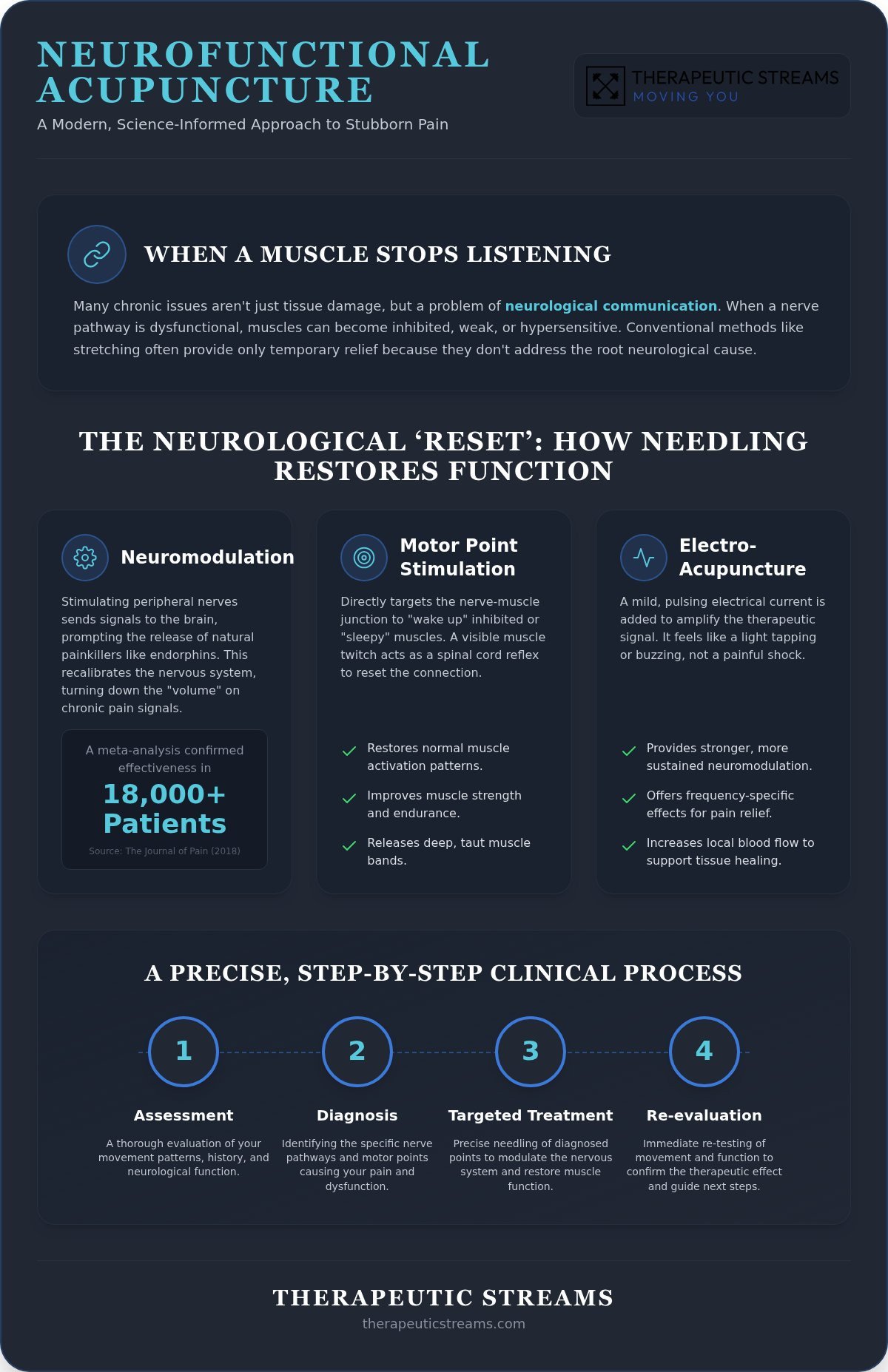
This is the clinical entry point for neurofunctional Acupuncture. It’s a modern, science-informed modality that operates on a simple but powerful premise: many chronic musculoskeletal issues are not just problems of tissue damage, but problems of neurological communication. When a nerve pathway is irritated, compressed, or simply dysfunctional, the muscles it controls can become inhibited, weak, or hypersensitive. Neurofunctional acupuncture is designed to directly intervene in this process, using fine needles to stimulate specific nerve pathways and restore clear communication between your brain, spinal cord, and muscles.
Instead of focusing on ancient concepts of energy flow, this contemporary approach uses the detailed map of human neuroanatomy to diagnose and treat the root cause of dysfunctional movement and pain. It is a precise, targeted intervention designed to reboot the system and remind your body how to function correctly.
The Neurological ‘Reset’: How Needling Restores Function
To understand how neurofunctional acupuncture delivers results, it’s essential to move beyond the image of a pin cushion and see the needles as tools for targeted neurological input. The treatment is less about the needles themselves and more about the physiological responses they trigger within the peripheral and central nervous systems. This process, known as neuromodulation, involves altering nerve activity to normalize sensation and restore proper muscle function.
From Signal to Relief: The Science of Neuromodulation
When a fine, sterile needle is inserted into specific anatomical points, it stimulates the underlying peripheral nerves. This targeted stimulation sends a cascade of signals up the spinal cord to the brain. In response, the central nervous system can release its own powerful pain-relieving chemicals, such as endorphins and enkephalins. This creates an analgesic effect, reducing the perception of pain not just at the local site but systemically.
More importantly, this input can interrupt and modulate the chronic pain signals that have become ingrained in your nervous system. For individuals with long-standing pain, the nervous system can become sensitized, over-reacting to normal stimuli. Neurofunctional acupuncture helps to recalibrate this sensitivity, effectively turning down the "volume" on persistent pain signals. A comprehensive meta-analysis involving nearly 18,000 patients confirmed that acupuncture is effective for chronic pain and its effects are more than just a placebo response, highlighting its ability to create measurable physiological change.
Source: Vickers, A. J., et al. (2018). Acupuncture for Chronic Pain: Update of an Individual Patient Data Meta-Analysis. The Journal of Pain, 19(5), 455-474. https://doi.org/10.1016/j.jpain.2017.11.005
Waking Up Dormant Muscles with Motor Point Stimulation
Have you ever been told you have "sleepy glutes" or that a specific muscle isn’t "firing" correctly? This phenomenon, known as neuromuscular inhibition, occurs when the brain reduces its signal to a muscle, often as a protective response to injury or repetitive strain. The result is weakness, compensation by other muscles, and dysfunctional movement patterns that can lead to further injury.
Neurofunctional acupuncture directly addresses this by targeting motor points—the specific locations where a nerve enters a muscle belly. Stimulating this neuromuscular junction creates a visible muscle twitch, which is a spinal cord reflex that helps to reset the nerve-muscle connection. This process can:
- Restore normal muscle activation patterns.
- Improve muscle strength and endurance by increasing motor unit recruitment.
- Release deep, taut muscle bands that are resistant to stretching.
By "waking up" these inhibited muscles, practitioners can address the root cause of instability and faulty mechanics that contribute to conditions from runner’s knee to shoulder impingement. Research into dry needling, a similar modality, supports its use for targeting myofascial trigger points and restoring muscle function by eliciting these local twitch responses.
Source: Dunning, J., et al. (2014). Dry needling: a literature review with implications for clinical practice guidelines. Physical Therapy Reviews, 19(4), 252-265. https://doi.org/10.1179/1083319614Z.000000000209
Amplifying the Message with Electro-Acupuncture
In many cases, the therapeutic input from the needles is enhanced by adding a mild electrical current, a technique called electro-acupuncture. A small device is connected to the needles, delivering a gentle, pulsing current between two points. This is not a painful shock; rather, it feels like a light tapping or buzzing sensation. This addition serves several key functions:
- Frequency-Specific Effects: Low-frequency stimulation tends to promote the release of endorphins for long-lasting pain relief, while high-frequency stimulation can help block pain signals more immediately. Your practitioner will select the appropriate frequency based on your condition.
- Enhanced Neuromodulation: The continuous electrical input provides a stronger, more sustained signal to the nervous system than needling alone, making it particularly effective for stubborn, chronic pain conditions and nerve-related disorders.
- Improved Local Circulation: The pulsing can increase blood flow to the treated area, bringing oxygen and nutrients that support tissue healing.
Decades of research have explored the mechanisms of electro-acupuncture, confirming its ability to modulate pain through complex neurological and biochemical pathways, making it a cornerstone of the modern neurofunctional approach.
Source: Zhang, R., et al. (2014). Mechanisms of Acupuncture-Electroacupuncture on Persistent Pain. Anesthesiology, 120(2), 482-503. https://doi.org/10.1097/ALN.0000000000000107
A Modern Tool for Clinical Problems: Applications in Whitby
Because neurofunctional acupuncture is grounded in anatomy and physiology, its applications are vast and integrate seamlessly with other forms of rehabilitation like chiropractic and physiotherapy. It is a powerful tool for resolving complex musculoskeletal issues that haven’t responded to conventional treatments.
Chronic Pain: Breaking the Cycle of Dysfunction
For conditions like chronic low back pain or sciatica, the problem often lies in a dysfunctional pattern of muscle activity. Deep spinal stabilizer muscles (like the multifidus) can become inhibited, forcing larger, more superficial muscles to overwork, leading to stiffness and pain. Neurofunctional acupuncture can precisely target these deep, inhibited muscles to restore core stability from the inside out. In cases of sciatica, treatment can focus on releasing tension in the piriformis and other deep gluteal muscles that may be compressing the sciatic nerve, while also stimulating the nerve pathway to reduce irritation and pain. This approach is a key part of an integrated strategy for sciatica treatment in Whitby, addressing both the muscular and neural components of the condition.
Athletic Performance: Fine-Tuning the Body’s Engine
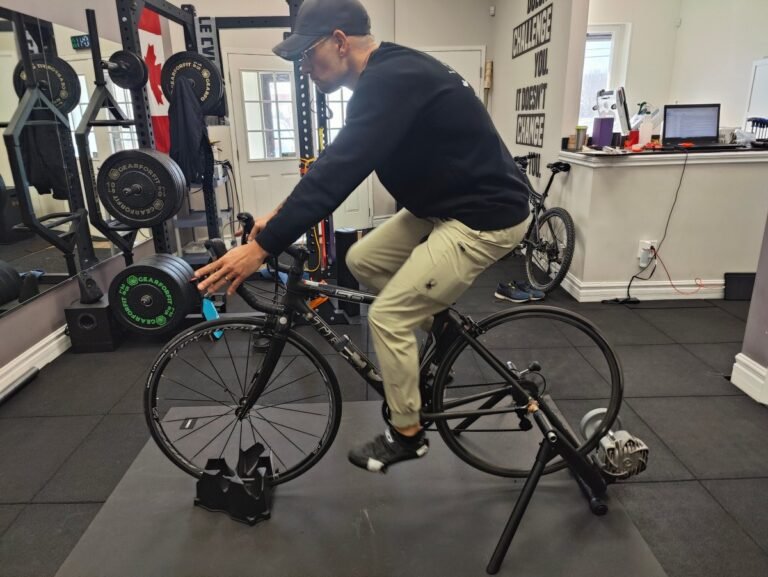
Athletes are constantly pushing their bodies, creating imbalances and neuromuscular fatigue. Neurofunctional acupuncture is an exceptional tool for performance optimization. For cyclists, this may involve activating inhibited gluteal muscles to improve power transfer to the pedals and releasing overworked hip flexors. This complements the mechanical adjustments made during a Professional BikeFIT in Whitby by ensuring the body’s "engine" is firing on all cylinders. For runners, it can be used to address pelvic instability or poor foot mechanics by restoring proper firing patterns in the core and lower leg, helping to prevent common running injuries before they start.
Your First Session: A Step-by-Step Clinical Process
Understanding the process can help alleviate any apprehension and set clear expectations for your treatment. A neurofunctional acupuncture session is a dynamic and interactive clinical procedure, far removed from a passive spa treatment.
The Initial Functional Examination
Before any needles are used, your session begins with a thorough assessment. Your practitioner will discuss your history and goals, but more importantly, they will watch you move. You may be asked to perform specific movements or resist pressure to test the strength and activation of key muscle groups. This examination is critical because it reveals the faulty neurological patterns that are contributing to your issue. The goal is to identify the precise nerves and muscles that require treatment, creating a specific, personalized plan for you.
The Sensation of a Neurological Change
Upon insertion, the sterile, single-use needles are incredibly fine—many people feel little more than a tiny pinch. The true therapeutic sensation occurs when the needle stimulates the targeted nerve or motor point. This is often described as a deep, dull ache, a feeling of pressure, or a brief muscle twitch. These sensations are indicators that the needle is in the right place and is creating the desired neurological effect. If electro-acupuncture is used, you will also feel a gentle, rhythmic pulsing or buzzing. Throughout the process, your practitioner will communicate with you to ensure you remain comfortable.
Integration with Your Overall Recovery Plan
Neurofunctional acupuncture is rarely a standalone treatment. Its greatest strength lies in its ability to prepare the body for other therapeutic inputs. By releasing muscle tension, activating inhibited tissues, and reducing pain, it makes the body more receptive to chiropractic adjustments, physiotherapy exercises, and manual therapy. For example, releasing deep spinal muscles can make a spinal manipulation more effective and longer-lasting. Activating a weak glute muscle makes it possible to then strengthen it effectively with prescribed exercises. This collaborative approach ensures that every part of your treatment plan is working together to help you achieve your goals faster.
Frequently Asked Questions About the Neurofunctional Approach
**How does the electrical stimulation feel, and is it safe?
**
The sensation is a mild, non-painful pulsing or tapping. The intensity is always adjusted to your comfort level. Electro-acupuncture is extremely safe when performed by a properly trained practitioner using modern, approved devices. It is not used on patients with pacemakers, certain heart conditions, or during pregnancy.
**If my issue is a nerve (like sciatica), why are you putting needles in a muscle?
**
Nerves travel through and around muscles. Often, a tight, dysfunctional muscle (like the piriformis in the buttock) can physically compress or chemically irritate a nearby nerve. By treating the muscle, we can relieve the pressure on the nerve. Additionally, we place needles along the nerve’s pathway to directly modulate its activity and reduce pain signals.
**Is this approach better for recent injuries or long-standing chronic issues?
**
It can be effective for both. For acute injuries, it can help control inflammation, manage pain, and prevent muscles from becoming inhibited. For chronic issues, its main strength is in breaking long-held patterns of pain and dysfunction, re-educating the nervous system, and restoring proper movement that has been lost over time.
**How is this different from Traditional Chinese Medicine (TCM) acupuncture?
**
The primary difference is the diagnostic and theoretical framework. TCM is based on concepts of meridians, Qi (energy), and balancing yin and yang. Neurofunctional acupuncture is based entirely on modern Western medical science, using principles of neuroanatomy, physiology, and pathology. The needle points are chosen based on their relationship to specific nerves, muscles, and joints, not on ancient meridian maps.
Take the Next Step Toward Neurological Recovery
If you are struggling with persistent pain, limited mobility, or athletic performance plateaus that haven’t resolved with other treatments, it may be time to look at the problem through a neurological lens. By addressing the communication breakdown between your brain and body, neurofunctional acupuncture offers a sophisticated and effective path toward lasting relief and optimized function.
At our Whitby centre, our practitioners are trained to perform the detailed functional assessments necessary to identify the root of your problem. We integrate this powerful modality into comprehensive treatment plans designed to get you back to moving without pain. To find out if this approach is right for you, we invite you to book a consultation with our clinical team.
Book Your Neurofunctional Acupuncture Assessment in Whitby Today